Sundaymail Editor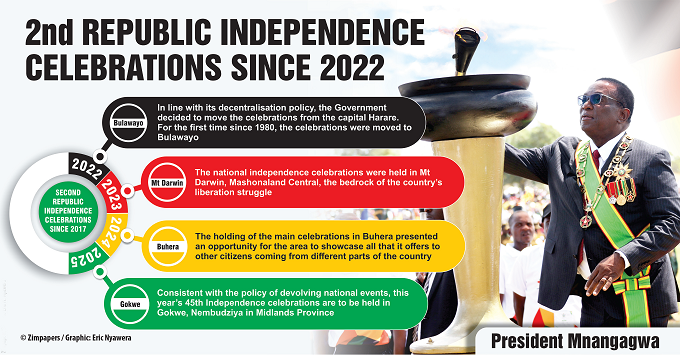
Ranga Mataire
Zimpapers Politics Hub
FOURTY-FIVE years ago, just after midnight on April 17, the Union Jack was lowered for the last time and the Zimbabwean flag was hoisted to represent a new era in then-Salisbury, now Harare.
The fall of one flag and the rise of another symbolised the sunset of colonial Rhodesia and the dawn of Zimbabwe.
Since that day, Zimbabweans all over the world staunchly celebrate April 18 as Independence Day from colonial rule.
At the inaugural celebrations held at Rufaro Stadium, then-Prime Minister Robert Gabriel Mugabe set the tone for national reconciliation as he delivered a speech in which he urged the people to “trample upon racism, tribalism and regionalism and work hard to reconstruct and rehabilitate our society as we reinvigorate our economic machinery”.
Cde Mugabe, who later became President in 1987, ruled for 37 years in a time marker generally referred to as the First Republic.
The period had its own triumphs and challenges.
It was a period one could describe as being dominated by a “decolonising agenda” as the new State grappled to redefine itself as an autonomous nation and an equal member of the community of nations.
Fast forward to 2017 and the ushering in of the Second Republic led by President Emmerson Mnangagwa.
With the “decolonising agenda” off the radar, President Mnangagwa rallied the nation towards economic recovery and development, with the major thrust of ensuring that “no one and no place” is left behind.
The rallying call for an inclusive development agenda is encapsulated in President Mnangagwa’s Vision 2030 national policy, which emphasises the importance of devolution in achieving equitable economic development and equalisation for all provinces in the country.
Devolution is a crucial building block for realising Vision 2030, as it enables the country to address regional disparities and promote balanced development.
The vision involves devolving more powers to provincial councils, which will then craft their own development plans.
This approach is expected to facilitate rapid and equitable development, promote private initiatives and self-reliance, and foster agricultural, commercial, industrial, technological and scientific development.
Unlike in the past, where Harare was the only area for hosting national events, the Second Republic has made sure that such occasions are devolved to all the country’s provinces.
Following the outbreak of Covid-19 in 2020, the holding of public national events was temporally halted, including in 2021.
In 2022, as per promise and in line with its decentralisation policy, the Government decided to move the celebrations from the capital, Harare.
For the first time since 1980, the celebrations were moved to Bulawayo.
This was a testimony of the Government walking the talk on devolution and the realisation of development that leaves no one and no place behind.
The following year, 2023, national independence celebrations were held in Mt Darwin, Mashonaland Central, the bedrock of the country’s liberation struggle.
It was in Centenary, Mashonaland Central, that the Second Chimurenga tentatively started when a group of 45 freedom fighters entered the country through Dande from Mozambique.
It was at this stage that the Rhodesian security apparatus sprang into action after the Altena Farm attack.
Addressing thousands of citizens who thronged Mt Darwin for the 43rd Independence Day celebrations, President Mnangagwa paid tribute to ordinary Zimbabweans who toiled during the liberation struggle by feeding and giving intelligence to the freedom fighters.
He said Zimbabweans should recognise that they had the onerous task of developing their country, as echoed by the national mantra of building the country “brick upon brick”.
From Mt Darwin, the main independence celebrations last year moved to Murambinda in Buhera, Manicaland province.
Known for its natural beauty, including the country’s highest mountain, Mt Nyangani, and the second highest waterfall in Africa, Mtarazi Falls, along with its diverse landscapes and rich cultural heritage, Manicaland also bore the brunt of the liberation struggle given its proximity to Mozambique.
The holding of the main celebrations in Buhera presented an opportunity for the area to showcase all that it offers to other citizens coming from different parts of the country.
It also spoke to the Second Republic’s quest to be in touch with the grassroots and getting to understand and appreciate their daily needs and challenges.
Consistent with the policy of devolving national events, this year’s 45th Independence Day celebrations are to be held in Gokwe, Nembudziya, Midlands province.
Nembudziya Open Grounds at the Nembudziya Growth Point in Gokwe North district are the venue this year.
Nyamuroro High School, which is 5km away, is the venue for the Children’s Party, while Nembudziya High School is the venue for the Independence Gala.
As has become the norm, upgrades of major roads in the district have already started, with priority being the Kadoma-Sanyati-Gokwe-Nembudziya road.
Geographically located at the heart of Zimbabwe, Midlands province is the most diverse in terms of languages spoken.
Shona, Ndebele, Tswana, Sotho and Chewa are some of the languages spoken in the province.
The province is also home to several towns that include Gweru (provincial capital), Kwekwe, Shurugwi, Zvishavane, Gokwe Centre and Mvuma.
Midlands is also home to a high number of training facilities offering modern knowledge and skills for various trades.
The province is also endowed with diverse minerals, with over 21 discovered to date.
There is no doubt that independence celebrations in Gokwe will have ripple benefits to the Gokwe North district in terms of infrastructural development and a boost for local businesses.
The Independence Gala, which will take place after the main celebrations, will present an opportunity for the majority of people in Gokwe to experience the proximity of some of the top artistes that will perform.
Since the advent of the Second Republic, the Government has been very consistent in theming the Independence Day celebrations.
Without exception, the focus is on Vision 2030.
In 2022, the celebrations were held under the theme “Zim@42 — Leaving no one and no place behind”; 2023 had a similar theme in terms of thrust, “Zim@43 — Nyika Inovakwa Nevene Vayo/Ilizwe lakhiwa ngabanikazi balo”, which basically places the people at the centre of the country’s development; and in 2024, the theme was “Zim@44: Unity, peace and development towards Vision 2030”.
It is not surprising that this year’s theme, “Zim@45: Devolve and develop together towards Vision 2030”, is anchored in the aspirational goal of attaining Vision 2030.
The theme encapsulates the country’s aspirations and goals.
Besides the aspirational goal of achieving Vision 2030 (upper middle-income society), the theme emphasises the importance of unity among Zimbabweans, regardless of their ethnic, linguistic or regional backgrounds.
President Mnangagwa has always emphasised that unity is essential for strengthening the social fabric, promoting a sense of belonging and fostering a shared national identity.
By referencing Vision 2030, the theme reinforces the country’s commitment to achieving its developmental goals, including becoming an upper middle-income economy by 2030.


 Online Reporter