Online Reporter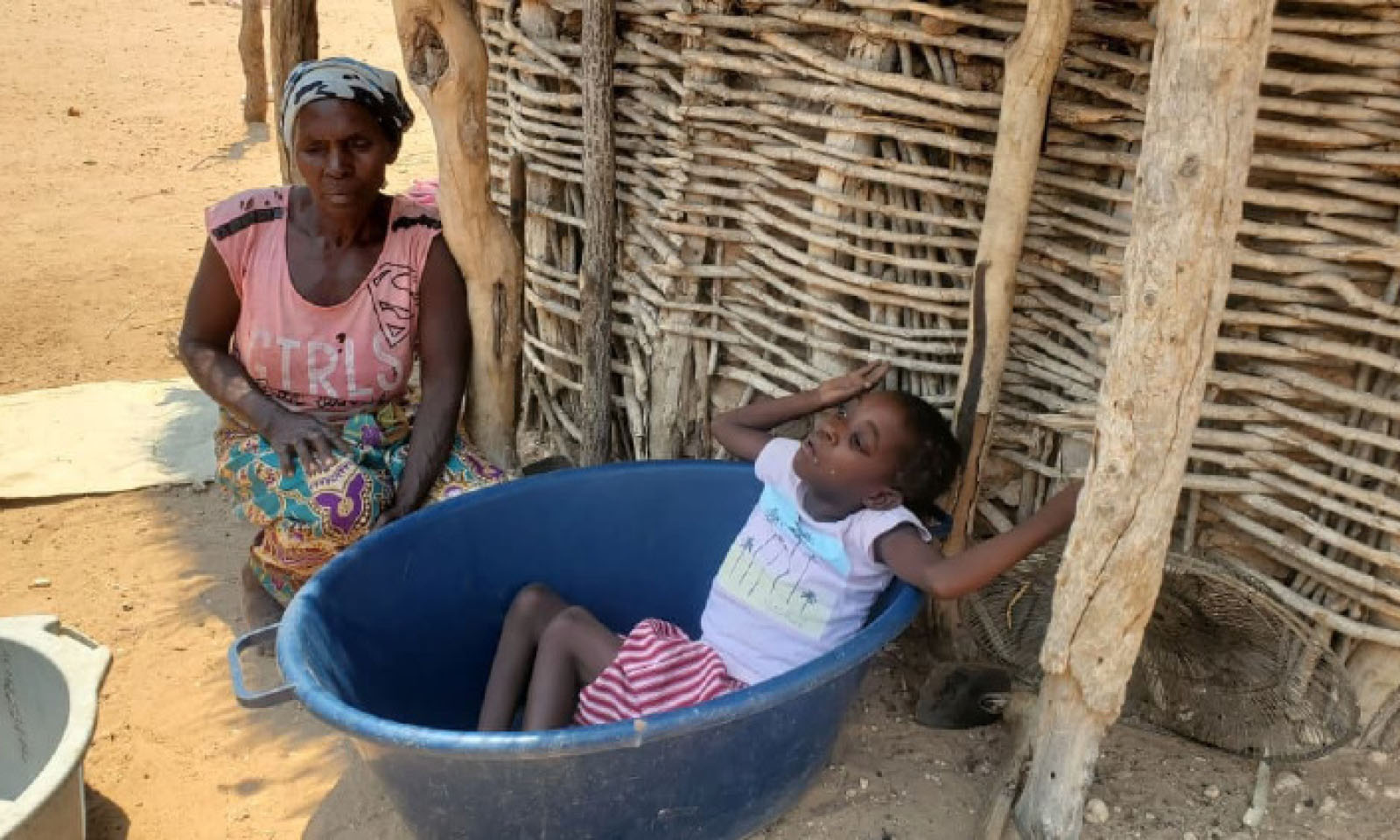
Theseus Shambare recently in BINGA
As the sun rises in Siansundu, its heat licks the dry ground, turning the sand white and the air heavy.
From a cluster of tiny huts — ing’anda ziniini zyaku akwaazya twaamu alubulo, the Tonga term for small houses built from sticks and mud — an elderly woman bends low, gripping the handle of a blue plastic bathing dish.
Inside it lies her granddaughter, 13-year-old Bwime Siyamwaka, a child who cannot walk, cannot speak, but whose eyes carry a universe of understanding.
Among the Tonga, there is a saying: “Mwana ni moyo” — a child is life itself. But for Gogo Ester Siyamwaka, that life has become a weight she drags through dust and drought, one plastic dish at a time.
Bwime was born with cerebral palsy, a neurological disorder that affects movement, coordination and muscle control.
Doctors say it happens when the part of the brain that controls movement does not develop properly or is damaged early in life.
To those who live with her, it means she cannot stand, hold a spoon, or form words — yet she feels pain, joy and love as deeply as any other child.
When she wants something, she hums or moans softly. When she is happy, she lets out a rhythm of gentle sounds that only her grandmother can translate.
“She tells me things in her own way,” Ester said, her voice trembling between pride and exhaustion.
“I just listen with my heart.”
The family’s homestead crouches in the middle of a dry plain, surrounded by brittle shrubs, baobabs and scorched anthills.
The zyanda ziniini — small-thatched huts — lean toward each other like tired old men. Some are so low that one wonders if an adult can even stand upright inside.
The wind whistles through the gaps, carrying dust, smoke and the faint scent of hunger. Here, drought is no longer an event — it is a condition of life.
The pearl millet – lupoko – crop rarely reaches harvest.
Many families survive on donor handouts — a few cups of maize meal from relief agencies, sometimes cooking oil if they are lucky.
For Gogo Siyamwaka, every day begins and ends with the plastic dish.
“When the sun burns too hard, I pull her under the tree,” she said, wiping sweat from her brow.
“When she wants to go to the toilet, I drag her there too.”
Until a few months ago, the toilet meant the open bush behind the huts.
“She used to crawl on the ground,” Gogo Siyamwaka recalls, her voice breaking.
“Sometimes she would cry because ants would bite her.”
Now, thanks to the Zimbabwe Red Cross Society, working with the Finnish and Danish Red Cross, Gogo Siyamwaka’s home has an inclusive toilet built under the Climate Smart Resilience (CSR) Project.
“They built a toilet that she can use safely,” she said, smiling probably for the first time.
“I thank them every day when I see it. They brought back her dignity — and mine.”
According to Spiwe Sibanda, the district field officer for the project, their goal was to include people with disabilities in all climate-resilience work.
“We discovered that most people with disabilities had no access to proper sanitation,” she said.
“So we built inclusive toilets in homes, schools and clinics.”
In Binga’s dry lands, that act of inclusion carries the weight of justice. Ester nods, clutching her shawl.
“Before Red Cross came, she was living like an animal,” she whispered.
“Now she can go with privacy.”
As Gogo Siyamwaka spoke, Sibanda, who led the media tour, stood silently beside the journalists.
Her eyes glistened in the harsh sunlight as she listened to the grandmother’s story. Several times, she looked away, visibly fighting back tears.
Later, she confessed quietly, “You tell stories like this a thousand times, but when you see it with your own eyes, your heart breaks all over again.”
But the family’s biggest need remains painfully visible — a wheelchair. The plastic dish that serves as Bwime’s only means of movement is cracked and faded.
When Gogo Siyamwaka drags it, dust clouds rise and stick to the girl’s skin. Sometimes, the dish catches on stones, jolting her fragile body.
“I want a wheelchair for her,” the grandmother said quietly. “Even a small one. Just so she can sit up and feel the wind.”
The veld fires that sweep through Binga every dry season have turned this hope into a race against time.
The huts, built of sticks and grass, ignite like paper. Last year, a fire burned through a nearby village, taking goats and granaries.
“If fire comes at night, I cannot carry her and run,” Gogo Siyamwaka admitted, her eyes moist.
“I just pray to God every day that smoke never comes our way.”
In this community, people measure wealth not in dollars but in survival. A few households have donkeys or chickens. Most have neither.
Many men have left for fishing camps along the Zambezi River or mines in Hwange, leaving women to fend for children and the elderly. Those who stay fight two enemies — hunger and heat. Water is fetched from boreholes 2km away.
Firewood is gathered at dawn before the sun becomes unbearable. In this rhythm of hardship, love becomes labour.
Gogo Siyamwaka’s daughter — Thembiso, who is a single, mother — lives far away in Bulawayo, working as a housemaid. She sends what little she earns — sometimes US$20 a month — just enough for mealie-meal
“The money feeds us for a few days,” Ester said. “The rest, we trust God and the people who help.”
At 13, Bwime’s body is maturing. She now faces the silent passage from childhood to womanhood.
But there are no health workers nearby trained to support girls with disabilities, no menstrual products, no SRHR education.
“I do not even know what to do when she starts her period,” Gogo Siyamwaka confessed. “There is no one to teach me.”
According to UNICEF data, one in every three girls with disabilities in rural Zimbabwe lacks access to sexual and reproductive health information or hygiene facilities.
Here in Siansundu, that statistic has a face — soft, beautiful and voiceless. During the Red Cross media tour, the community gathered to greet visitors with shy smiles and warm handshakes.
Children ran barefoot, chasing dust devils across the road. From a distance, a group of women sang in Tonga, their song carrying a mix of joy and pain: “Takwepe, takwepe — when the suffering of climate change and hunger will end.”
It is the same question Gogo Siyamwaka asks every night as she tucks her granddaughter under a thin blanket.
Despite everything, the bond between the two remains unbreakable. Gogo Siyamwakalaughs easily when Bwime makes sounds, calling them “our little songs.”
“She likes the sound of goats and children,” she said. “When people visit, she smiles.”
In those moments, love outweighs fatigue. Her spirit, though weathered, refuses to break.
Still, the story of Siansundu is not only about pain — it is also about resilience. The Climate Smart Resilience Project has brought piped water to some households, established grinding mills and introduced fowl runs for income generation.
Spiwe Sibanda says the goal is to ensure “no one is left behind”. Yet for Gogo Siyamwaka, participation is difficult.
“I cannot leave her alone to attend training,” she said. “My work is here — with her.”
That is the invisible cost of caregiving — love that traps, devotion that drains. When the day cools, Ester pulls the plastic dish back into the yard.
The setting sun paints the sky crimson and the mopane trees cast long, skeletal shadows.
She fans her granddaughter with a torn calendar page. The girl hums softly, eyes half-closed, as if talking to angels.
“She likes this time,” Gogo Siyamwaka said. “It is when she forgets the pain.”
The wind picks up, carrying the smell of ash — a reminder of how fragile everything here is. But inside this little yard, surrounded by ing’anda ziniini zyaku akwaazya twaamu alubulo, hope still flickers.