Online Reporter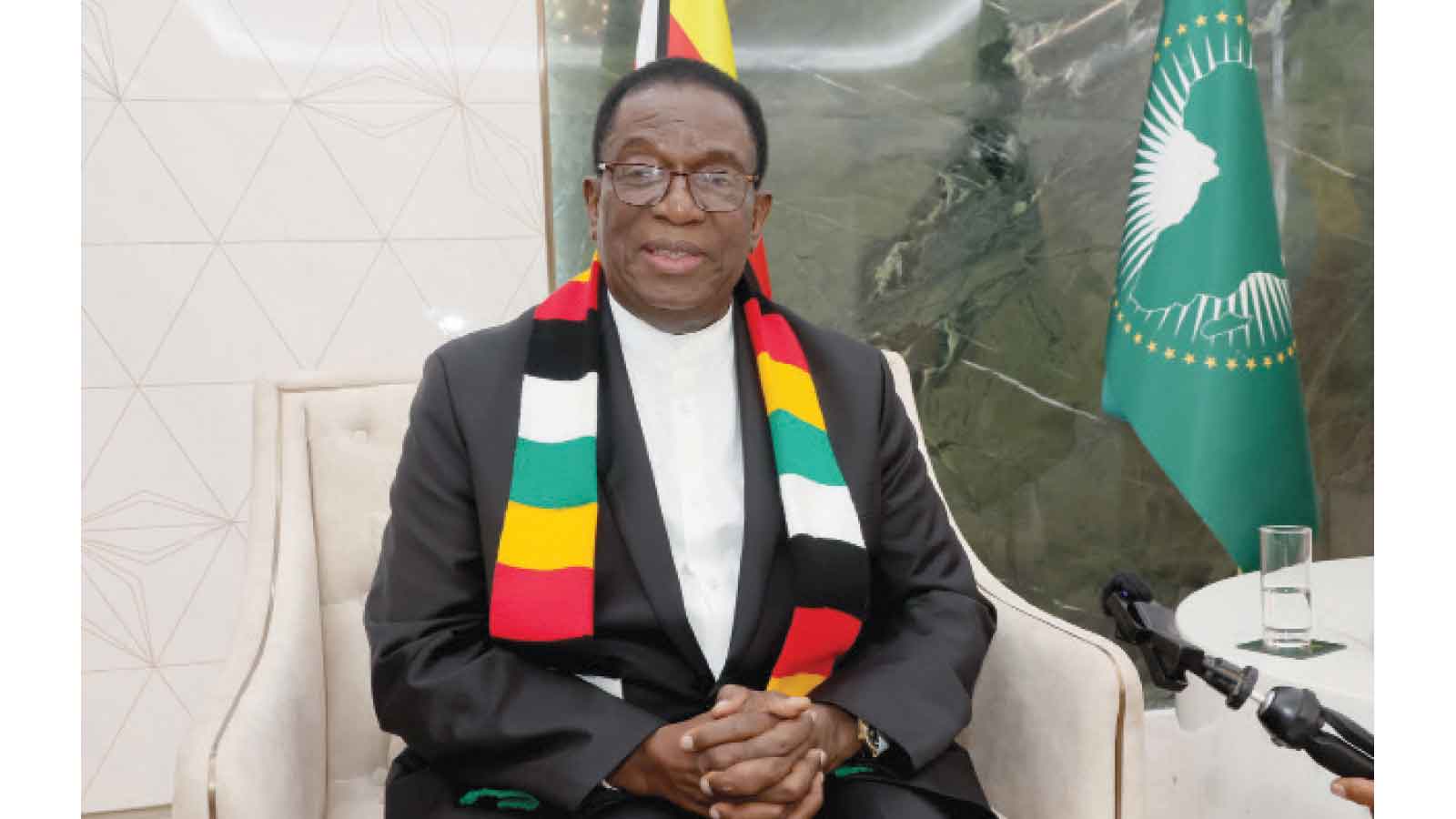
Ranga Mataire and Alexander Rusero
At the recently concluded African Union summit, President Mnangagwa’s call for the establishment and full operationalisation of a robust African Standby Force (ASF) was not merely a policy suggestion; it was a historic echo.
President Mnangagwa used the closed-door summit debates to call for urgent continental ownership of peace and security mechanisms, arguing that Africa must reduce over-reliance on external actors and fully activate its own defence and response architecture.
The President’s call reverberated across decades, reaching back to the bold and uncompromising vision of Kwame Nkrumah, who, in the early years of African independence, insisted that political liberation without military sovereignty would remain fragile, incomplete and vulnerable to external manipulation.
Nkrumah’s proposal for an African High Command was anchored in a clear understanding of power.
He recognised that sovereignty is not sustained by rhetoric or symbolic independence alone, but by the capacity to defend territorial integrity, protect citizens and assert strategic autonomy in a hostile global order.
His vision was simple yet radical — a unified African military structure that would secure the continent against external aggression, internal destabilisation and neo-colonial interference.
In his own words, Nkrumah said: “We need a common defence system with African High Command to ensure the stability and security of Africa.”
He said this when he delivered his speech at the 1963 Organisation of African Unity summit in Addis Ababa, where he pushed for an immediate, united and strong defence against neo-colonialism.
That vision, however, was deliberately sidelined.
It was portrayed as overly ambitious, impractical and even dangerous.
Yet beneath these critiques lay a deeper anxiety that a united Africa, with a centralised military command, would have fundamentally disrupted the architecture of global power.
It would have dismantled the ease with which external actors could intervene in African affairs, exploit divisions and manipulate conflicts for strategic gain.
Instead, a loose confederation of states (fragmented, diplomatically weak and militarily dependent) was encouraged.
The consequences of that compromise are evident today.
Across the continent, insecurity persists in various forms, ranging from violent extremism in the Sahel, insurgencies in the Horn of Africa, resource-driven conflicts in Central Africa and political instability in multiple regions.
These crises are often framed as purely internal failures, yet many are entangled with external interests, covert interventions and geopolitical competition.
For too long, Africa has outsourced its security to external actors whose priorities do not always align with the continent’s long-term stability.
Africa’s agency
It is within this context that President Mnangagwa’s call must be understood.
The proposal for a credible ASF is not just about military coordination, but about reclaiming agency.
It is about moving away from reactive, externally mediated security responses towards proactive, African-led solutions.
It signals a shift from dependency to self-determination.
President Mnangagwa’s clarion call for the securitisation of Africa reveals important dimensions of his leadership calibre and situates him within the ideological lineage of Africa’s first generation of nationalists.
His intervention reflects strategic historical consciousness, a defining trait of early African nationalist leaders.
Figures of that generation understood that independence was never meant to be a one-off political event, but an ongoing process of consolidating sovereignty across political, economic and security domains.
By invoking the need for a continental security architecture, President Mnangagwa is not merely responding to present threats; he is engaging with an unfinished liberation project.
This ability to think historically, and to connect contemporary challenges with earlier liberation visions, is a hallmark of leaders shaped within nationalist traditions.
Moreover, his position demonstrates a deep commitment to African agency.
The first generation of nationalists rejected dependency and external tutelage, insisting that Africans must be the primary architects of their own destiny.
President Mnangagwa’s call for a standby force echoes this ethos.
It is a rejection of the continued outsourcing of African security to external actors and an affirmation that sustainable peace and stability must be African-driven.
This orientation towards self-reliance aligns closely with the ideological foundations of early liberation movements, which saw sovereignty as indivisible.
In essence, President Mnangagwa’s reflections demonstrate a leadership style anchored in historical awareness, continental thinking and a willingness to pursue structural solutions to Africa’s challenges.
They position him within the continuum of Africa’s first generation of nationalists anchored in ideological disposition.
His call can thus be seen as part of a broader effort to carry forward an unfinished agenda — the full realisation of African sovereignty in all its dimensions.
At its core, this is a question of dignity.
A continent that cannot secure itself is often denied respect in the global arena.
It is treated as a theatre of intervention rather than a centre of decision-making.
Rehumanisation, in this sense, is inseparable from sovereignty.
To be fully recognised as equal actors in the international system, African states must demonstrate the capacity to protect their people, stabilise their regions and shape their own security narratives.
The establishment of an effective continental force would also serve as a powerful deterrent against the resurgence of imperial designs.
On paper, the ASF is supposed to be a multidimensional, regional-based peacekeeping framework comprising military, police and civilian components, designed for rapid deployment to crisis-hit areas across the continent.
It is supposed to focus on prevention of conflict escalation, support peace operations and restore stability.
The establishment and operationalisation of the ASF have faced significant, long-term constrains despite its conceptual adoption in 2003.
While intended as a rapid-response
mechanism under the African Union (AU) to address conflicts, its effectiveness is being hindered by a combination of financial dependencies, as well as political, logistical and structural bottlenecks.
Lack of sustainable funding, fragmented political will, logistical and some legal hurdles have also impinged on the effective implementation of the ASF.
And yet in an era of renewed global designs, where strategic minerals, maritime routes and geopolitical influence are once again at the centre of global contestation, Africa risks becoming a battleground for external interests.
Without a unified security architecture, the continent remains vulnerable to proxy conflicts, militarised interventions and subtle forms of control that undermine its autonomy.
Nkrumah foresaw this danger.
His insistence on an African High Command was not militarism for its own sake; it was a defence against the reconfiguration of imperialism in new forms.
Today, President Mnangagwa’s call can be read as a revival of that same consciousness, a recognition that political unity must be matched by security integration if Africa is to navigate the complexities of the 21st century.
However, the success of such an initiative will depend on political will.
The idea of collective security requires states to transcend narrow national interests and embrace a broader continental identity.
It demands trust, coordination and a shared commitment to the African project.
Without this, even the most well-designed structures will remain symbolic.
There is also a need to redefine what security means in the African context.
It cannot be limited to military responses alone.
True security must incorporate human protection, economic resilience and social cohesion.
A continental force must, therefore, operate within a framework that prioritises peace-building, conflict prevention and the protection of civilians, rather than merely responding to crises after they erupt.
The moment is critical.
Africa stands at a crossroads where it can either continue along a path of fragmented security dependence or assert a new paradigm of continental sovereignty.
President Mnangagwa’s intervention offers a timely reminder that the tools for transformation already exist within Africa’s intellectual and political heritage.
Nkrumah’s vision was never extinguished; it was deferred.
Reviving it today is an act of necessity.
If Africa is to reclaim its agency, restore its dignity and command global respect, it must be prepared to defend itself, not in isolation, but collectively.
A functional ASF could become the embodiment of that resolve and, importantly, a statement that Africa is no longer a passive space of intervention, but an active architect of its own security and future.
The question is no longer whether Africa can afford to build such a force.
The real question is whether it can afford not to.