admin
admin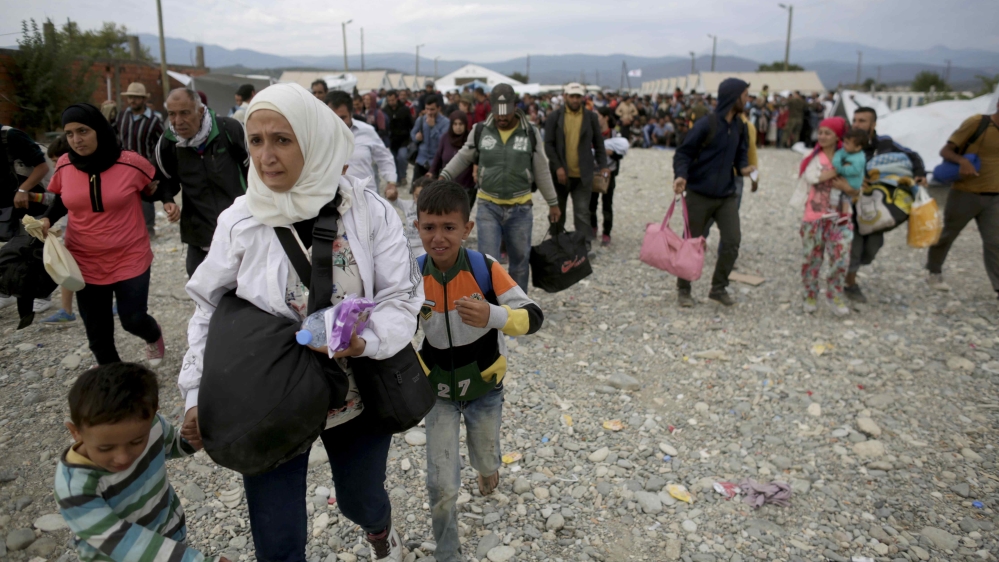
Thousands of additional people seeking asylum in Western Europe have pushed through police lines at Austria’s main border crossing with Hungary and set off on foot on the highway towards Vienna. They began their march after rail traffic was sharply reduced due to overcrowding, despite moves by authorities to compensate for that at the Nickelsdorf crossing, the Associated Press news agency reported.
Police spokesman Helmut Marban said there was “some kind of group dynamic” that started with a few people beginning to walk towards Vienna and quickly developed into a large movement of people. Regularly scheduled trains from Nickelsdorf continued to other Austrian destinations, including Vienna, with three departures scheduled. But the railway company announced an end to special shuttles between Nickelsdorf and Vienna that had been running for days. Buses and taxis were called to Nickelsdorf to take refugees to the Austrian capital.
Refugees also continued to enter from Serbia to Hungary, the last stop before reaching Western Europe, yesterday, walking along railway tracks. Families with little children were sitting on the ground at Hungary’s Roszke crossing, sharing food donations and taking care of their youngest family members while taking a rest during their march.
At a station in Roszke, where refugees are temporarily held, the wife of an Austrian politician has filmed the chaos as police threw food to refugees, saying that they were being treated like “animals”.
Hungary has recently increased the number of soldiers building its anti-refugee border fence in order to speed up the construction process. The country wants to erect the sharply-criticised fence along its border with Serbia as it struggles to cope with huge numbers of refugees travelling up from Greece and the Balkans.
Foreign Minister Peter Szijjarto said yesterday that the number of refugees entering the country could rise to 400,000 to 500,000 by the end of the year. More than 170,000 migrants, many of them refugees from conflicts in the Middle East, have been recorded entering Hungary so far this year. Vast majority of them are heading towards Germany via Austria.
In a statement yesterday, Peter Salama, UNICEF’s regional director for the Middle East and North Africa, said that millions more in Syria could become refugees and head to Europe if there is no end to the war.
More than 430,000 refugees and migrants have crossed the Mediterranean to Europe so far in 2015, a record number that is more than double the total for the whole of last year, the International Organization for Migration said. Meanwhile, Macedonia’s Foreign Minister Nikola Poposki has said that his country might follow Hungary’s example and build a border fence to stem the influx of refugees trekking through the Balkans to reach Western Europe.
The news comes as foreign ministers from four Central European nations met in Prague yesterday, amid a growing rift over the refugee crisis. The Czech Republic, Hungary, Poland and Slovakia reject quotas proposed by the EU Commission, which proposed 120,000 additional asylum seekers per year to be shared out between 28 member states.
“We too will need some kind of physical defence to reduce illegal border crossing . . . Either soldiers or a fence or a combination of the two,” Poposki was quoted as saying in an interview with Hungarian business weekly Figyelo on Thursday. He said his country was currently forced to let the 3,000 to 4,000 migrants who arrive in his country on a daily basis continue their journey to Serbia and Hungary unimpeded. “There is no European consensus on how we can handle this question,” he said.
As of 0600 GMT yesterday, an estimated 7,600 refugees had already crossed into Macedonia from Greece in a 24-hour period, according to the UN refugee agency. Peter Salama, UNICEF’s regional director for the Middle East and North Africa, said millions of people in Syria could become refugees and head to Europe if there is no end to the war.
Al Jazeera’s Hoda Abdel Hamid, reporting from the border between Greece and Macedonia yesterday, said the situation has settled down after tensions on Thursday. At the border crossing station, from where our correspondent was reporting, about 1,500 had crossed yesterday morning. They are reportedly being organised into groups of 50 people.
From there, public transportation will then take them to the border with Serbia, our correspondent said. But overnight, the situation was tense, with “impatient” refugees facing off with the police. “Macedonian border police had blocked their path and frustrations grew once more,” she said. “This is not the first time for the Macedonian border guards to use force.”
Syrian refugees Bassem, his wife Marwa, and their child Ali, were among those in the crowd. They left Syria 25 days ago, entering Greece through the island of Rhodes. — Al Jazeera.



 Online Reporter