Online Reporter
Debra Matabvu-Herald Reporter
REGIONAL coordination is critical in building resilience against climate change, biosecurity risks and other emerging threats to the development of agriculture, South African President Cyril Ramaphosa has said.
Officially opening the 115th Zimbabwe Agricultural Show yesterday at the Harare Exhibition Park, President Ramaphosa said agriculture remained central to economic growth, food security and employment creation across southern Africa, but faced increasing risks that required collective action.
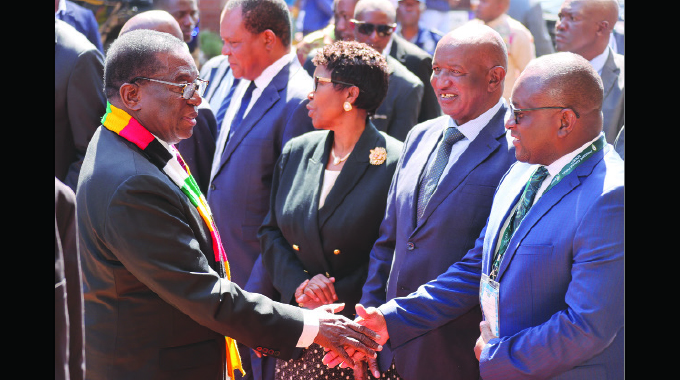
The President is welcomed by Information, Publicity and Broadcasting Services Minister Dr Jenfan Muswere (right) on arrival at the Harare Exhibitions Park. Also present are Agriculture Minister Dr Anxious Masuka (second left), Defence Minister Oppah Muchinguri-Kashiri and State Security Minister Lovemore Matuke (second right). — Picture: Believe Nyakudjara.
“Agriculture is a cornerstone of the Zimbabwean economy. We congratulate the Government of Zimbabwe for the measures it is taking to revive the country’s agricultural sector through policy reforms, investment in irrigation and mechanisation and empowering large-and small-scale farmers.
“We know that the agricultural sector has been heavily affected by the growing impacts of the changing climate. Severe drought has impacted crop yields in recent years.
“Adapting to and mitigating the effects of climate change are an imperative for all nations. Collaboration among countries is critical to the success of these efforts.”

President Mnangagwa and his South African counterpart, President Cyril Ramaphosa, interact with Agricultural and Rural Development Authority (Arda) chief executive officer Mr Tinotenda Mhiko while touring the authority’s exhibition stand at the 115th edition of the Zimbabwe Agricultural Show in Harare yesterday. — Picture: Believe Nyakudjara.
He noted that biosecurity challenges such as foot-and-mouth disease, avian influenza, and crop infections posed further threats, and called for countries to pool resources and collaborate more closely through research institutions.
“Biosecurity is another area in which we must step up our cooperation.
“Outbreaks of foot and mouth disease, avian or bird flu, crop infections and others, call on us to pool our resources and strengthen our collaboration, including through our respective research institutions.”
President Ramaphosa underlined the need for greater investment in innovation and technology, citing the growing use of new technologies as tools to boost output while conserving resources.
“Technological trends in agriculture must be fully embraced to increase output and conserve resources,” he said.
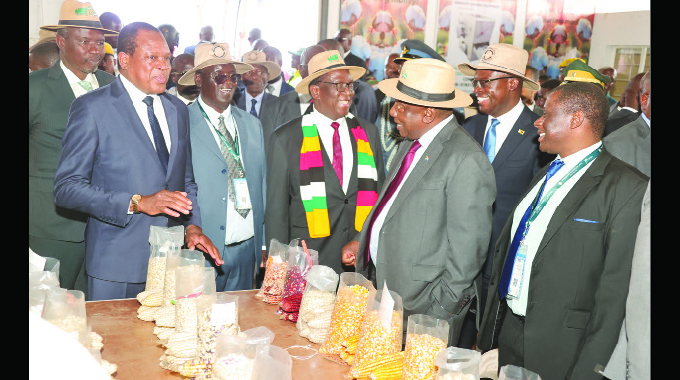
The President and Cde Ramaphosa tour the farmers’ hall in the company of ministers Dr Anxious Masuka (second from left) and Professor Amon Murwira (second from right). Also present are Land Tenure Committee chairperson Dr Kudakwashe Tagwirei (far left) and Zimbabwe Agricultural Show past president Mr Ngoni Kudenga (third from left). — Picture: Believe Nyakudjara.
“By way of example, geospatial agriculture, using earth observation and Artificial Intelligence, has started to feature in some sectors of agriculture in South Africa and Zimbabwe.
“Such innovation will be key as we collectively build resilience in pursuit of food security. It will also help to make our industries more competitive in the global trading market and to make use of the substantial opportunities of the African Continental Free Trade Area.”
Investment in small and medium-scale farms, particularly those run by women and youth, as well as in infrastructure such as irrigation schemes, storage facilities and agro-processing, would be vital in securing the sector’s future.
“According to the Food and Agriculture Organisation, agriculture accounts for between 60 and 80 percent of employment in the region.
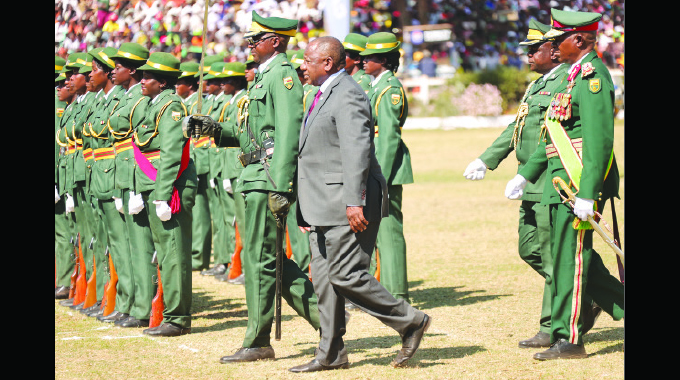
President Ramaphosa inspects the parade mounted in his honour at the Zimbabwe Agricultural Show.
“We must therefore work towards a more enabling regulatory environment to further boost this sector. We need increased investment in small and medium farming entities, particularly those owned and run by women and the youth.
“I call on the private sectors in both Zimbabwe and South Africa to use this show to explore avenues for great collaboration that will result in more trade and investment across our borders.”

Vice President Kembo Mohadi (right) and Defence Minister Oppah Muchinguri-Kashiri (wearing a hat) follow proceedings.
He commended Zimbabwe for ongoing policy reforms, irrigation projects and mechanisation efforts aimed at reviving the sector, saying such initiatives were essential for long-term food security and economic growth.
“President Mnangagwa and I recently attended the SADC Summit in Madagascar, where agricultural transformation in the region was a major point of discussion.
“The hosting of this Agriculture Show resonates with the Comprehensive Africa Agriculture Development Programme, which seeks to improve domestic production and marketing as well as the facilitation of regional trade in food staples. Agricultural cooperation is key to sustaining jobs.”
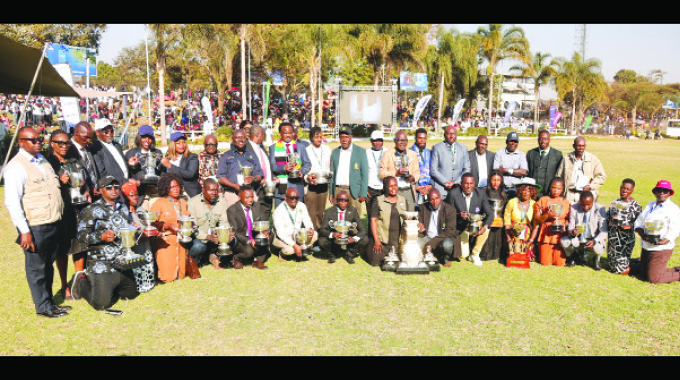
Winners at the 115th edition of the Zimbabwe Agricultural Show pose for a group photograph.
He also commended Zimbabwe for implementing land reforms that allowed black farmers to enter commercial agriculture, describing it as both a matter of historical justice and a foundation for future food security.
“On independence in 1980, the new democratic Government of Zimbabwe had to take on the momentous task of dismantling colonial-era patterns of land ownership,” he continued.

Children enjoy motorbike rides at the Zimbabwe Republic Police stand. — Picture: Memory Mangombe.
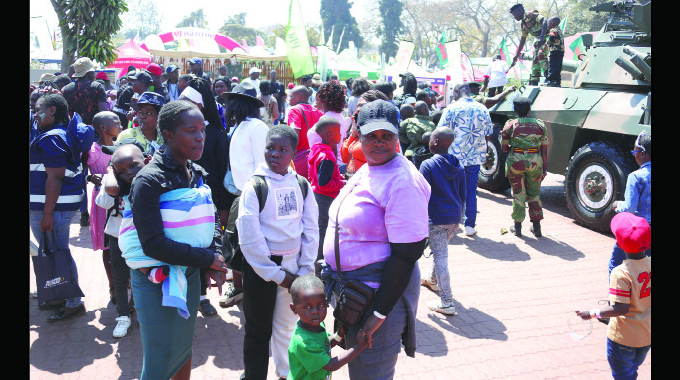
Showgoers view a tanker and an assortment of other military equipment at the Zimbabwe Defence Forces stand.
“Most of the country’s commercially productive land and large-scale commercial farms were owned by whites. The black majority was confined to communal lands and all but completely excluded from commercial farming. This mirrored our own experience in South Africa.
“It was therefore essential, for both historical redress and food security, development and economic growth, that the Government embarked on ambitious reforms to facilitate the entry of black Zimbabweans into productive agriculture, including support to small-scale farmers.”
The Zimbabwe Agricultural Show, now in its 130th year, is the country’s largest agricultural event, bringing together farmers, businesses, policymakers and investors.