admin
admin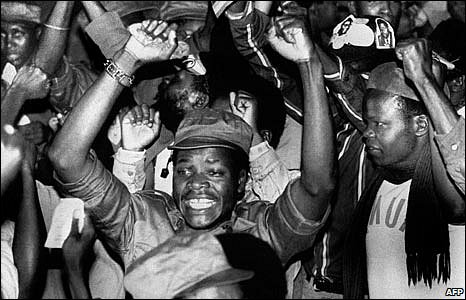
Isdore Guvamombe Saturday Lounge
Birds returned to their nests as the silhouette horizon announced the end of another day. The village busied itself with the final lockdown of everything and little everything else, in respect of the night.
The moons of waiting for Independence were over.
Zimbabwe had crawled out of the liberation eggshell and was beginning to find its firm footing.
Happiness dawned on many taut village faces, once masks of apprehension. Smiles kissed, oiled and soothed lips that once quivered nervously in silent supplication.
Rhodesia was gone.
Granny’s kitchen was big.
A low fire always lit at the centre in the evening and we always sat around it.
The haven behind the kitchen door was busy, with a scullery of things from broken unfired pots to pieces of metal. An old Adam Bede table, now rickety, had a hotchpotch of goods either on top or underneath. More often than not, rats fought and quarrelled among themselves.
The old cat that used to be their biggest enemy had been mauled and killed by a neighbour’s dogs. The rats were now all over the place. The dark corners of the house smelt of rat urine.
This evening granny was working on the grinding stone.
As usual, she approached the grinding stone and ground nuts with dexterity.
Once in a while, the whole family would abandon everything to kill one stray rat. Kicking around. Missing, cracking pots. Breaking claypots. The night momentarily belonged to grandfather.
During granny’s spirited grinding, a rat appeared, obviously attracted by the scent of roast groundnuts.
During the melee, the cunning rodent went up one leg of grandfather’s pair of overalls.
Wearing no undergarment, the rat found an express highway up to his leg and to his essentials and he jumped for dear life, hands clasped between his thighs.
It took great skill to avoid hurting himself.
We laughed in muffed voices, but to granny and grandfather it was no laughing matter. We struggled to control our laughter, but granny was a master of changing things.
The rat having been killed by squashing in grandfather’s overalls, she switched to our then most difficult subject, counting one to 10.
Three was the most difficult number. Independent Zimbabwe needed educated people. The new Government had a thrust of education for all. Granny was actually going to school. She had started in Grade Five because in Rhodesia she had ended in Standard Three.
At 60 years, granny had an ample bosom that stuck out defiantly against the three scores of years. She had seen 60 harvests and most of us had seen less than 10. Wow!
For minutes we went through school. It must have been one of her home works from school. We never liked these moments.
Suddenly granny picked on Mucha, for not sitting like a woman. Granny swung into surprising action, sitting with her legs apart, her wrap-round cloth pulled above her knees, its folds deliberately hanging loosely in front of her as she demonstrated the correct way a woman should sit.
Thereafter granny started her storytelling. She regaled us with her stories, which she told in her own inimitable ways, making us laugh until our side rib-cages cracked and ached. Sweet pain!
So powerful was her storytelling that every day when we were away from her earshot, we tried to imitate the stories, without much success.
This night was very special.
Everyone was going to the village centre to celebrate Independence under the full moon.
Normally children were barred from going out, but this very, very, special night was different.
It was a free-for-all.
On our way to the centre we met other families. All roads led to the centre where a huge old tree superintended over proceedings.
Granny started a conversation with one village woman about replacing an old insignia written “SIPOLILO” that had survived termite attacks for years, which would soon be replaced by a new one inscribed “GURUVE”. Things had changed dramatically, she said.
The new Government was giving equal opportunities to blacks and whites, to women and men.
Granny cherished on the prospects of her own national identity card. In Rhodesia she did not have one. She would soon open her own bank account. She was now a recognised full human being.
Many things, she reckoned, would change. The land across the river where the white man farmed would be shared among villagers.
Her grandparents had been dispossessed of that land without compensation by the white men when they came. Her grandmother had been buried on that farm somewhere on a rock promontory, but for long she had had no access to the grave. It was now the white man’s private property. Trespassing was a serious offence in Rhodesia.
Many rituals they would have wanted to perform on the graveyard had agonisingly failed as year-after-year passed, without access.
The war of liberation had ended and breathed a new lease of life.
At the village centre, people sang and danced to a cross-rhythm of a heartthrob of drums. Spirit mediums possessed by a lineage of ancestors joined and danced to a popular song, “VaMugabe ndimambo, shumba inogara yoga musango . . . Eyee ndimambo, shumba inogara yoga musango . . .”
Was among the songs, praising the founding leader of Zimbabwe, Cde Robert Mugabe.
Villagers danced in rings and circles. Boys chased their dates under the moonlight. Women wriggled their waists as song-after-song was churned out.
Even spirit mediums came to the village centre, something that had never been seen.
They had largely remained confined to their shrines as oracles of vision, hope and traditional values.
Even, Karitundundu, the senior medium, now old and shrivelled sat authoritatively on a stool following proceedings under the moonlight. There he was, snuffing his nostrils, flanked by his lieutenants Nyamapfeni, Dandajena, Dumburechuma and Gumboremvura.
Suddenly one possessed medium somersaulted and landed in front of drummers, sending the cross rhythm of drums to an abrupt end.
Shaking every limb and singing in a shriek of a voice, the medium stood up, danced around waving his cow tail.
Then the voice changed in tempo, crescendo and intonation into guttural noises. Karitundundu raised his hand to signal cessation of proceedings.
A hush fell on the crowd, that stared in amazement. All children were chased away.
Everyone who had not reached puberty was chased away.
It was time to discuss the future of a new Zimbabwe. Zimbabwe had come and there would be no going back to Rhodesia. Rhodesia was gone, dead and buried.
There was renewed hope for dignity for the majority black people. Zimbabwe had come.


 Online Reporter