admin
admin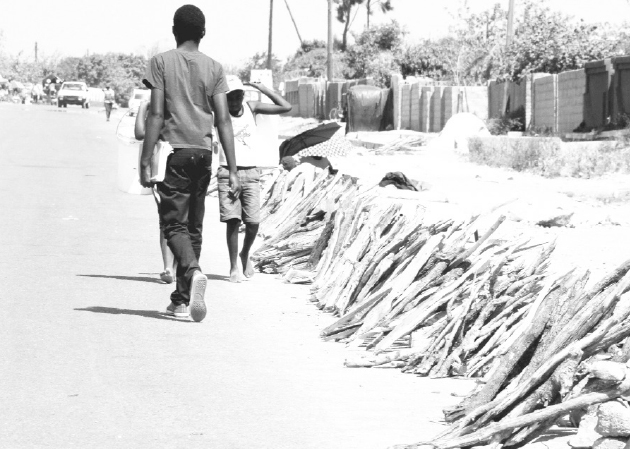
Yoliswa Dube
SICHELESILE Sibanda sits on a stump of wood as she fiddles with the pieces of firewood that keep the fire burning in her backyard in Cowdray Park.
Beside her is a bowl of finely chopped cabbage and a bucket of mealie-meal as she prepares her family’s supper. This is a scene recreated every day for Sibanda and other residents in the neighbourhood who are forced to use wood fuel to prepare meals.
She wakes up at 4AM three times a week and walks about 10km each time to fetch firewood for cooking because her home, like many others in the area, has not been connected to a power grid for about 10 years.
She is not any different from someone who stays in the remote villages of the country yet she made the great trek to the city in search of bright lights.
Her struggles, due to failure by the country’s power utility to provide the service, are the same as those of many other residents of Cowdray Park, Emganwini and Pumula South suburbs.
“I have been staying here since 2008 and there has not been electricity since I moved into this house. No one from Zimbabwe Electricity Supply Authority (Zesa) has said anything to us about the failure to supply us with electricity for so many years.
“The last time we asked them (Zesa) they said the houses in the area were too few to be connected to electricity. We have since adapted to this life but it frustrates me because I am not any different from someone who lives in the rural areas. Some people in the rural areas are even better off because they have electricity following the introduction of the rural electrification programme,” said Sibanda.
She said life had been difficult as a number of day-to-day activities which could have been done easily, with the availability of electricity, had become mammoth tasks.
“We wake up at 4AM three times a week and walk about 10km each time to fetch firewood for cooking. We cook three times a day but we try by all means to save the firewood so that the number of times we travel to fetch it are less,” said Sibanda.
Ironing is a luxury, let alone watching television or listening to the radio.
“When it is absolutely necessary, we warm up the iron by placing it on the fire and iron once it has heated up. We do not watch television, neither do we listen to the radio. We do not even know what is happening around the world. The only way we get news is when we buy a newspaper.
“We also want our children to watch cartoons. They do not even know how to switch on a television. We always see John Cena (the American wrestler) on packets of chips but we have never actually seen him in action,” she said.
The unavailability of electricity has also taken its toll on Emganwini residents who said they were tired of leading embryonic lifestyles.
“Zesa has done nothing at all to connect our houses to a power grid. We have seen no progress whatsoever regarding this ongoing problem.
We need to see meaningful development as soon as yesterday.
“Because firewood is expensive, at $1 for three logs, we only make a fire when it is time to cook. Even then, we use very little wood because it is an extra expense.
“In order to bath with warm water, we put a bucket filled with the precious liquid in the sun for it to warm up, other than that we bath with cold water. During winter, we just have to bath with cold water. When it is raining, cooking meals is almost impossible. For light, we use candles or paraffin lamps.
“I own a television and a radio but they are just lying idle,” said Joshua Bulala of Emganwini suburb.
He said even after staying in the suburb for a number of years, he still could not adjust to living without electricity.
“We would have finished cooking our supper by 7PM and we go to bed early so as to save candles. When we go with our children to places with electricity or a television, they are astonished as if it is something so amazing.
“We pay R5 to re-charge our phone batteries, but the price can go higher depending on the amount of time the battery requires to re-charge,” said Bulala.
He said it was high time Zesa officials connected their area to a power grid.
“Zesa should really do something soon. We have been patient for too long. Our children eat a lot of unhealthy cold meals because we cannot afford to buy enough firewood that will allow us to cook frequently.
“We just want electricity as it will make our lives more convenient, even more now that winter is approaching. Asikwazi ukuthi iqhinge nga inqola ingasahambi,” said Bulala.
In Pumula South suburb, residents said they had lost hope and would just wait for Zesa to bring power to the suburb, whenever it will.
They said they were tired of clamouring for the same thing over a protracted period of time.
“We have since adapted to this lifestyle because there is no alternative. We have stayed here for almost five years, not having electricity is no longer frustrating,” said Tatenda Murondi.
Despite the dangers of deforestation, Murondi said they chopped down trees for firewood in nearby bushes.
“Sometimes we use paraffin instead of firewood to cook. To watch television, we use a generator or a battery,” he said.
In as much as Murondi said he would appreciate the electrification of his neighbourhood, he had found alternatives of generating power other than relying on the country’s power utility.
“We can only make use of what is available to us until Zesa rectifies the problem,” he said.
Bulawayo United Residents Association chairman Winos Dube expressed disappointment over Zesa’s failure to connect these suburbs to a power grid saying it was unfair considering these people were living in an urban set up.
“Zesa’s failure to connect these areas to a power grid is really disappointing. The situation is badly affecting residents and it is very unfair considering they are staying in an urban area.
“Zesa does not want to come out in the open and say what the challenges are. They should tell us where the problem is,” he said.
Dube said it was disheartening to note that these residents have been living in darkness for about a decade.
“We are concerned and disappointed. How are these people meant to survive without electricity in an urban set up? There is no place from which they can fetch firewood except on other people’s farms, which is regarded as poaching. It is shocking that Zesa still fails to connect these areas to a power grid considering the fact that there is the rural electrification programme running at the moment,” he said.
Dube added that it was time the Government intervened.
“I would also like to challenge the councilors as well as the Member of Parliament for those areas to voice these concerns. It is a very unfair situation, all relevant authorities should step in,” he said.
Efforts to get a comment from Zesa public relations manager Fullard Gwasira were fruitless as he did not respond to questions sent to him via email, as per his request. His mobile phone continually went unanswered by the time of going to print.


 Online Reporter