admin
admin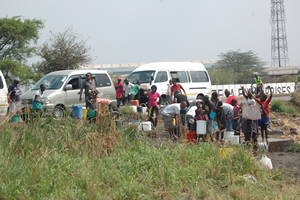
which they view as of poor quality.
The residents expressed dismay over the city authorities’ “indifference” towards improving the water quality.
A survey by The Herald yesterday revealed that most boreholes were crammed with people fetching water for domestic use.
They said they resorted to borehole water because tap water left some residue in containers and had a stench.
Mrs Mercy Tsatsa of Highfield said her family was being forced to walk for more than five kilometres to get to the nearest borehole despite paying monthly water bills.
“There is no substitute for health and life,” she said. “I live with a family of nine and we use more than 30 litres of drinking and cooking water daily.
“My priority is the safety of my family and I have to endure the distance and the heat to get clean water.”
Some residents have questioned the motive of the city council in pumping “semi processed” water to residents, saying the move would result in the increase of diarrhoeal diseases.
HARARE WATER
Ms Irene Tsodzo of Kambuzuma accused city fathers of being irresponsible.
“The city should be responsible for its residents and avoid feeding the suburbs with unclean water,” she said.
“All our water containers have been tainted by dirt from the tap water. The water forms a green coat above if it is boiled. We do not know whether this is algae or sewage.”
The residents’ fears come despite several tests on Harare’s water which proved that it was of good quality.
Last year, tests run by the University of Zimbabwe’s Civil Engineering and Water Testing Laboratory and city officials revealed that the water was of high-quality and met international standards of cleanliness.
The tests revealed that the water was clean, but the colour fell below international standards.
Harare has in the past faced water borne diseases like cholera and typhoid which were blamed on poor water quality or the lack of constant supplies.
Council spokesperson Mr Leslie Gwindi said the city’s water was of good quality.
“We don’t have any reports of the problem and certainly nothing of that nature,” he said. “Our water is actually safe, we do not supply water that is unsuitable for drinking.”
Mr Gwindi said water shortages in some areas were a result of maintenance works that they were carrying out.



 Online Reporter