Online Reporter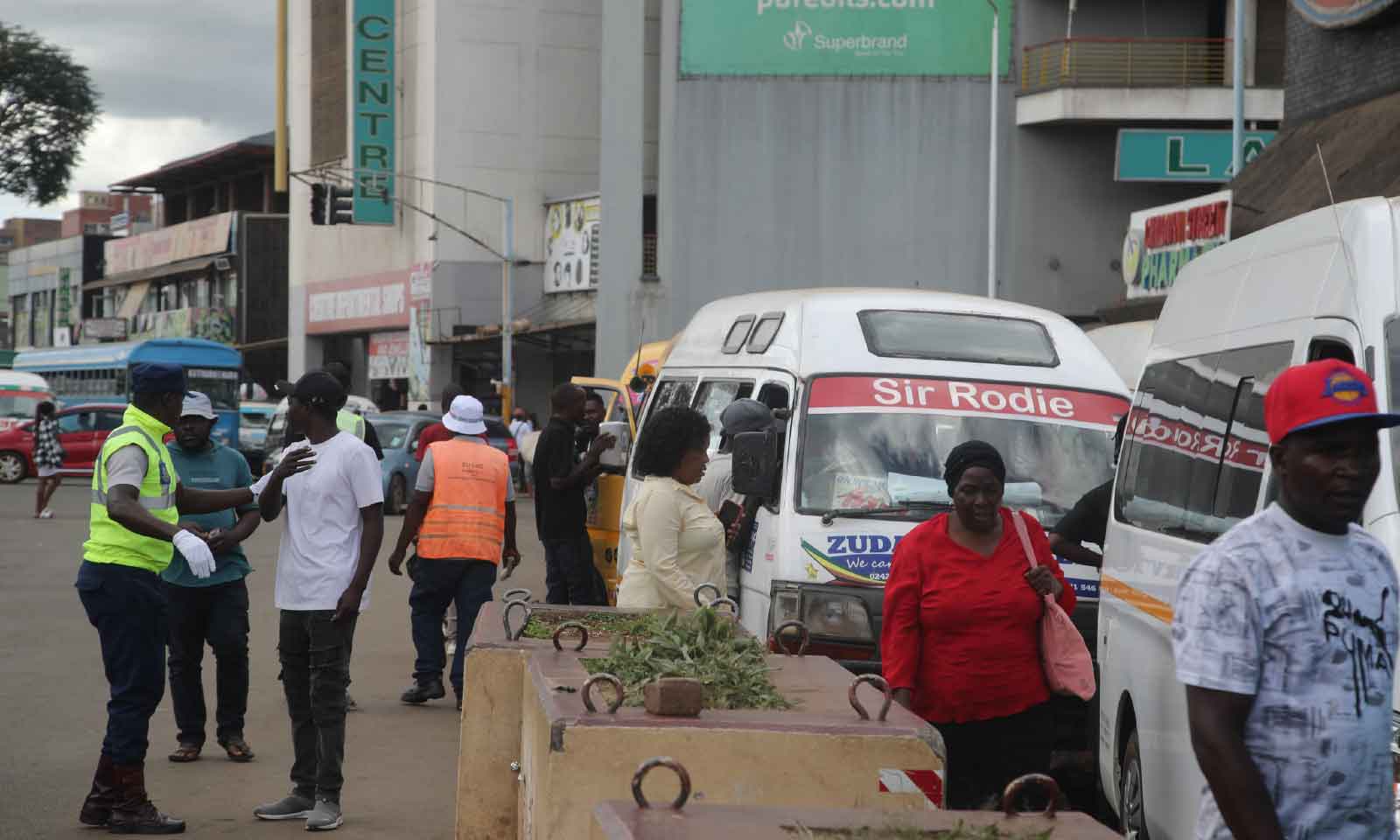
Theseus Shambare
AT the junction of Rezende Street and Robert Mugabe Road in Harare, a commuter omnibus suddenly swerves onto the pavement, heading east.
Pedestrians scatter in panic, while street vendors temporarily abandon their wares.
The conductor leans halfway out the sliding door and touts for passengers as the kombi speeds through a red light.
In another incident, along First Street, commuter omnibuses mount the pavement in a high-speed chase with the authorities.
The crews show little regard for either passengers or pedestrians.
Such scenes have become frighteningly routine in the capital’s central business district.
While some commuter omnibus crews are arrested, repeated violations suggest that many escape accountability with ease.
For Josiah Tambudzai, such episodes stir painful memories.
A few years ago, his father was hit by a commuter omnibus, dragged several metres along the pavement and lost an eye.
“The culprit was never apprehended,” Tambudzai recalled.
“As a builder, my father could not continue working. He was forced to retire and move to his rural home in Njanja.”
The driver had been fleeing police after flouting traffic regulations.
Across the capital, commuter omnibuses (kombis) routinely drive on pavements, run red lights, invade lanes meant for oncoming traffic and load passengers at undesignated pick-up points.
Ineffective
According to the Traffic Safety Council of Zimbabwe (TSCZ), reckless driving remains one of the leading contributors to road crashes, particularly in urban areas.
Experts warn that such violations endanger not only passengers but also pedestrians, cyclists and private motorists.
The risks are compounded by counterfeit brake pads, worn tyres and speeding vehicles — common factors in tragic crashes.
The persistent violation of traffic regulations by kombi crews and mushikashika (illegal taxi) operators has prompted many to question whether the authorities have failed to decisively restore order on the roads.
Critics argue that despite heavy police presence, the situation remains unchanged, suggesting that current enforcement strategies are ineffective.
However, police spokesperson Commissioner Paul Nyathi said the authorities are intensifying efforts to curb traffic violations.
“There are a lot of things we can do. Anyone who wants to get into the business (transport) should comply with the country’s rules and regulations,” said Commissioner Nyathi.
“Those drivers on First Street were captured on camera. We followed them up and ensured the law was enforced to the letter. Anyone thinking they can get away with reckless driving is fooling themselves.”
Several commuter omnibuses were recently captured driving along First Street, which is a pedestrian-only pavement.
Zimbabwe, Comm Nyathi added, will be adopting an electronic traffic management system designed to make enforcement faster, accurate and less prone to corruption.
“Days of people thinking they can flout traffic laws are coming to an end. We are also contending with fake brake pads and counterfeit brake fluids that continue to cause crashes,” he said.
Zimbabwe Union of Drivers and Conductors (ZUDAC) spokesperson Reason Dombo Ajida urged the authorities to embrace technology rather than rely on endless “cat-and-mouse” chases with drivers.
“We need to move away from the mushikashika style of enforcement and implement systems that monitor and prevent dangerous behaviour in real time,” he said.
“Associations of commuters must be formalised and regulated. Bogus associations that operate outside the law often become syndicates of corruption and put lives at risk.”
For compliant drivers like Wonderful Vhunye, the system feels unfair.
“I have all the paperwork required to operate legally,” Vhunye said.
“But non-compliant operators can work freely, pick up passengers in undesignated areas and make money all day without risk of arrest. Meanwhile, registered kombis get impounded even for minor issues.”
Conductors such as Tonderai Chandavengerwa highlighted operational challenges that increase risks.
“On routes like Westgate, some areas have no official bus stops. We are forced to drop passengers on roadsides, risking lives and attracting penalties from the police,” Chandavengerwa explained.
Greater Harare Association of Commuter Operators (GHACCO) secretary-general Ngoni Katsvairo emphasised the need for systemic reform.
“We have about 16 000 kombis in the city, but only 5 500 are registered,” Katsvairo said.
“There are about 1 000 buses, but only 100 are compliant. Pirate taxis dominate the streets, leading to cat-and-mouse chases with the police. Commuters are getting injured and killed, and this is unacceptable.”
He stressed that associations are critical for safety and training.
“Registered operators must be part of an association. We educate members on proper conduct, legal compliance and safe operations. Those operating illegally are the ones putting lives at risk.”
Katsvairo also pointed to holding bays as a practical short-term solution.
Public scepticism is mounting over the local authority’s ability to enforce the use of designated terminuses and facilities. Critics contend that these hubs possess the potential to restore order almost immediately, yet they remain underutilised while congestion persists elsewhere.
“Facilities like the Coventry Road holding bay, which can accommodate over 700 kombis, allow vehicles to wait safely before moving to major ranks like Copacabana or Market Square. These bays have boom gates, gatehouses and allocated areas for high-density suburbs, reducing illegal street operations and improving commuter safety,” added Katsvairo.
He also said enforcement alone is insufficient.
“We need a holistic system. Proper infrastructure, association oversight, compliance enforcement and technology-based monitoring. Without these, tragedies will continue . . .
“Every unregistered kombi on the road is a potential casualty. We must combine regulation, associations, holding bays and technology to ensure commuters, pedestrians and drivers are safe.”
Katsvairo believes reviving the Zimbabwe United Passenger Company (ZUPCO) as an operator of a transport system that uses small buses/minibuses is part of the solution.
“Affordable, reliable and safe public transport reduces demand for risky pirate taxis. It is also a visible model of compliance that others can emulate while prioritising commuter convenience and safety.”
Innovative solutions
Experts argue that Zimbabwe could benefit from adopting global best practices in urban traffic management. During the 88th session of the United Nations Inland Transport Committee (ITC) in Geneva last month, Dr Luciana Iorio, chairperson of the Global Forum for Road Traffic Safety, praised Zimbabwe for its commitment to road safety.
“Being part of the global forum is not just about attending meetings; it is about sharing a vision of saving lives. Road safety is a shared responsibility, but action must be localised and informed by global best practice,” Dr Iorio said.
She emphasised that middle-income countries can improve safety through technology, automation and regulatory frameworks, ensuring these systems save lives rather than complicate roads.
“Road safety performance reviews identify gaps in infrastructure and driver behaviour. Countries like Zimbabwe can leverage data to reduce fatalities and serious injuries by 50 percent during the Second Decade of Action for Road Safety (2021-2030),” she explained.
Transport and Infrastructural Development Minister Felix Mhona told the ITC that the country has already begun adopting innovative solutions.
“Zimbabwe has introduced an Integrated Transport Management Information System, moving away from paper-based systems. Vehicle registration, licensing and inspections are now streamlined,” Minister Mhona said.
He added that artificial intelligence (AI)-enabled cameras, solar-powered traffic lights, cashless “tap-and-go” ticketing and GPS tracking are being deployed to modernise enforcement and improve safety.
However, he acknowledged that Zimbabwe must contend with historical inequalities that hinder rapid adoption compared to developed countries.
Minister Mhona also addressed the need to revive ZUPCO with a model better suited to commuter convenience.
“A revitalised ZUPCO must focus on small buses and minibuses rather than large buses, which are not practical in urban areas,” he said.
“Previously, when ZUPCO partnered with private operators, delayed or non-payments caused breakdowns in service. A new model must ensure reliability, affordability and timely service for passengers while maintaining safety standards.”
Traffic expert Dr Douglas Baruka suggested benchmarking ZUPCO operations against successful models in South Africa, Malaysia and Brazil.
“Integrated scheduling, electronic ticketing, GPS tracking and safety audits are common practices in these countries that Zimbabwe can adapt. Strengthening ZUPCO would not only improve commuter safety but also enforce a culture of compliance across all urban transport operators,” he said.
Currently, the TSCZ is limited to education and awareness campaigns, unlike agencies such as the Environmental Management Agency, which can fine and enforce compliance.
TSCZ has proposed transforming into an agency with arresting powers, giving it a stronger enforcement mandate to curb reckless driving.
Statistics show Zimbabwe averages more than 1 500 road fatalities annually, with urban crashes accounting for over 40 percent of deaths. Commuter omnibus violations are a major contributor, with thousands of crashes recorded each year, many involving unlicensed operators. Experts warn that human life must remain central in all traffic interventions.
International examples reinforce this approach. In Malaysia, electronic monitoring, fleet management and designated stops have reduced urban commuter crashes by over 30 percent in five years.
Brazil’s Rio de Janeiro and São Paulo enforce GPS tracking and real-time penalty systems for buses and vans, significantly reducing fatal crashes in dense urban areas.
South Africa’s Johannesburg metro combines driver training, vehicle audits and electronic monitoring to curb illegal taxi operations. Experts argue that Zimbabwe can adapt these systems, combined with community education campaigns, to create safer urban roads while ensuring commuter convenience is not sacrificed for safety.
At the human level, the message is clear: Reckless driving is preventable.
Every pedestrian, cyclist and commuter is a life at risk when vehicles operate outside the law. Restoring order on the streets of Harare, experts say, requires a combination of technology, strengthened associations, compliance incentives, law enforcement and a reliable ZUPCO network.
Without urgent reform, Harare is at risk of more tragedies like the one that devastated Josiah Tambudzai’s family.