

 dyton mupawaenda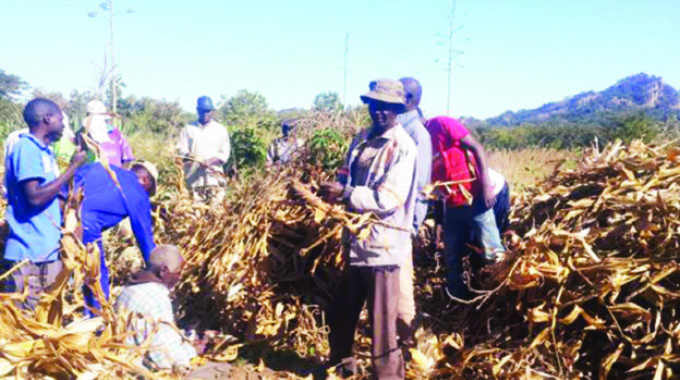
Obert Chifamba-Agri-Insight
THE Government’s recent call on farmers to resuscitate the traditional nhimbe/ilima culture and add impetus to the current planting activities taking place across the country all but conjured nostalgic memories inside me.
The call opened a floodgate of the priceless memories when villagers would invite those they were friends with to come and help them do tasks such as tilling the land, ferrying manure to the fields, weeding, harvesting or thrashing and winnowing of crops and many other tasks without extending a monetary payment.
They would just brew some traditional beer and maheu (for non-alcoholics), buy a few loaves of bread or even bake their own from wheat flour and slaughter one or two road runners and in some cases a goat depending on the attendance.
This would be enough to see many people from the village or even beyond coming together to do the work all in a day. A task that would have taken weeks for an individual to accomplish would be completed in one day — usually starting very early in the morning to somewhere around midday.
This usually happened at the start of a new season when genuine needs and shortcomings of all families in a community would be laid bare, as they sought to plant crops timeously in order to avert famine. In most cases families without ox-drawn draught power would need help to ensure they did not lag behind in their activities, for instance, planting that would allow them to score decent yields and avert food insecurity.
Today the country is battling to keep abreast with the fast galloping season following the prolonged dry spell that characterised the better part of its first half (October to December).
A month into the second and last half, the bulk of farmers are still planting, thanks to the prevailing high moisture levels courtesy of the rains that are falling.
It is now a must for dry land farmers to ensure that they do the planting and complete before tomorrow’s (January 10) deadline so that their crops will be able to mature within the remaining months or slightly beyond and salvage some yields. Some farmers’ biggest undoing at the moment is the shortage of manpower, which makes it necessary for them to work together and beat the pressure they are currently facing.
This is where the nhimbe/ilima (communal collaboration) concept comes in. Driven by a strong spirit of communalism, the practice allows people doing seemingly insurmountable tasks to upstage them using the power of numbers and pooled resources. At this point in time most farmers are seized with completing planting but they can make more impact if they work together. Group work naturally adds impetus to activities.
Nhimbes/ilimas are normally done on a rotational basis so it will be up to the farmers to structure their programme in such a way that they can all have their turns before the wet spell expires. Besides making tasks lighter, nhimbes or ilimas will help foster a sense of communalism and solidarity among farmers. It will also be a platform for the sharing of ideas and expertise. The crux of the matter, however, is that the practice will enable farmers to capitalise on the favourable weather conditions provided by the current wet spell. No one will be left behind. Nhimbes’ are therefore a vehicle of empowerment for communities because they erase the differences between the haves and have-nots.
One thing the farmers must not forget as they expedite the formation of the working groups is to use early to ultra-early maturing seed varieties so that they allow the crops to make up for the lost time through their high varietal performance characteristics.
Farmers must choose varieties that can mature within 90 days or slightly beyond that so that their crops are not deserted by the rains at the crucial ripening moment.
Remember weather experts have predicted a season saddled with the El Nino phenomenon, which incidentally has already hinted at its presence through the just ended prolonged dry spell. Everything that farmers are doing now should be guided by the warning shots the El Nino phenomenon has already fired. Forewarned is fore-armed.
The traditional concept of nhimbe runs deep in Zimbabwean culture, not just among the dominant Shona but the entire nation and was responsible to a very large extent for the food self-sufficiency that used to prevail throughout the country. No one would miss important seasonal deadlines owing to lack of traction power, as is happening today. Even those that did not have cattle or donkeys would have their fields ploughed in time and people would even use open pollinated varieties of seed if they could not afford treated seed from the shops. The burden would be less.
The nhimbe concept is generally a social unifier, as it takes care of both nutritional and social issues of the general populace. Implements are used communally and all people develop a sense of oneness that also promotes a very high sense of responsibility in most things they do. This will outlive the current crisis for which the concept has been roped in. In fact, it can easily become the missing tonic that farmers have been looking for when it comes to digging holes for the Pfumvudza/Intwasa programme, which many have been dreading because of its tedious nature.
And now that Pfumvudza/Intwasa has demonstrated its vast potential to make the nation food secure, it may not be a bad idea for all farmers to increase hectarages under the programme going forward, which will once again require team effort in digging the planting holes.
Nhimbes will allow those that cannot hire labour or implements to participate actively in agricultural production, which is a plus to the national efforts to eradicate food insecurity and get industry working to capacity.
Sometimes the not-so privileged farmers have no choice but to reduce the hectarage under cropping or even leave the land fallow after failing to mobilise the required labour or input resources, which is the ideal recipe for food insecurity.
The nhimbe concept has been used in many countries globally as a vehicle for promoting the spirit of voluntarism and sustainable local development.
At independence, the Government of Zimbabwe sought to uphold the concept but at a slightly different level. Then, it was called “mushandirapamwe” (co-operative), which meant working together for the general good of production in most activities, of course with a huge bias towards agriculture.
This practice saw the country leaving a very legible footprint in agricultural circles on the continent and even globally, as most of the food that earned it the status of bread basket of Africa came from smallholder farmers who thrived on mishandirapamwe while the large commercial farmers, predominantly whites, concentrated on lucrative cash crops such as tobacco and flowers to name a few.



 Peter Tanyanyiwa
 Online Reporter