Online Reporter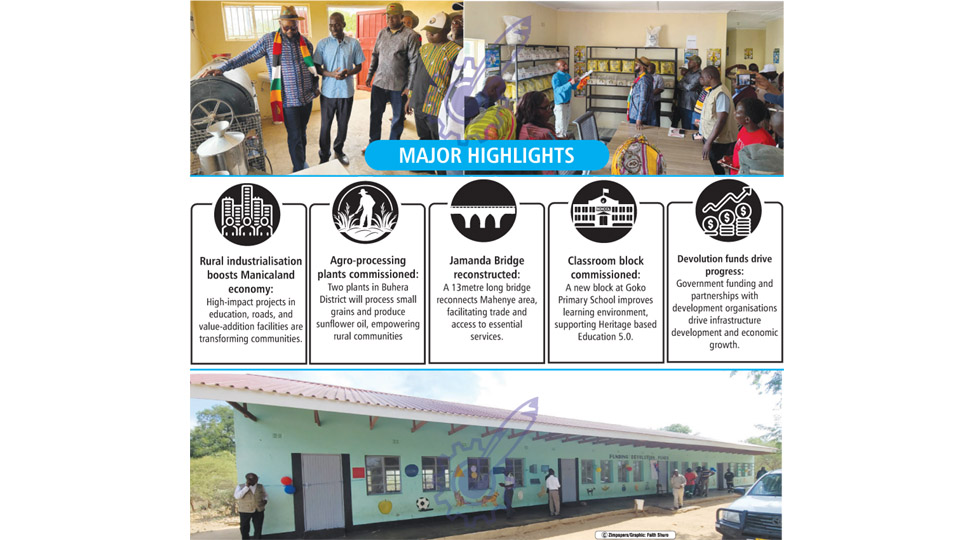
Lovemore Kadzura
Post Reporter
MANICALAND Province is witnessing a remarkable surge in economic growth and development, driven by rural industrialisation and major infrastructure initiatives.
High-impact projects in education, roads, and value-addition facilities are transforming, both the economic prospects and social well-being of communities across the province.
This week, the Minister of State for Manicaland Provincial Affairs and Devolution, Advocate Misheck Mugadza, presided over a busy schedule of project commissioning.
These initiatives, funded through devolution resources and partnerships with development organisations, are reshaping the province’s economic and social landscape.
Among the projects launched were two agro-processing plants in Buhera District, a bridge in the remote Mahenye area of Chipinge, and a new classroom block at Goko Primary School in Chipinge.
The commissioning of road equipment for Chipinge Town Council was postponed at the 11th hour.
Collectively, these projects tackle critical priorities such as value addition, education, and infrastructure development—key pillars for enhancing mobility, boosting local economies, and uplifting rural livelihoods.
Minister Mugadza described them as milestones that will accelerate development in line with national aspirations, while improving the quality of life for ordinary citizens.
The Bangure and Masasa Agricultural Processing Centres, established through a partnership between Government, World Vision, Buhera Rural District Council, and local communities, stand out as flagship projects.
They are designed, not only to promote value addition, but also to empower rural communities to participate meaningfully in the national economy, contributing to Gross Domestic Product growth at the village level.
Currently, the centres are processing small grains such as finger millet and groundnuts, as well as producing sunflower oil. This marks a significant step towards realising Government’s vision of inclusive development—ensuring that no place and no person is left behind.
“As Government, we remain firmly committed to Vision 2030 of transforming the country into an upper middle income economy. Central to this vision is rural industrialisation, value addition and mordenisation of our agricultural systems.
“Zimbabwe is in transition from the implementation of National Development Strategy (NDS1), which stabilised the economy and laid foundational reforms, to (NDS2) a much more ambitious phase that will decisively accelerate community upliftment. For Buhera, the transition from NDS1 to NDS2 signals intensified rural industrialisation, expansion of irrigation and climate-resilient agriculture, increased investment in roads, energy and water infrastructure and stronger emphasis on value addition and beneficiation.
“NDS2 is designed to push the fruits of development deeper into the grassroots, ensuring that communities like Bangure and Masasa, which have often been on the margins, now become thriving centres of economic activity and dignity.
The commissioning of Bangure and Masasa Agro-Processing units is a strategic step towards boosting agricultural productivity, creating employment for our youths and women, enhancing value addition and agro-processing, and positioning Buhera as a vital contributor to provincial and national economic growth,” said Minister Mugadza.
Minister Mugadza also commissioned the Jamanda Bridge on Wednesday, in Chief Mahenye’s area, which was destroyed during the devastating Cyclone Eline in 2000. Twenty-five years later, the Second Republic released devolution funds to fund the construction of the bridge.
The people of the area had lost hope on the reconstruction of the bridge, but the Government finally came to their rescue.
The 13-metre-long bridge serves 15 villages with a population of 15 000 people, and also connects Mahenye and Manica District of Mozambique, which is 26km away. As such, it is critical in facilitating international trade.
“The bridge is more than a crossing point – it is a critical piece of infrastructure that directly address the historic challenges faced by this community. For too long, the people of Mahenye and surrounding areas have endured immense difficulty, particularly during the rainy season, when accessing essential services, taking crops to market or simply getting children to school became a dangerous and often impossible task.
“The seasonal disruption was a burden on our farmers, businesses and the very fabric of our social life. This project conceptualised in a build-back-better model, was funded and executed through the spirit of devolution, proving that when resources and decision-making authority are placed closer to the people, development accelerates. This project is cornerstone of our broader national infrastructure plan designed to unlock the economic potential of every region and ensure that no community is left behind,” said Minister Mugadza.
Chipinge Rural District Council chairman, Alderman Godfrey Makuyana credited devolution funds for a number of infrastructural projects the local authority has been undertaking, and said people’s livelihoods have been enhanced.
“The destruction of Jamanda Bridge had made transport systems in Mahenye difficult, especially during the rainy season. Haulage trucks transporting essential products such as drought relief and inputs were failing to access the area, forcing them to drop the consignments far away from the intended beneficiaries, who ordinarily should receive them at their doorsteps.
“This is now a thing of the past following the intervention of the Government, which released devolution funds used to construct the bridge. We also received some cement from a conservancy operating in the area. Mahenye is a very remote area on the border with Mozambique and the people are so happy to see a Minister paying them a visit,” said Alderman Makuyana.
Minister Mugadza further said Government is on a massive school construction exercise, building new ones and adding more classroom blocks across the province, in an endeavour to fulfil the tenets of Heritage-based Education 5.0, which entails that good infrastructure is a catalyst for quality education delivery.
He said Government invested thousands of dollars to construct a standard block with four classrooms at Goko Primary School in the Mutema-Musikavanhu Constituency to improve the learning environment.
The school was affected by Cyclone Eline in 2000 and a classroom block was extensively damaged, leaving it with inadequate classrooms.
“This classroom block stands as a tangible symbol of Government’s vision to empower local authorities and bring accelerated development to every corner of Manicaland and the entire nation. We acknowledge the hardships this school faced, particularly in 2000, when a 1×4 classroom block was destroyed by Cyclone Eline. This unfortunate event severely affected the teaching and learning environment, forcing learners and teachers to conduct lessons in open spaces, exposed to all weather conditions. Such conditions are unacceptable in the Second Republic, which is focused on building an upper-middle-income society by 2030, while leaving no one and no place behind,” said Minister Mugadza.
Goko Primary School headmaster, Mr Chamunorwa Mugwandi said they have been rescued from an untenable situation of conducting lessons in the open and under trees.
He revealed that since the construction of the building, the school has managed to register positive results in teacher retention, pass-rate, and enrolment.
“We had a serious challenge of learning space since 2000 when a classroom block was razed to ground level by Cyclone Eline. We had nowhere to conduct lessons except out in the open. This affected teaching and learning heavily until 2020 when devolution funds came to our rescue and constructed a new standard classroom block which houses 160 pupils.
“Since the completion of the block, we have seen an improvement in teacher retention, a rise in learner enrolment, and the pass-rate rose sharply from 48 percent in 2021 to 60 percent in 2024. Due to lack of classrooms, we had to introduce hot-seating, which is not ideal for a rural primary school.
“Our enrolment has significantly risen from 621 in 2021 to the current 728 learners. The school and community are grateful to Government for remembering us. For effective education to take place, proper infrastructure is required,” he said.