Online Reporter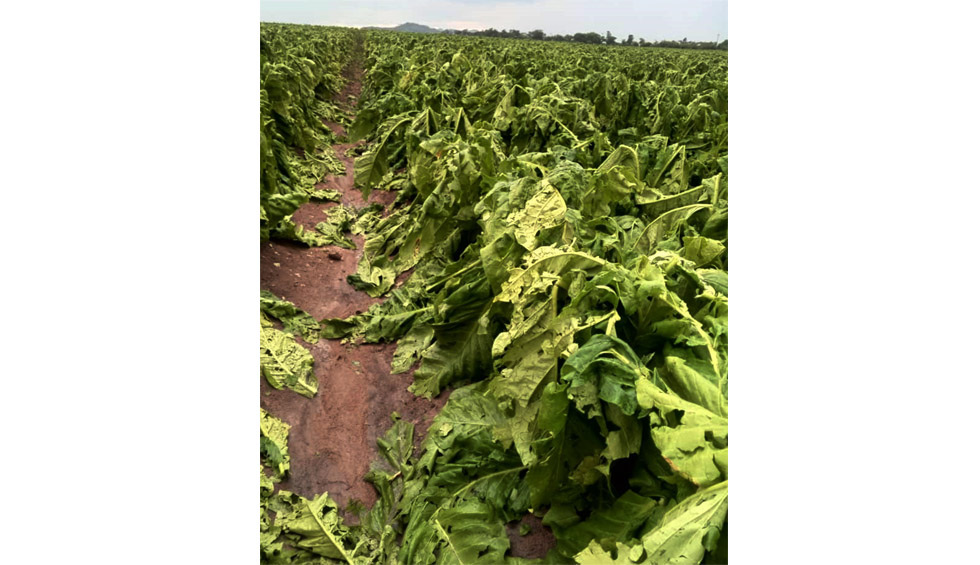
Lovemore Kadzura
Post Reporter
TOBACCO farmers in Headlands were left devastated last week after a violent hailstorm destroyed irrigated golden leaf valued at more than US$4 million, just days before harvest.
What began as welcome rainfall quickly turned disastrous, dashing hopes of a bumper crop and leaving fields in ruins.
The hailstorm shredded 387 hectares of flourishing tobacco — mainly from large scale commercial farms—leaving the leaves pock marked, ripped, and pruned beyond recovery.
While most large scale producers had insured their crops, small scale farmers in Bingaguru, whose rain fed tobacco was also damaged, were not as fortunate.
Among the hardest hit were some of Zimbabwe’s top tobacco producers: Mr Denfrod Mutwiwa of Mutwiwa Farm, Mr Felix Kamusasa of Dzikiti Farm, and Mrs Monica Chinamasa of Tsukumai Farm.
Mr Mutwiwa, who was crowned the country’s best tobacco grower by the Tobacco Industry and Marketing Board (TIMB) last season, described the destruction as catastrophic.
“At one of my leased farms, all 120 hectares of prime tobacco were shredded in less than 10 minutes, inflicting losses of about US$1 million,” he said.
The disaster has sent shockwaves through the farming community, highlighting the vulnerability of agriculture to extreme weather events and leaving many farmers counting heavy losses.
“I lost 120 hectares of irrigated tobacco last week. This year, I had planted 330 hectares of tobacco on a number of farms I lease. The affected 120 hectares were on a single farm. The five other farmers from our area were also affected by the hailstorm. My neighbours lost 140ha, 40ha, 35ha, 42ha, and 30ha, respectively.
“My tobacco was insured. You cannot grow tobacco at large-scale without insurance because it is suicidal. Imagine 120 hectares of ripening tobacco gone in just 10 minutes – how do you recover from that if you are not insured it? It is suicide to put a lot of resources into a crop and avoid having it insured – it will all be wiped off in the twinkling of an eye. With the other crops, you can do without insurance, but not with tobacco – you cannot take the gamble and survive,” said Mr Mutwiwa.
In an interview on Wednesday, Mr Kamusasa said he lost 140 hectares with an estimated value of US$1,9 million.
“All in all, I lost about 140 hectares of ripening tobacco, which was due for harvesting on December 5. It was all shattered in a matter of seconds by the hailstorm. The whole crop was shredded and cannot recover. The damage was 100 percent, and I had to restart all over again. I had to look for seedlings to replant some of the fields, but I cannot replant all the 140ha because the crop won’t make it if the replanting spills into January 2026. It is very painful – the 90 hectares of the 140 hectares had just been top-dressed. The crop was insured, but being a contracted crop, it means I had borrowed, and that was a huge blow,” said Mr Kamusasa.
Another tobacco grower, Mrs Monica Chinamasa, had 40 hectares of her crop affected, with mostly the top seven leaves lost.
Mrs Chinamasa, who is Zimbabwe National Farmers union (ZNFU) president, said had she not insured her crop, she would have lost a significant amount.
“We lost about 40ha of tobacco in a severe hailstorm that was quite violent. We lost about half of the leaves that were exposed to the hailstorm. We picked some affected leaves that had coloured for curing, meaning they had matured, but the green ones had to be discarded. We grow tobacco under contract, and it is mandatory that we insure our crop.
“A team from our insurer is assessing the extent of the damage and its value. The contractor will lose out on the crop because we will deliver fewer kilogrammes to the contract floors. Farmers should always insure their crops because you never know what will happen. A farmer has no control over some weather-related calamities. Some farmers are reluctant to insure because they feel their money will be wasted if disaster does not strike,” she said.
Besides hailstorms, tobacco farmers also face challenges such as losing their produce during curing, where a fault can ignite fires and burn the crop.
They are also exposed to theft and robbery during transportation of the bales to auction floors.
The Tobacco Industry and Marketing Board (TIMB) has since demanded that tobacco bales should only be transported by transporters registered with them and have goods-in-transit insurance.