admin
admin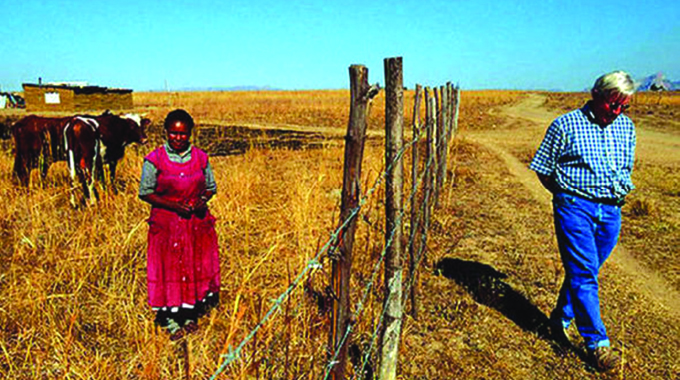
Langton Makuwerere Dube, Correspondent
Events surrounding the land issue in South Africa have sparked a compelling debate that stands as a stark reminder for the region to reflect on.
Interestingly, some spaces and voices have raised concern about the dangers of drawing similarities between South Africa and Zimbabwe.
While caution could be exercised and cognisant that these arguments may have traction depending on one’s ideological worldview, this piece is not a riposte.
However, be that as it may, for those of us born and bred in the dungeons of punctured revolutions, restricted to the hinterlands of development, from where we are perennially fighting to liberate ourselves, those of us nourished by the belief that the Empire will always remain repugnant to our progress, we cannot help ourselves but draw similarities.
As a disclaimer, I do not seek to hard-press Zimbabwe everywhere or, as others have argued, to perch Zimbabwe’s relevance.
However, because the affinities are glaring, I unequivocally and unapologetically, respectfully or otherwise, argue and draw similarities to the conclusion that history is repeating itself.
The aphorism “history repeating itself” should not be taken in its literal sense to imply events imitating or replicating themselves.
Instead, it denotes that specific patterns and behaviours tend to recur over time in certain guises and configurations when subjected to specific conditions or fundamentals. In that line of reasoning, specific historical realities allow us to draw similarities between the two countries.
South Africa and Zimbabwe have a history of acute land imbalances inherited from the colonial enterprise wherein blacks were marginalised to the Bantustans and Reserves, respectively.
Also, though of British descent in Zimbabwe, South Africa has an aloof and unrepentant white population predominantly of Afrikaner origin whose claims to entitlement and belonging are hardened. Because the colonial institution was never a terrain for democracy and civility, so lynching, black peril legislations, and all sorts of dehumanising tendencies characterised Apartheid and the Rhodesian settler regimes.
Pacted or negotiated as it was, independence through CODESA (South Africa) and Lancaster (Zimbabwe) bequeathed liberal-democratic constitutional arrangements whose veiled and long-term mandates were to preserve the status quo. Buttressed by reconciliation rhetoric devoid of restorative justice, the massive socio, political, and economic fissures from the colonial era were plastered over, left to fester and simmer.
While it may be politically instrumental to blame the liberation forces for acceding to such arrangements, it is practically prudent to realise that the exigencies of the times and the realities of liberation demanded that a common ground be reached. Unfortunately, in both countries, such a scenario bred an economically powerful white gentry who wittingly or unwittingly grew a self-inflated ego of entitlement, one that ensured they remained trapped in their racial sensibilities.
As I have argued elsewhere, land is the abode of all natural resources. Therefore, within the grand scheme of things, the land issue is not about agriculture per se but should be viewed as a factor of production spanning such diverse fields as mining, tourism, and real estate and their combined value chains. Zine Magubane opined that “whiteness is defined above all by the superior economic and political power it commands . . .” Therefore, in South Africa, as was in Zimbabwe at the turn of the millennium, such commanding heights of the economy remain an enclave economy of white monopoly capital.
In addition, the Empire has a penchant for employing treachery, deceit, brinksmanship, and diplomatic sleights in dealing with matters of post-colonial affirmative action. True to the above, the Empire manipulated CODESA and Lancaster through the willing buyer-willing seller principles and other sunset clauses to hoodwink liberation democratic forces. The end game was to postpone, if not throw obstacles, to the future of affirmative action.
If their liberal constitutional albatross could be circumvented, the Empire was and is always ready to resort to its liberal imperialistic machinations. In this case, it invokes liberal democratic facades like human rights as a pretext to dismiss countries pursuing restitutive policies. Hence, they are besmirched as authoritarian outposts of tyranny or outliers to the civilized world of democracy.
Target countries are subjected to an imperial backlash to solidify and justify their stance. This assault is fought on many fronts, in diplomatic fora, through the threat or use of sanctions, international isolation, and so forth. Just as it evolved in Zimbabwe, the script is already playing out in South Africa. The declaration as “persona non grata” of the South African Ambassador to the United States, Ebrahim Rasool, by the Trump administration or the withdrawal of USAID funding to South Africa comes from an old and tired Daudi’s bag of tricks. Zimbabwe was a rehearsal, and nothing comes as a surprise anymore.
Already fed by the mirth and myth of a white genocide narrative, the US has disparaged South Africa as a human rights risk. Just like in Zimbabwe, white nationalists in South Africa continue to stubbornly cling to a narrative that has been debunked and dismissed, one that portrays land redistribution as an existential threat to whites.
Forget the apocalyptic smokescreen that markets will react badly to land redistribution; it is a scare-mongering tactic whose meta-communication is that South Africa should not dare touch white capital.
However, given the inevitability of land redistribution, South Africa should learn from past mistakes. As a signpost towards the dismantling of colonial white vestiges and having borne the brunt of sovereign assertiveness against the Empire, Zimbabwe has become a reference point. Therefore, South Africa is expected to take a cue from those mistakes.
Nonetheless, by viewing land redistribution as a process, not an event, Pretoria should be fully aware of the arduous journey and the hazards ahead. As they say, “Ateya mariva murutsva haachatyi kusviba magaro (He who sets stone traps in burnt grass is not afraid of blackening his bums)”.
In that regard, cognisant of the reality of the political background that births land redistribution, Pretoria should avoid mistakes that Zimbabwe could have made by omission or commission.
But wait, I must confess that I never envisaged or dreamt of the day that President Cyril Ramaphosa was going to declare that enough is enough and that imperialist forces will not bully South Africa.
For all it’s worth, former President Robert Mugabe could be smiling from above. Remembering his urbane and aristocratic tone and demeanor, bellowing and railing against the Empire at various international spaces, many mistook RG Mugabe for a rabid elder statesman.
But alas, on that one he hit the bull’s eye. What is happening to South Africa is true ‘History Repeating Itself.’
To draw inspiration from Thucydides, I have written this piece not as an essay to win the applause of the moment but as a possession of all time, an affirmation conveying the reality of the inevitability and fatalism surrounding land in Southern Africa.
A new era beckons, and it is time that the region defies the jingle bell.
Dr Langton Makuwerere Dube is a post-doctoral research fellow in the Centre for Africa-China Studies (CACS) at the University of Johannesburg’s Confucius Institute (UJCI)


 Online Reporter