admin
admin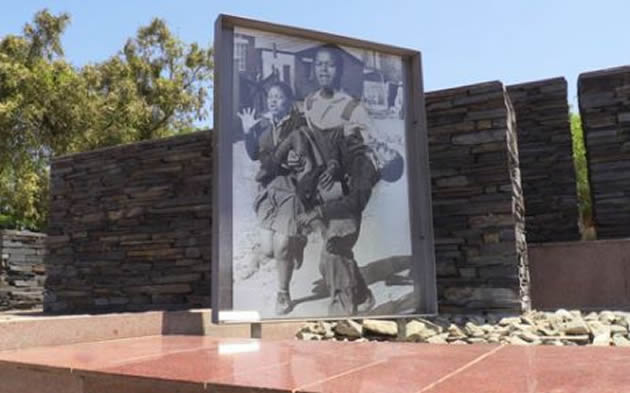
 Johannesburg — The day apartheid police opened fire on protesting black school children in Soweto on June 16, 1976 was commemorated in South Africa yesterday.
Observed as a public holiday, it recalls the day police shot at children marching in Orlando West to protest over Afrikaans as a medium of instruction in the then government’s “Bantu education’’ system.
Photographer Sam Nzima managed to capture the photograph of 17-year-old Antoinette Sithole running next to Mbuyisa Makhubu carrying Hector Pieterson, who, with Hastings Ndlovu, were among the first to die as police cracked down on any resistance by black people to laws which gave whites rights that other races were denied.
In 1996, Sithole testified at the Truth and Reconciliation Commission on events of the day.
“When we arrived at Pafeneng there was confusion. There were police. They threw us with teargas. We ran away and we hid ourselves,’’ according to a transcript of her testimony.
“There was a gun sound. There was teargas and there was confusion. I saw people hiding themselves and then I hid myself too. While we were standing there I then – I was afraid because I didn’t know where Hector has gone to and people were holding something. And then I moved forward and I couldn’t see properly, and I saw Hector’s shoe.’’
They were helped to a clinic by journalists, but Pieterson was already dead.
In the days that followed, government buildings were torched, police were stoned, and many black school pupils and political activists abandoned their lives and families in South Africa and left the country to escape the police crackdown, and to build a resistance against apartheid from neighbouring countries.
Yesterday’s commemorations included an address by President Jacob Zuma at the Tshwane Events Centre, an Economic Freedom Fighters rally at the University of Limpopo addressed by Julius Malema, and a rally addressed by Inkatha Freedom Party president Mangosuthu Buthelezi.
Democratic Alliance leader Mmusi Maimane was to be at the university in Nelson Mandela Bay for the party’s rally.
Meanwhile, the African Union also commemorates Youth Day across the continent as the “Day of the African Child”, President Jacob Zuma said yesterday.
“The AU designated this day in memory of heroism of South African youth on June 16.
“The day is used to highlight the rights of the African child,” he said.
He was speaking at a Youth Day event in Tshwane.
He said the organisation was working on intensifying efforts across the continent to end child marriage, including in South Africa.
“We add our voice to the continental call for an end to these practices which are harmful to women and children.”
He said the objective of the AU was to make the continent stable and peaceful.
“We want you to love each other as South Africans and Africans, regardless of race, colour, creed or mother tongue that one speaks.
“That’s the South Africa that many of our illustrious leaders such as Oliver Tambo and Nelson Mandela fought very hard to build. It’s the South Africa that you, as the youth, should build.”
South Africa hosted the 25th annual AU Summit in Sandton from June 7 to 15.
In Polokwane, Economic Freedom Fighters leader Julius Malema told a Youth Day rally yesterday that the 1976 generation did not fight for young people to be drug and alcohol addicts or engage in unprotected sex,
“The 1976 generation of youth never fought for the youth to smoke drugs and abuse alcohol, or for you to sleep with each other without a condom,” Malema told thousands of EFF supporters at the University of Limpopo’s Turfloop campus.
He told youths to arm themselves with quality education and revive the dream of the 1976 youth of better education and quality jobs.
“June 16, 1976 was about black people. It was about the restoration of the dignity of black people. It was about ensuring that black people occupy leadership responsibility through quality education,” he said.
Malema said signs of oppression still lingered, citing what he perceived as the dominance of the Afrikaans language.
“Today when you write examinations at Unisa, the question paper is written in English and Afrikaans, and that’s what the youths of 1976 said they didn’t want, it’s still dominating.”
“Afrikaans is still supreme,” he said.
He called on young people to “refuse the dominance of Afrikaans” because it was an ordinary language like all 11 official languages.
“That’s why in the national anthem, we must stop singing the Afrikaans version, because we don’t regard Afrikaans as a supreme language.”
He said changing names was a tool to liberate the country.
“South Africa will never be liberated unless we change the names.
“Most of you are saying what do we benefit, what’s it going to benefit us when we change the names? We want jobs, is neither here nor there.
“We fight for employment at the same time we must liberate the mind. They don’t want us to change the names of oppressors who killed us, saying it’s part of history.
“We don’t want to remember them.” — Sapa


 Online Reporter