

 admin
admin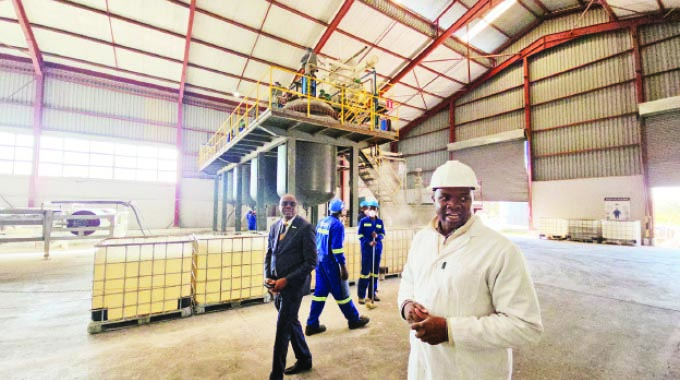
Wallace Ruzvidzo
Herald Reporter
As the SADC Industrialisation Week draws closer, Herald Reporter had an interview with Chilmund Chemicals’ director for business development Mr Nicholas Bhero (NB) on the company and its participation in the six-day event.
WR: Please tell us about Chilmund Chemicals?
NB: We are the main manufacturers of aluminium sulphate, which is the main coagulant that is used in water treatment. We started manufacturing on July 1, 2023 and our plant was then commissioned by His Excellency, the President, Cde ED Mnangagwa on October 13, 2023. Our plant has a capacity of producing 36 000 tonnes of aluminium sulphate a year and the local demand is around 20 000 tonnes. This means our production far outweighs the local demand.
WR: Since you are left with surplus after meeting local demand, are there any plans for export?
NB: We are now gearing towards the export market. We are so excited about the SADC Industrialisation Week because it speaks to the plans that we have; plans of expansion into the region. One thing that I will tell you is the technology that we have is the first of its kind in Africa and is the fifth in the world. There are no emissions at our manufacturing plant. We produce in environmentally sustainable ways and our product is non-ferrous. It means it does not have iron content and we are meeting global standards. We have a state-of-the-art laboratory, and every batch that we produce undergoes rigorous testing to ensure that the aluminium content is between 16 and 17 percent, in line with the global standards. We are the only company producing non-ferrous aluminium sulphate in the region, in Southern and East Africa, at the moment.
So you look at countries in the Southern Africa region, they are importing their product from China, Turkey, and other areas outside of Africa. Now one of the main challenges that they face is supply chain disruptions, for instance, there can be challenges at the ports of entry among other things. So, if we then can be supplying from Zimbabwe, it does not only strengthen regional integration and of course increasing our GDP, but it also helps availability and accessibility of chemicals. At the moment in Zimbabwe all the councils are adequately supplied and challenges such as water-borne diseases, for instance, cholera which has been causing havoc for long is a thing of the past.
Most local authorities procure the chemicals on credit. Accessing chemicals locally reduce the import bill which I also think is a plus to the economy in general.
RELATED STORIES
WR: And how has the operating environment been in Zimbabwe?
NB: We are truly thankful to central bank for the foreign currency, it has been helpful. We approached the Ministry of Industry and Commerce on a number of issues and they have had an open door policy, they have been very much willing to assist. When the Second Republic came into power and promoted the ‘Zimbabwe is open for business’ mantra, many people were apprehensive, but we just heeded to the call. We tried what we could and what we have seen is more than what we had anticipated.
The Government, to a greater extent has helped us and we believe they will continue helping us as we aim to expand into the region. We want to manufacture the raw materials locally. So, these are some of the plans that we have as Chilmund Chemicals.
We applaud the Second Republic’s policies and interventions that they are pushing. The President has an open door policy. If you have a sound business idea, he is willing to support, we invited him to officially open our plant and he came. There are a number of things that we wanted the Government to help us with, and they are still assisting us. The current infrastructure developmental projects are an enabler in doing business. Business is also about perception.
WR: Can you give us a brief on some of the social benefits that have come with the establishment of the plant?
NB: We are employing 150 permanent employees in Bindura and you if look at the ripple effect on the downstream industry, it means most of the things that we need to be running the plant, we are also buying from the local industry and this speaks to the Government’s position on devolution. We chose Bindura and their provincial GDP has also gone up as a result of some of the efforts that we are making. We are talking of quality product, we are talking of affordability, and we want every Zimbabwean and every individual in the markets that we are operating in to have access to clean and safe water.
WR: What does the company’s participation at the forthcoming SADC Industrialisation Week mean to you?
NB: We are ready to participate at the upcoming SADC Industrialisation Week. It gives us an opportunity to showcase what we are doing and we are hoping to meet stakeholders from SADC member states and discuss about possible collaborations. And as a Zimbabwean company, we are able to supply them with an alternative for their inputs; we offer quality products which are affordable. So it is something that we are really looking forward to, where we are going to cross-pollinate and engage with stakeholders, most of those who are in the water sector.



 Online Reporter