Online Reporter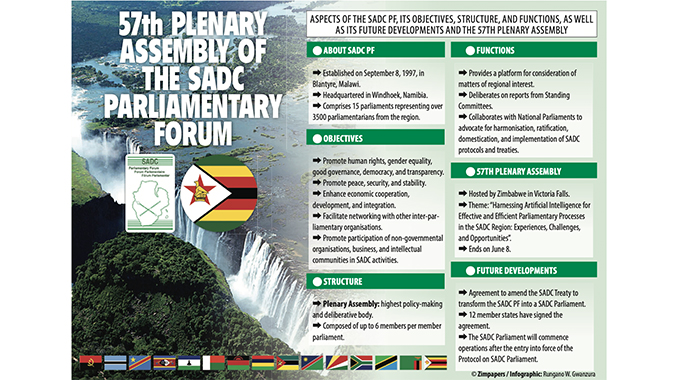
Gibson Nyikadzino-Zimpapers Politics Hub
THE SADC Parliamentary Forum (SADC PF) — a Southern African Development Community (SADC) institution — was set up in accordance with Article 9(2) of the SADC Treaty on September 8, 1997 by the SADC Summit of Heads of State and Government held in Blantyre, Malawi.
It is headquartered in Windhoek, Namibia.
The summit’s main objective for establishing the forum was to “constitute a regional parliamentary framework for dialogue on issues of regional interest and concern”.
Article 9(2) of the SADC Treaty establishes the principle of non-discrimination.
It declares that SADC and its member states shall not discriminate against anybody on the grounds of gender, religion, political beliefs, race, ethnic origin, culture, illness, handicap or any other reason determined by the summit.
This principle is critical for promoting justice and fairness in the community.
Currently, the SADC PF has a membership of 15 parliaments, representing over 3 500 parliamentarians from the region.
Only Comoros has no representation in the SADC PF.
At regional level, member states have deliberated to amend the SADC Treaty to transform the SADC Parliamentary Forum into a SADC Parliament.
At least 12 member states have signed the agreement to amend the SADC Treaty.
The composition, powers, functions, procedures and other related matters governing the SADC Parliament shall be prescribed in a protocol to be adopted by SADC member states.
The SADC Parliament will commence its operations after the protocol comes into force, with the SADC Parliamentary Forum ceasing to exist.
The agreement to amend the SADC Treaty was adopted by the SADC Summit of Heads of State and Government at its meeting held in Kinshasa, the Democratic Republic of Congo, on August 17, 2022.
Victoria Falls 57th Plenary Assembly
Zimbabwe last week hosted the 57th Plenary Assembly Session of the SADC PF in the resort city of Victoria Falls.
The plenary, held under the theme “Harnessing Artificial Intelligence for Effective and Efficient Parliamentary Processes in the SADC Region: Experiences, Challenges and Opportunities”, was officially opened by SADC chairperson President Mnangagwa.
It started on June 2 and was scheduled to end today.
Delegates attending the plenary have benefitted from visa-free entry, in accordance with regional integration protocols.
Special arrangements were made for a visa on arrival for others.
At the Victoria Falls session, key motions for adoption included reports from the Regional Parliamentary Model Laws Oversight Committee; the Regional Women’s Parliamentary Caucus; the Standing Committee on Gender Equality, Women Advancement and Youth Development; and the Joint Sitting of Standing Committees.
Objectives
The SADC PF seeks to bring regional experiences to bear at the national level to promote best practices in the role of parliaments in regional cooperation and integration, as outlined in the SADC Treaty and the Forum Constitution.
The institution’s main aim is to provide a platform for parliaments and parliamentarians to promote and improve regional integration in the SADC region through parliamentary involvement.
The objectives of the SADC PF address a wide range of issues such as:
Promotion of human rights, gender equality, good governance, democracy and transparency;
Promotion of peace, security and stability;
Hastening the pace of economic cooperation, development and integration on the basis of equity and mutual benefits;
Facilitating networking with other inter-parliamentary organisations;
Promoting the participation of non-governmental organisations, business and intellectual communities in SADC activities;
Familiarising the people of SADC with the aims and objectives of SADC; and
Informing SADC of the popular views on development and issues affecting the region
Plenary Assembly
The SADC PF has a Plenary Assembly, which is its highest policy-making and deliberative body.
It is composed of up to a maximum of six members per member parliament, consisting of the presiding officer and a maximum of five other members of parliament, selected by national parliaments to represent them at the SADC PF.
Among its functions, the plenary assembly, in its consultative and deliberative role as provided in Article 11 (5) of the Constitution, does the following, among others:
Provides a platform for consideration of matters of regional interest;
Deliberates comprehensively on the standing committee reports introduced by motion of the chairperson or any delegated member of that committee;
Through resolutions on the motions, adopts the reports of the standing committees. The resolutions are submitted to the SADC Secretariat and to relevant national ministries through national parliaments;
Collaborates with national parliaments to advocate for the harmonisation, ratification, domestication and implementation of SADC protocols, treaties and other decisions at the national level;
Considers and deliberates on any matters that will strengthen the implementation capacity of SADC;
The quorum of the Plenary Assembly meetings is made up of a simple majority of the member parliaments.