admin
admin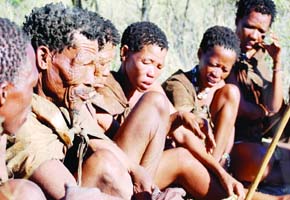
 Msilisi Dube
Historians assert that they were the first people to occupy much of southern Africa yet they have lived as aliens in their own land. In the last century, the San people have suffered much at the hands of other peoples. Known as the Bushmen, abaThwa in isiNdebele and Basagwa in Kalanga, the San inhabit remote areas of southern Africa, in Angola, Botswana, South Africa, Zambia, Namibia and Zimbabwe.
In modern day Zimbabwe, the San community is found in Matabeleland North’s Tsholotsho district and Plumtree in Matabeleland South where they have lived under the dominion of BaKalanga and Ndebele tribes for the past century.
Their leadership has bemoaned abuse by these tribes whom they accuse of undermining and treating them as outcasts. Their hunter-gatherer lifestyle has also set them against police who frequently arrest them for poaching.
Stricter enforcement of anti-poaching laws has cut their main source of livelihood, hunting forcing them to adapt to the prevailing circumstances. They are now a sedentary people like the traditional farming communities.
A recent visit to Mgodimasili Village in Tsholotsho this Christmas, revealed how their lifestyle and perception of their physical and social environment has changed. The village is situated less than 30 kilometres from Africa’s third biggest animal and bird sanctuary, Hwange National Park.
As we approached the park’s boundary fence, we heard noise emanating from what sounded like a stereo. After driving for less than a kilometre towards where the sound was coming from, it soon dawned on the news crew that the source of music was a small but powerful, solar-powered radio!
It belongs to Joseph Ndlovu. He was playing one of the hits of from Ndolwane Super Sounds.
Mr Ndlovu narrated how aloof they were as a community that moved from one bush to another in search of food. However, poverty caused by the law which criminalises their traditional hunting lifestyle, has forced them to associate with other communities, mainly as workers.
“The cattle that I rear belong to a person who is not a San. I got them through the system of kuronzerwa/ukusisela from some of the Ndebele villagers.
“We now share virtually everything. There is a need for us to live peacefully and work together with other communities because we are not hunters and gatherers anymore.
“As you can see I am listening to music. I was given this stereo by my son who works in South Africa. My forefathers never had this privilege, but life has changed,” he said.
Ndlovu said in the past, the San people used to disappear into the forest once a stranger arrived in their territory. However, this is a thing of the past now. They have developed a good rapport with the Ndebele communities in Tsholotsho, although they live in separate villages.
Most of the San now use cellphones in order to communicate with their families especially those who stay outside the country.
Early this year the San conducted the Bush Cultural Festival in their area in celebration of the recognition of their language in the new constitution. The festival was also meant to re-unite all the San people in Zimbabwe.
The event was held under the theme: “The Reunification and Revitalisation of the San Culture and Language: My Constitution, My Hope.” This is in line with the UN International Day of the World’s Indigenous People which is celebrated on August 9 every year to promote and protect the rights of the world’s indigenous people. They had an opportunity to showcase their culture through song and dance.
While the San people in Mgodimasili Village seem to have transformed and adapted to a few trends of modern life, they have held on to some of their ancient practices like dependence on traditional herbal medicines. Occasionally however, they visit modern health facilities.
During the Shangano Arts Festival which was held in Tsholotsho Business Centre in November, the San showcased their dancing skills.
An estimated population of over 2,000 San is found across the country.
In Tsholotsho San families are found in Wards 1, 2, 7, 8 and 10. For thousands of years San people have lived on hunting and gathering. Game meat and fruits were their staple food.
Now the San community survives on subsistence farming. However, hunger has been the order of the day because the area is not suitable for crop farming.
As a result of the creation of Hwange National Park in 1928 a majority of them was forced to give up their hunting and gathering lifestyle and become subsistence farmers and poachers.
A recent study by Unesco established that marginalised communities, including the San people of Southern Africa, still do not have access to formal education.
This makes it difficult for them to contribute to the economic development of their communities, countries and the region. According to Unesco, most of the world’s 370 million marginalised indigenous people — representing approximately five percent of global population — do not have access to education.
“This is despite the important role they play through their ecologically sustainable practices to protect a significant part of the world’s biological diversity.
“Today there are about 100,000 San people living in Botswana, Namibia, Angola, and South Africa, with small numbers in Zimbabwe and Zambia. Because of their hunter-gatherer lifestyle, today the San are living in extreme conditions and poverty and are struggling to adapt to a fast-changing world,” Unesco said.
David Ndlovu, the director of Creative Arts and Educational Development Association, an organisation promoting San language and culture, said there is lot to be done to promote San language and culture.
“Our major concern at the moment is that the Tshwao language is dying and something must be done to revive and preserve it. We have engaged the University of Zimbabwe to assist us with the documentation of the language.
“We want our culture to flourish despite the changing times.
“San children do not go to school because their parents cannot afford paying fees. I have asked their grandparents to teach them their language (Tshwao) so that they know it,” he said.



 Online Reporter