admin
admin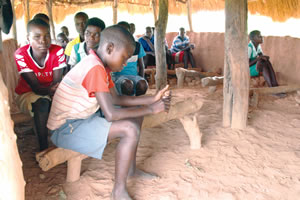
Yet they are determined to make it to Chibwezulu Primary School at the intersection of Karoi-Binga and Bumi Hills-Binga roads.
They are keen to learn whatever they can, a process that will hopefully see their area – an outpost of wildlife near the Zambezi River in the North West of Zimbabwe – develop and gain a modicum of national respect.
Having to walk to school in a wildlife-infested area is enough of a challenge, or rather menace, but the school environment itself is not one that would pass for modest or even decent.
Asked what the grass is for, one of the children says it is for building a “chinjausi” – changing house or specifically a bathroom – for the teachers.
It means, when the “chinjausi”, is constructed the teachers will no longer have to bath at night in the open to avoid the prying eyes of passers-by.
It also means they are safe from wild animals.
But this is not the worst part of the story.
Here is where the aphorism that teaching is a noble profession can easily be spat at.
Chibwezulu is a satellite for Siakobvu Primary School some 18 kilometers away.
A recent visit to the school by The Herald revealed a pathetic situation.
Located just metres away from the road, the school has its back to a wild bush where animals roam.
The five buildings that house the 115 pupils are a sorry sight of mud-and-pole structures.
The sides of the three-by-five-metre “classrooms” are open and unusable when it rains.
The roofs are thatched and at the time of The Herald’s visit the thatch was run down.
Only three of these structures have chalkboards, made in 2010 when some stipend from Campfire found its way here.
Children sit on wooden benches made out of rough poles from the bush.
Each classroom, if such structures can lay claim to such a term, houses two classes facing different ends of the room.
Staff living quarters comprise a single room attached to a Campfire-built pre-school shed, which is the only brick and mortar building.
It is also the only one with an asbestos roof.
This room – shared five male teachers, including the acting head, also serves as a storeroom and administrative office.
The community recently built a two-roomed cottage to be shared by the female teacher and the head.
The situation is bad and the teachers hope to see a brighter future here or get a better placement.
The acting head, Robert Siachimwaika said the school was built in 2005 to save children from walking long distances in this wildlife-infested area to the nearest school.
Dangers associated with walking to school have discouraged children from going to school.
“It is hard to be working under such conditions,” lamented Siachimwala, who has to live apart from his wife and two children.
“We need proper infrastructure such as teachers’ houses and learning blocks. The community is supportive but the biggest problem is of finance,” he said.
Campfire remittances have been a woefully inadequate as the school last received US$50 which they used to make chalkboards in 2010.
Endowed with only the strength of its hands, the community is almost powerless to make the desired difference they envision.
Luckson Zandu (46), who has three children attending Chibwezulu says the biggest problem is that of infrastructure.
The community will do everything within its power to better the school.
“If teachers request assistance, we always help.
“We are the ones that constructed the two roomed house and toilets. We have not been receiving much assistance from the outside world and our MP (Cleopas) Machacha never visits and we have not seen him since the last election.
“We receive some assistance from the Basic Education Assistance Module which pays fees for some children, and an organisation called Concern.”
The story of Chibwezulu Primary is replicated across the whole of Nyaminyami Rural District.
Chibwezulu shares the parentage of Siakobvu with two other satellites, Munamata and Chikuno.
Negande, Mola, Nebiri, Kasvisva, Chidyamugwamu, among other primary schools have their own satellites which are invariably underdeveloped.
MP Machacha conceded that he had not done much to improve the situation but will this year embark on classroom building at Manhanga, Kasvisva and Malembenja, subject to his securing funding.
Mr Machacha said he had used his Constituency Development Fund to build classroom blocks at Chidyamugwamu Primary, roofing a classroom block at Chalala Primary among other projects.
Government is concerned about satellite schools.
Deputy Minister for Education, Sport, Arts and Culture Lazarus Dokora said satellite schools are not a new phenomenon and represent the entry into education of previously deprived people.
“We actually encourage them but we would like to see them mainstreamed,” he added.
[email protected]


 Online Reporter