

 admin
admin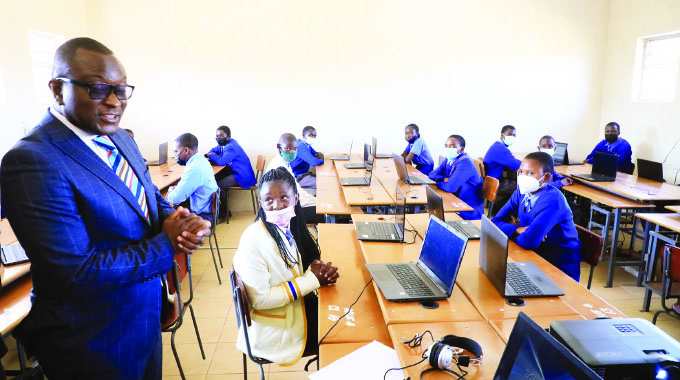
Farai Dauramanzi Herald Reporter
More Information Communication Technology (ICT) laboratories in schools will go a long way in helping pupils acquire the requisite digital skills, pupils and their teachers have said.
This came out yesterday during the launch of the programme in Harare metropolitan to provide an ICT lab in every school by the Ministry of ICT, Postal and Courier Services.
The programme is national and will be extended to all schools nationwide.
The labs are part of the country’s e-learning drive that is aimed at computerising, equipping, and connecting schools in line with the country’s aim of achieving a digital economy by the year 2030.
The first five schools cut across the range in Harare: Mufakose 4 High School, Queen Elizabeth High School, Mabvuku High School, Chikurubi Primary School and ZRP Support Unit College. Each of the five schools received 30 laptops, a projector, a printer, a whiteboard and Internet connectivity.
Speaking during the main launch of the programme that was held at ZRP Support Unit College, Minister of ICT, Courier and Postal Services Dr Jenfan Muswere said that the vision of the programme to put an ICT lab in every school is to develop ICT to a level such that it will serve as the backbone of teaching, curriculum development, innovation, research, administration, and service.
“The ICT lab per school project is one of the key projects which we are undertaking in our journey to become a digital economy. The digital economy is a national priority as espoused in the National Development Strategy 1 which was launched by His Excellency the President last year.
Digitalisation of the education sector allowed pupils to interact in real-time as well as to build digital literacy.
“Through the ICT labs, students develop questioning skills and become creative and critical thinkers, they become active seekers and users of information.
“Pupils become competent constructors of knowledge by using the ICT lab and its resources to find information that helps to solve problems and develop an understanding of the world and the worlds beyond their immediate experiences,” added the ICT Minister.
Minister of Primary and Secondary Education Dr Evelyn Ndlovu, who attended the launch, thanked the ICT Ministry saying that the labs will go a long way in helping students, especially during the continuous assessment learning activity.
“This programme has got a lot of benefits to our children as it will see them upgrade their skills and literacy in the use of technological gadgets that are being provided by the Ministry of ICT.
“The labs will also go a long way in assisting students when they do the continuous assessment component which requires them to be very innovative,” explained Minister Ndlovu.
Parents also thanked to the Ministry of ICT. School Development Committee chairperson at Queen Elizabeth High School Mr Mtombeni said that the donation of laptops to the school will go a long way in providing more computers at schools.
“We are really grateful as this donation will go a long way in complementing the computers that we already had. We had 53 computers against our pupil complement of over 900.
“Now with these 30 new machines, it means that we now have 83, which brings down the ratio to about 10 students per machine and we are grateful for that,” said an elated Mr Mtombeni.
Mr Norman Kuwatedza, the headmaster at Chikurubi Prison Primary School, said that the ICT lab per school programme was a move in the right direction as it will put pupils from all schools on the same footing in terms of technological advancement.
“This equipment will help our learners to develop their ICT skills and also to do their research. We are so pleased with these new gadgets and promise to keep them in a good state,” said Mr Kuwatedza.
Pupils were happy over the ICT lab programme. Francisca Mrewa, a Form Two pupil at Mabvuku High School, said that it was important for them to be exposed to digital technologies.
“We are grateful to the Minister for giving us the computers as this will make our research easier as well as enable us to network with other students.”



 Online Reporter