Vusumuzi Dube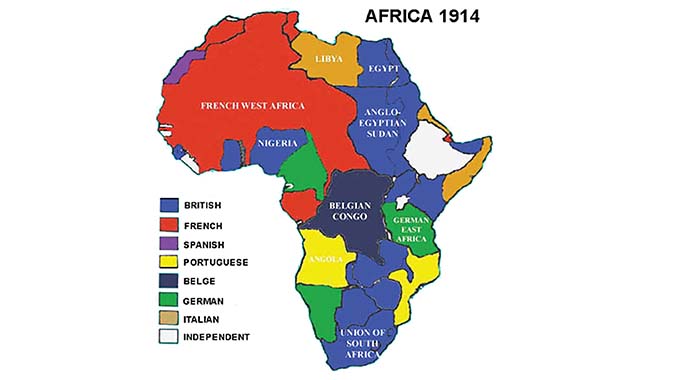
The word scramble refers to a competition between Europeans for territories in Africa.
The word scramble simply means rush for territories in Africa.
By 1900 most of Southern Africa had been invaded by foreign colonists. Africans were no longer free since they were ruled by foreigners in their own land.
Various explanations have been advanced to explain the rush by Europeans for colonies in Africa. These factors can be grouped into political, social and economic factors.
Economic factors
Robson and Galagher argue that Africa was occupied or colonised mainly for economic reasons.
Search for markets: It is said that as a result of technological advancement in Europe ,goods were produced in large quantities resulting in under consumption of goods.
Technological advancement led to overproduction of goods which led to too many goods chasing too few customers.
European countries such as Britain and France had to look for markets in Africa.
The need for raw materials
Various European countries were engaged in scramble of Africa in search for raw materials. Industrial revolution led to an increase in demand for raw materials.
The supplies for these scarce raw materials could not meet the demand so had to look for Africa.

This resulted in a great competition for raw materials such as gold ,rubber,cotton,vegetable oil, etc.
The discovery of palm oil in West Africa which was needed in Europe resulted in many European powers to develop a passion for colonies.
The discovery of gold and diamond in South Africa also made various European countries to develop passion for colonies in Africa.
New hopes were raised by countries such as Britain for other parts of southern Africa particularly present-day Zimbabwe where the second Rand was thought to exist.
Africa also provided cheap raw materials which were very important in European industries. Therefore various European countries such as Britain, Germany and Portugal developed a strong passion in Zimbabwe.

Search for investment opportunities: Investment of capital by 1900 became less profitable.
This forced many European finance capitalist to view Africa as a virgin land with lots of investment opportunities which could bring super profits.
The Rand gold fields and Kimberly diamond mines were so profitable that investments in mines doubled those in Europe.
This therefore explains why Africa was occupied by European powers.
Philanthropism, social reasons
Eurocentric historians believed that Africa was mainly colonised for moral reasons.
They argue that Africa was occupied as a way of bringing enlightenment to people of dark continent. Colonial historians argue that the whites were God sent to Africa to bring civilisation.
Eurocentric historians believed that Africans were primitive and barbaric.
Colonialists such as Cecil John Rhodes believed that colonisation was meant to civilise the dark continent.
Europeans argue that the occupation of Africa was a blessing. They wanted to spread western civilisation.
This is evidenced by the coming of missionaries in Zimbabwe e.g. London Missionary Society around 1850s. A schoolhouse at Inyati, Matabeleland North province was constructed and they taught Ndebele people.

Spread Christianity
Africa was regarded as a dark continent where witch craft, cannibalism and twin killing were practised.
Europeans wanted to abolish these evil acts. No wonder why we saw large numbers of missionaries coming in Africa in an effort to enlighten Africa.
Need to reduce population in Europe: The population of the industrialised countries increased rapidly.
The population led to food shortages and outbreak of diseases. In order to reduce population, Africa was occupied.
Political reasons
Most European countries rushed to Africa for prestigious reasons.
It is said that a European country that was regarded or considered to have many colonies was considered a powerful politically and economically.
Germany and Italy were eager to acquire colonies in order to increase their status. Individuals like Bismarck of Germany and CJ Rhodes occupied Africa for prestigious reasons. This is evidenced by Rhodes’ Cape to Cairo dream.
Need to maintain balance of power
Taylor argues that Africa was occupied because European countries were struggling for supremacy in Europe.
The emergency of powerful countries such as Germany upset the traditional power between Britain and France.
The defeat of France by Germany in 1871 led to loss of Alsace and Lorraine which left her seeking revenge elsewhere and compensation.

Strategic reasons
Historians argue that African territories were colonised because of their strategic value. It is said that Europeans wanted to occupy areas that was going to enrich themselves.
British occupied Suez canal ensuring that no other powers could control the sea route (Suez canal) to India.
This strategic value was occupied by Britain so as to further her interest.
Rivers such as Congo and Zambezi were regarded as of strategic reason’s hence this explains why Africa was occupied by large number of Europeans
Effects of scramble and partition of Africa
Positive: Development of transport system such as railway lines, roads etc. Establishment of social services such as schools hospitals and clinics.
Improvement of agricultural facilities (new farming methods, new crops etcetera etcetera). Introduction of education, Africans became literate
Negative: Loss of land. Europeans took over fertile lands leaving Africans in poverty.
Exploitation of resources. Europeans siphoned Africans’ resources sending them to their counties.
They developed their mother countries at the expense of Africans. Africans were forced to work in mines etc.
They were also forced to pay a plethora of taxes. Christianity divided Africans. Loss of political independence. Africans were now controlled by the whites .
Questions: “Africa was occupied only for humanitarian reasons” discuss; “Africa was occupied for economic reasons “ how’ valid is this assertion?
Manners Msongelwa is the president of History Teachers of Zimbabwe and a teacher at Camelot College in Kwekwe



 Online Reporter