Chronicle Editor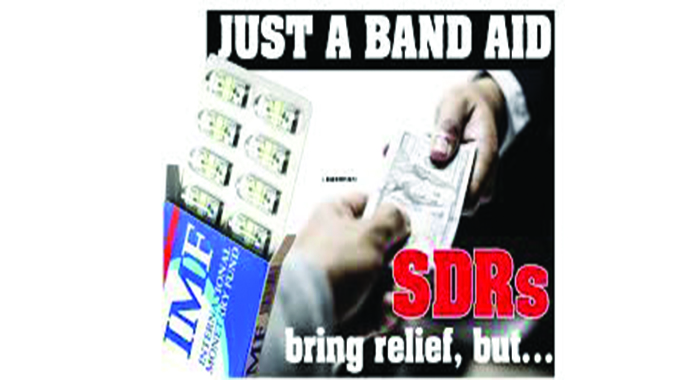
David Muchagoneyi
ON August 23, 2021, the International Monetary Fund (IMF) made a general allocation of Special Drawing Rights (SDRs) equivalent to about US$650 billion available to its members.
The 16 SADC member states have for now been allocated US$11.16 billion of this.
Allocations are based on a country’s stake in the IMF, meaning that rich nations ironically get more support from the institution than developing ones.
While governments have welcomed the allocation, observers have noted that US$650 billion is inadequate to revive economies hard hit by Covid-19 in light of estimates by the United Nations Conference on Trade and Development (UNCTAD) that the impact of the pandemic has cost the world trillions.
Such assessments had led a coalition of more than 220 organisations to lobby the IMF for a disbursement of at least US$3 trillion.
Of the US$650 billion that the IMF allocated, only US$275 billion – less than half the total disbursement – is going to poor and developing countries. Rich countries are sharing US$375 billion.
In addition, of the US$650 billion in SDRs, only eight percent of this money has found its way to countries that have high debt stress levels, at a time when the average public debt of Southern African states increased from 39.2 percent of GDP in 2011 to 55 percent in 2019.
Some commentators have thus said while welcome, the latest SDR disbursement is akin to treating a gunshot wound with a band aid.
Such realities have seen lobbyists calling for an overhaul of the international financial architecture.
Mr Tirivangani Mutazu, senior policy analyst at the African Forum and Network on Debt and Development (Afrodad) says key aspects of such an overhaul would include reworking the SDR allocation formula and the developing world’s debt situation.
“The amount of $650 billion is a drop in an ocean. UNCTAD in March 2020 estimated that the fight against Covid-19 economic, social and health impacts require estimated amount of between US$2.5 to US$3 trillion.”
This is something economist Mr Nick Beams (“IMF offers crumbs to poor countries”), has expounded on.
“Viewed within a longer term historical perspective, the IMF’s latest intervention via SDRs could well be described as the case of a criminal returning to the scene of the crime and seeking to expunge vital evidence.
“One of the main reasons health services in less developed countries are in such parlous condition and why debt levels are so high — constricting the spending on vital health services — is the impact of so-called structural adjustment programmes imposed on them in an earlier period by the IMF.
“First imposed in the 1980s and then continuing into the 1990s and the present century, countries that sought assistance from the IMF were required to meet strict conditions including the privatisation of public services, deregulation of financial markets and reduction of social spending, including on health.
“Between 1980 and 2014, 109 out of 137 developing countries had to enter at least one structural adjustment programme. A recent article by Adele Walton in the UK Tribune magazine pointed out that some 25 countries were spending ‘more on debt than healthcare, education, and social protection combined in 2019, meaning the intense strain of an international health care crisis has left swathes of populations without access to essential services and resources’.”
Nonetheless, the SDR disbursement from the IMF will offer some breathing room to struggling economies in Southern Africa.
SDRs are an international reserve asset created by the IMF in 1969 to supplement members’ official reserves and provide liquidity support; and their value is based on a basket of five currencies: the US dollar, euro, Chinese renminbi, Japanese yen and British pound sterling.
They cannot be held by private entities or individuals. IMF members do not have to meet any specific requirements to receive their share of an allocation and they have the right to use the SDRs for whatever they want.
In the history of the IMF, there have been three general allocations (1970-72, 1979-81, and 2009). In 2009 the SDRs were issued as a response to the global financial crisis and the IMF issued a total of US$250 billion worth of SDRs.
Once SDRs are allocated to a country, they are listed as reserves and are under management of the country’s central bank. While maintained in that state, they cost nothing, and bolster a country’s savings, thereby increasing its creditworthiness and perceived economic stability.
Afrodad’s Mr Mutazu advised African countries to spend the latest allocations on health and social services.
“There should be increased health spending – for tests, protective equipment, treatment and eventually vaccination and increased social protection spending to allow locked down citizens to survive financially and protect the most vulnerable,” he said.
He also called for transparency in use of the allocations, calling on national parliaments to play an oversight role on how governments use the money.
“A decline in budget transparency, participation and oversight can lead to the misuse of SDRs. Transparency and accountability in the use of public resources remains a major challenge in most African countries.
“Perennial issues of non-compliance to public finance management legislation, ie governments spending outside parliaments’ approval, is well-documented in auditor-general reports across Africa. Moreover, weak and politically compromised parliaments cannot effectively oversee the executive and the budget process.”
General SDR allocation to Southern African Development Community member states by the International Monetary Fund, effective August 23, 2021.
Angola – 709.4 (approx. US$1 billion)
Botswana – 189 (US$268.5 million)
Comoros – 17.1 (US$24.3 million)
DRC – 1021.7 (US$1.45 billion)
Eswatini – 75.2 (US$106.8 million)
Lesotho – 66.9 (US$95 million)
Madagascar – 234.2 (approx. US$332.8 million)
Malawi – 133 (approx. US$189 million)
Mauritius – 136.3 (US$193.6 million)
Mozambique – 217.8 (approx. US$309.5 million)
Namibia – 183.2 (US$260.3 million)
Seychelles – 21.9 (US$31.1 million)
South Africa – 2924.4 (US$4.1 billion)
Tanzania – 381.3 (US$541.8 million)
Zambia – 937.6 (US$1.3 billion)
Zimbabwe – 677.4 (US$962.5 million)


 Online Reporter