Sundaymail Editor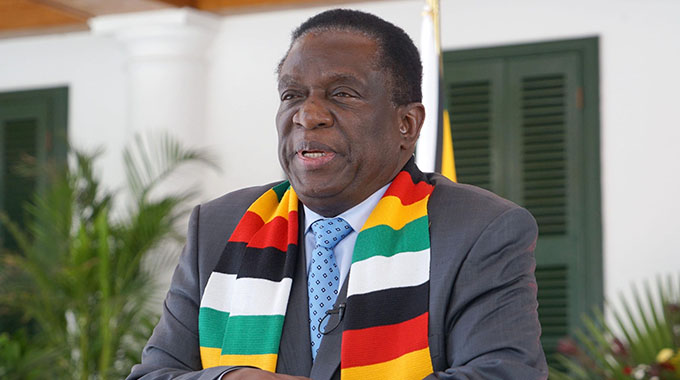
PRESIDENT Mnangagwa last week presided over the ground-breaking ceremony for the Gwayi-Bulawayo Pipeline in Nyamandlovu, Matabeleland North and commissioned the Epping Forest Water Supply Augmentation Project for the City of Bulawayo.
The two projects represent a remarkable milestone in Government’s quest to improve water supplies to Bulawayo and its surrounding environs.
The 245km pipeline will connect Bulawayo to the Gwayi-Shangani Dam whose construction is ongoing and is set for completion in December this year. The pipeline and dam are key cogs in the Matabeleland Zambezi Water Project (MZWP) which is slated to permanently solve water problems in the region.
Pumping of water is scheduled to start next year after the rainy season with the pipeline also set to be operational by then.
The Government allocated $535 million for the pipeline, which will be undertaken solely by local contractors and this will be drawn from the overall $4,5 billion set aside for the MZWP in the 2021 National Budget.
The Gwayi-Shangani Dam, which constitutes the first phase of the project alongside the pipeline from the dam to Bulawayo, is 40 percent complete with civil works stalled by the coronavirus pandemic .
The second phase of the project will see an extended pipeline being laid down from the Zambezi River to connect to the one at the Gwayi-Shangani Dam, completing a historic milestone and fulfilling a dream which was first mooted in 1912 by the settler colonial Rhodesian regime.
While successive colonial Governments failed to realise this dream despite stable economies and budgetary support from wealthy countries, the Second Republic has moved with speed to implement the monolithic project in less than three years in office.
Since independence in 1980, Bulawayo has been rapidly de-industrialising and this has been blamed on, among other factors, the lack of a reliable water supply. Bulawayo’s supply dams are located in the Umzingwane catchment area which is in Matabeleland South province — a region which is dry.
The city has over the years implemented a stringent water rationing regime to conserve its supplies and this has hit industry hard, precipitating a flight of companies to Harare with some firms even closing shop.
Once an industrial hub, the city has been reduced to a shadow of its former self but that is soon to change. With a holding capacity of 650 million cubic metres of water, the Gwayi-Shangani Dam will be the third largest inland dam in the country and sufficient to cover Bulawayo’s water needs.
On completion, the dam will convey 160 000 megalitres of water each day to Bulawayo — enough to meet the city’s water, sewer and reticulation needs and possibly leaving the other supply dams to cover the expected boom in population arising from increased economic activity.
The political will and budgetary support for the MZWP will change the fortunes of the entire Matabeleland region right from the Zambezi through communal areas of Matabeleland North to Bulawayo, the nation’s second largest city.
In addition to being a magnet for investors due to reliable water supplies, the region will be transformed into a greenbelt with communities in the vicinity of the pipeline benefiting from irrigation schemes set to be established.
Villagers from areas such as Lupane, Tsholotsho and Umguza will become food secure and prosperous as export-oriented rural industries sprout along the path of the pipeline.
As productivity increases, the livelihoods of the people of Matabeleland North will improve drastically with the heightened economic activity feeding into the wider national economy, resonating with the Second Republic’s commitment to equalising principles under the devolution and decentralisation agenda.
We, therefore, understand the excitement surrounding the accelerated implementation of the MZWP given the false starts and inertia which characterised past efforts to operationalise the project. The people of Matabeleland are obviously optimistic that this time the project will take off and proceed to completion given the Second Republic’s track record when it comes to developmental projects.
Dams, roads and other critical infrastructure are at different stages of construction in the country with notable examples including the Harare-Beitbridge Highway, which is being rehabilitated by local contractors, Marovanyati Dam in Buhera and Causeway in Marondera which were completed using local resources.
Progress on the Gwayi-Shangani Dam itself has been swift with President Mnangagwa assuring the people of Matabeleland North on Thursday that the MZWP will become a reality during his administration.
We expect an accelerated pace in the laying down of the pipeline from the local contractors. We implore them to emulate the professional approach of the contractors on the Harare-Beitbridge Highway who have not only excelled, but outdone themselves in the manner in which they achieved their targets.
By giving local contractors different sections on the pipeline, the Government is not only speeding up completion of civil works, but providing employment opportunities for communities.
We believe that the timelines for both the pipeline and Gwayi-Shangani Dam construction are feasible and achievable. All that is needed is unity of purpose from everyone involved.
In the words of President Mnangagwa, “no one and no place in our country should be left behind. There are no spectators in the projects which my Government continues to roll out. Our people must be organised as both participants and beneficiaries”.
Having clamoured for the MZWP for so long, the people of Matabeleland must guard jealously the infrastructure during the construction phase up to completion. They must protect it against vandalism and theft because it is for their benefit in the long run.



 Online Reporter