

 admin
admin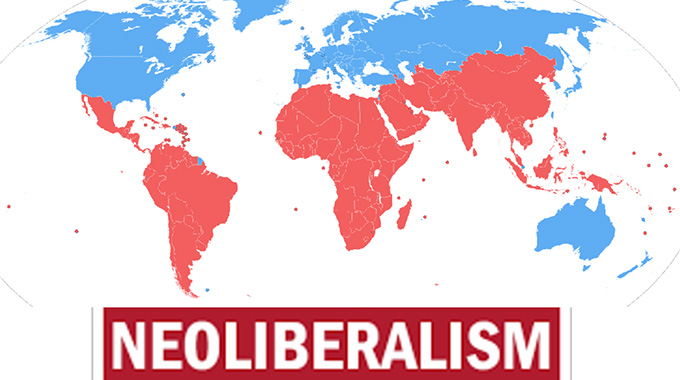
Tapiwa Muruviwa Herald Correspondent
Today, the United States and Britain are driving the neo-liberal tradition of exercising financial hegemony in loans.
Before I get into the details let me talk about industrial capitalism.
This is a different kind of capitalism that started in the 1800s in England and France. It was the power of industry that they produce goods, quickly sell and make a lot of profit.
That power of industry ended with the World War II, when Europe was bombed flat.
Europe was industrially flattened, and Japan was flattened.
Industrially, the only economy that was left was that of the US. It then started lending money to its allies in Europe and Japan, so that they can reconstruct their economies.
This was critical in the sense that it marked the foundation of neo-liberalism, its credit essentially.
In this dispensation, there is that issue that the majority of people tend to only reduce the whole discourse of neo-liberalism to free trade.
Neo-liberalism is not just about free trade, it is the new liberalism that emerged after the Second World War based on financial capital whereas before the world war it was based on industrial capitalism.
Liberalism worked hand in hand with the development of capitalism because it was about freedom of opportunity, rights to own land, capital and rights to own machinery.
Thus, it backed the development of industrial capitalism but then again neo-liberalism backed the development of financial capital.
These are the issues that need to be addressed and we got to get to the heart of these matters and address them.
Unluckily, this is never talked to people very much to what Critical Theory says.
There is need to reveal the truth to the people.
People need to know that neo-liberalism is about financial capital.
This theory is all about identifying the mechanisms of power; who has power, how did they have power and how does it operate.
In essence, it seeks to demystify and take away the veil that hides power.
The reason there is still domination is because people are confused and they have to know where the real power lies and it lies with financial hegemony.
Robert Cox (1981) gives an explanation on the origins and institutionalisation of global financial hegemony. Cox explained of the “new world order” dominated by the US and its allies.
This US-led financial hegemony has been institutionalised by the setting-up of international financial institutions known as the Bretton Woods Institutions which includes, the International Monetary Fund (IMF), World Bank (WB) and the World Trade Organisation (WTO) primarily to consolidate the global power of financial capital in the hands of the US and its allies.
Therefore, this became vitally important for it then set the trend for hegemonic power of financial capital in this contemporary global political structure
The IMF, WTO and the World Bank are financial institutions, they exercise their financial power through giving financial loans and credits, while advocating for free trade that is a global capitalist project that over and over again keeps post-colonial African states from becoming industrialised and accumulate financial capital.
African states are disciplined into doing what global capital need that is raw materials.
Any attempts for Africa in particular Zimbabwe to industrialise competitively are ever going to be sabotaged by the financial power of the US and Britain that is consolidated through the financial institutions.
With the advent of neo-liberal power in Zimbabwe in 1990, Government was forced to adopt the structural adjustment programmes with a series of conditions which compelled the country to adopt neo-liberal practices.
The adoption of the structural adjustment programmes as an external agenda had marked Zimbabwe’s incorporation into the global economic and political system.
The element of hegemony involves not simply power dominance, but also the hegemonic exercise that seeks to secure the global consent and acceptance of ideas.
Zimbabwe like all other post-colonial African states has had been incorporated into the global economic and political system through its adoption and acceptance of institutionalised neo-liberal policies championed by the IMF and World Bank, to consolidate the global hegemonic power of financial capital in the hands of the United States and its allies.
Her meaningful industrialisation was immensely constrained by the hegemonic power of financial capital that time and again undermines its economic and political independence and triggered the country to be more dependent on the primary exportation of raw materials to the industrialised nations.
Financial loans and credit to Zimbabwe continually upsurge the level of indebtedness additionally dipping the economy into a debt trap.
Ultimately, this is the predicament of Zimbabwe and the above sentiments clearly demonstrates how dominated states are paralysed within the context of the global economic and political system, and deprived of the ability to make independent policy choices.
This, therefore, undoubtedly illuminates the inexorable effect of global neo-liberalism over the post-independent Zimbabwe.
Nonetheless, these expected economic predicaments will ultimately give impetus for the development of counter-hegemonic movements predominantly from the dominated economies.
To make things easier, another element of Critical Theory is that, it is about clarifying the mechanisms of power to create change.
It advocates for a quest for autonomy for self-determination of subordinated economies from the constraints and the continued suppression by the dominant financial powers.
From this, the unprecedented work being done by the Second Republic under the indispensable leadership of President Mnangagwa, and I invoke the pillars Vision 2030, is a manifestation of the attempts to manoeuvre the effects of global neo-liberalism.
A number of commitments made by President Mnangagwa to elevate the Zimbabwean economy are fully lived up to.
There is a commitment by the President to look at how value addition for commodities can positively impact economic growth in Zimbabwe.
At hand, there was a strong emphasis from President Mnangagwa on the need for all captains of industry and all those in the mining sector to augment value addition and diversify exports as a viable avenue to prevent Zimbabwe’s continued reliance on the exportation of raw materials.
Today, action is flowing, Zimbabweans and the world at large are observing the talk of value added exports being walked.
I immediately recognise and applaud many initiatives that have been put on the table, up to date, President Mnangagwa has among others commissioned mining plants that have already installed the capacity for value addition and beneficiation the Chinese Sinomine Resource Group in Bikita and the Unki Mines smelting plant in Shurugwi.
These are all visible and unshakable commitments by the Second Republic to position Zimbabwe on a pedestal of prospects to manoeuvre and pursue a more independent economic and political counter-hegemonic project in the global economic system.
A vibrant industrial and manufacturing sector will position Zimbabwe on a pedestal towards an industrialised economy.
To fully attain the objectives of the Vision 2030, we as Zimbabwe must work together pressing towards the mark, and as the President always say “Nyika inovakwa nevene vayo”.
It must be emphasised that an industrialised and modernised Zimbabwe will gradually counter the effects of global neo-liberalism.
Tapiwa Muruviwa holds a Msc Political Science (UFH), Bsc (Hons) Political Science (UFH) and a B.A International Relations (Univen). He is a PhD candidate at the University of Zimbabwe.
Feedback: Email [email protected]



 Peter Tanyanyiwa
 Online Reporter