Online Reporter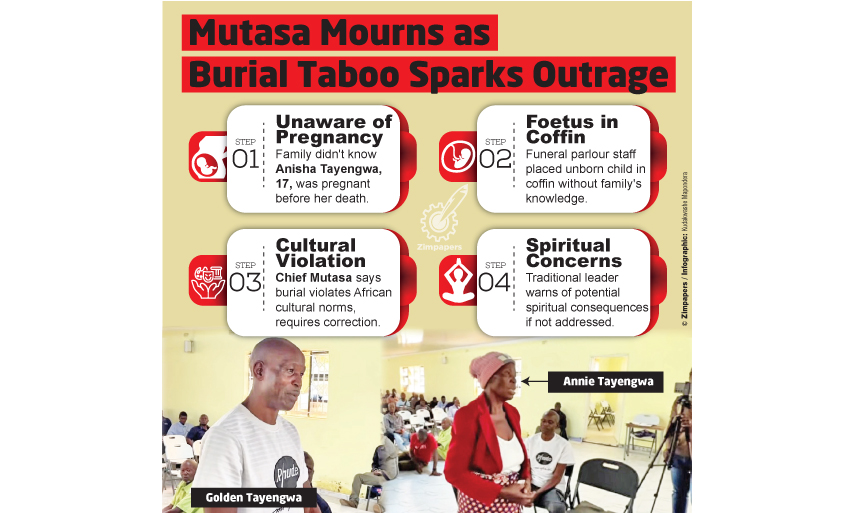
Tendai Gukutikwa
Weekender Reporter
A MUTASA family has come under scrutiny from traditional leaders after burying their teenage daughter, Anisha Tayengwa, together with her unborn child in a single grave—an act considered a violation of cultural norms.
Anisha, who was pregnant, died in Harare, and was later buried in Mutasa. Relatives say they only discovered after the funeral that the foetus, removed during a post-mortem, had been placed in the coffin with her by the funeral parlour.
The matter has since been brought before Chief Mutasa’s community court, where the family is seeking cultural and moral guidance.
Traditional leaders have warned that the burial arrangement could invite misfortune if not addressed.
Anisha’s aunt, Annie Tayengwa, explained that the family was unaware of the circumstances surrounding her niece’s death.
“We had a funeral after my niece died in Harare. Her father, Golden, brought the body home for burial. We did not know she was pregnant, nor that a doctor had removed the foetus and placed it in the coffin,” she said.
The family believed the coffin contained only Anisha’s remains.
However, a week later, funeral parlour staff contacted them with shocking news.
“They told us there were two corpses in the coffin and asked if we had been informed. That is why we reported the matter, because we were never told,” Annie added.
The revelation has sparked tension among relatives, with some accusing Golden of withholding crucial information during the funeral arrangements.
Golden, however, insists he was equally unaware that the unborn child had been placed in the coffin.
“I did not know that my child was pregnant. She got sick while I was at work and died on her way to the hospital. The following day the post-mortem results revealed that she was pregnant, and that the doctors would remove the foetus,” he said.
Golden said funeral parlour staff briefly showed the family the foetus after it had been removed during the post-mortem procedure, but did not tell them whether they had put it in the incinerator or in the coffin.
“At the parlour they showed us the foetus, but they did not ask us what they were supposed to do with it. We also did not ask where it had been put,” he said, further explaining that the family was under immense pressure during the funeral arrangements, and burial was rushed after the body arrived late at night.
“We got to our rural home around 2am. She was hurriedly buried later that morning because people had gathered for the funeral for far too long. We did body viewing, but we did not check whether the baby was inside or not,” Golden said.
Golden also described the pain of losing his daughter, who had just completed her secondary school examinations.
“She was only 17-years-old and had just written her Ordinary Level examinations. In fact, the released results showed that she had passed, and I am still in pain,” he said.
For the grieving father, the news that his daughter had been buried together with the foetus came as another painful shock.
“I only heard about it later when other relatives were told by the funeral parlour. I did not know what had happened with the baby,” he said.
The case attracted strong criticism from Chief Mutasa, who said the incident violated African cultural norms surrounding death and burial.
The traditional leader said the situation needed urgent correction.
“It is un-African what you did. This might keep happening in your family. You could have cursed yourselves by doing what you did,” said Chief Mutasa.
According to the chief, cultural practices require that the unborn child be buried separately from the mother.
“A child should never be buried in the same grave as the mother. There are traditional procedures that must be followed in such situations to ensure peace for both spirits,” he said, further questioning the actions of the mortuary staff who prepared the body.
“Even the mortician did something wrong if they indeed did that without your knowledge. This is no longer just a customary matter, it may also have criminal implications,” said Chief Mutasa.
The chief said placing the foetus between the legs of the deceased without informing the family raised serious ethical concerns.
“Why would the baby be put between the legs? That now becomes concealment,” he asked.
Chief Mutasa warned that failure to address the issue properly could lead to spiritual consequences according to traditional beliefs.
“If it becomes an avenging spirit, it will be devastating for the family. You need to correct this,” he said, advising the family to seek guidance from elders and spiritual leaders to determine the proper cultural procedures required to rectify the situation.