Thupeyo Muleya, Beitbridge Bureau
AN hour’s drive southwest of Beitbridge town will lead one to Sentinel Eco Safaris, where the country’s component of the Greater Mapungubwe Transfrontier Conservation Area (GMTFCA) begins.
This is not just another safari lodge. It is a living museum where wildlife, human history and prehistory converge.
The Greater Mapungubwe TFCA is a tri-national conservation initiative made up of national parks and private conservancies in Zimbabwe, Botswana and South Africa. In Zimbabwe, it covers parts of Gwanda and Beitbridge districts along the Limpopo and Shashe Rivers.
For over five decades, this area has been home to the Bristow family. What they have preserved could become one of Zimbabwe’s most significant tourism drawcards.
The family has known about large dinosaur fossil beds on the property since 1950. Today, at least 15 known sites have been documented on Sentinel Eco Safaris, with researchers saying there are likely more still to be discovered.
The sites are dated between 237 million and 190 million years old, placing them at the very dawn of the dinosaur era.
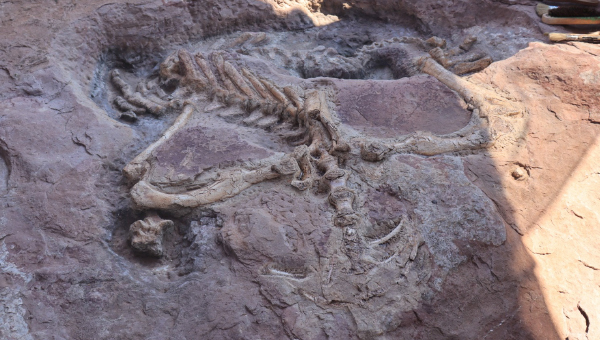
One of the most important sites was discovered around 1993 when a member of the family stumbled upon clearly visible vertebrae, ribs, pelvis, and leg bones in their sandstone sarcophagus while walking on the farm with friends.
The safari itself is rich in fauna and flora. It boasts over 400 recorded bird species, vast Mopani woodlands, Mapungubwe heritage sites, and Middle Stone Age archaeological sites that are more than 750 years old.
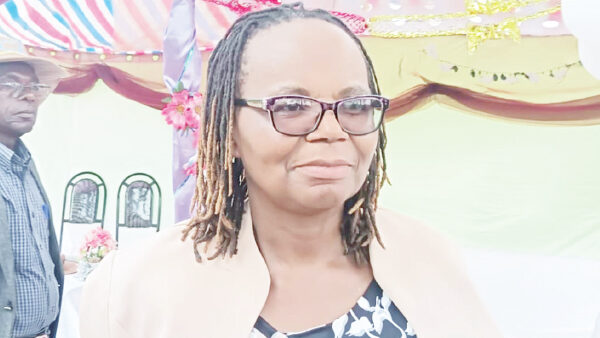
Mrs Vanessa Bristow, managing director of Sentinel Eco Safaris, says the area deserves far more than its current low profile.
“My late husband and I have been running safaris on Sentinel Eco Safaris since the 1980s, and we now collaborate through the CAMPFIRE programme with the communities in three neighbouring wards,” she said in a recent interview.
“There are 150 beneficiary families on Sentinel, and they are working towards creating a private trust, which will go a long way in preserving wildlife and the natural heritage that Sentinel has.”
She said the greatest threat to the heritage remains mining activity in the valley, but the family remains hopeful that the natural endowment will be preserved.
“Of course, our biggest concern is always what mining is taking place near the area. But we really hope that Sentinel will be preserved for the magnificent natural heritage that we have, and the archaeology and the palaeontology,” said Mrs Bristow.
“We have a wonderful variety of wildlife with many species of mammals; over 400 species of birds in the Limpopo Valley itself that we’ve recorded here. So, it’s quite a destination.”
Mrs Bristow said the history of palaeontology in the Limpopo Valley was very long and that the first
Massospondylus fossils were discovered in the 1960s, if not earlier, on the riverbank.
What makes the 1993/1994 find exceptional is its condition.
“This particular fossil was found in about 1993. And it’s of particular value to palaeontology because
it is articulated. It’s lying as it died,” she explained.
“Even though it’s not a complete fossil, the upper rib cage, the forearms, the neck, and the head are
missing. They might have died under the substrate; it could also have washed away; they could have been eaten. Nobody knows.
“But the fact is that the piece that remains there is articulated, and it gives an enormous amount of information to palaeontologists on how these animals moved, how they lived, what they ate.”
The specimen has been identified as a prosauropod, an early form of sauropod.
“It had a very tiny head about the size of a fox terrier but a very long neck and very robust hind legs.
In a lot of the early specimens that went to museums, they were portrayed as four-legged species, but subsequently it’s been determined that they were two-legged,” said Mrs Bristow.
“So, we call it a prosauropod. The Massospondylid family of sauropods was one of the first land-living dinosaurs on earth, and it goes very, very early back in dinosaur history.”
She said the dinosaur naturally had a great appeal to young people and that they usually host educational trips and group visits of young children and adults who want to learn more about dinosaurs.
That scientific value is what the National Museums and Monuments of Zimbabwe is now working to protect.
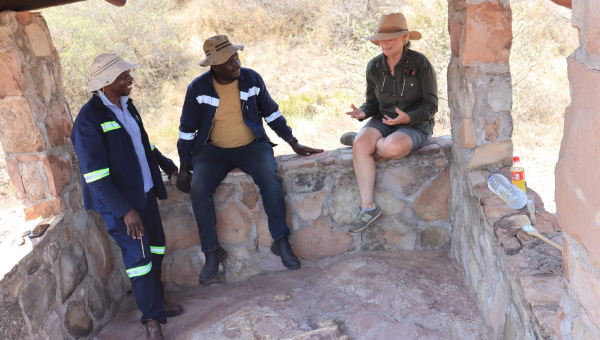
Mr Michel Zondo, curator of palaeontology at the National Museums and Monuments of Zimbabwe, was recently at the site leading preservation work.
“We are here as Natural History Museum Palaeontologists to preserve and conserve this specimen that was found in the early 1990s here. It’s quite a rare specimen and important to us as a country,” said Mr Zondo.
“So, as the Natural History Museum, we are mandated to make sure that these are preserved for us here and for the generations to come. They are important for us as people of Zimbabwe for education, for tourism.”
He explained how the fossils survived millions of years.
“Sediments, rapidly covered by sediments such that oxygen will be excluded and they are compressed over many years without any exposure, and there is heat that will result in that, in the process of mineralisation, the infiltration of those minerals into the bone. So, after many millions of years they become fossils,” added Mr Zondo.
The bones also hold lessons about climate change and mass extinction, linking the distant past to current global concerns.
“Here, on this rock, we have fossils of the Sauropodomorph dinosaur, which we keep preserving. Its timespan ranges from 237 million years ago (Triassic) to 190 million years ago (early Jurassic). So, we basically want to preserve this site for future generations, and it’s a site that is good for educational tours, geological studies, and tourism development,” said Mr Zondo.
“We should be proud of this kind of heritage, which we must continue to preserve. These things are critical as we examine the paleoenvironment. They tell us a lot about what this area was before and the changes it has gone through. They tell us if there were rivers and their direction of flow, among other things.”
For Mrs Bristow, the next logical step is a museum right in the GMTFCA.
She wants to have a museum built in this area because Sentinel has more than just palaeontology.
“To have a museum built in this area because we not only have the palaeontology, we have the archaeology. Mapungubwe is just across the river, but we have a lot of Mapungubwe-related sites, and there have been generations of African peoples living on the banks of the Limpopo River, in different societies. So, we have an enormous amount of archaeological material,” she said.
“We also have paintings in the hills here. Exceptionally beautiful and unique Bushmen paintings. And these are all coming together as part of the marketing programme for the Greater
Mapungubwe TFCA in Zimbabwe.”
Mrs Bristow believes dinosaurs can be a gateway to science.
“Dinosaurs really capture the imagination of young children, and if we can expose young children to fossils like this and get them interested in the sciences, in palaeontology. There’s a massive movement; there’s an opportunity here to get our own children, our Zimbabwean children, schooled in the sciences and in geology to enhance the study of palaeontology in this country,” she said.
As the tourism sector continues to evolve and grow, it is clear that investment will play a critical role in shaping its future around Beitbridge District.
If fully realised, Sentinel’s fossil beds could anchor a new tourism circuit for the GMTFCA, drawing domestic learners, regional researchers and international tourists, who would otherwise fly past Zimbabwe for South Africa’s Mapungubwe National Park or Botswana’s Northern Tuli Game Reserve.
The bones have waited 200 million years. The question is whether Zimbabwe will now turn them into a sustainable future.