

 admin
admin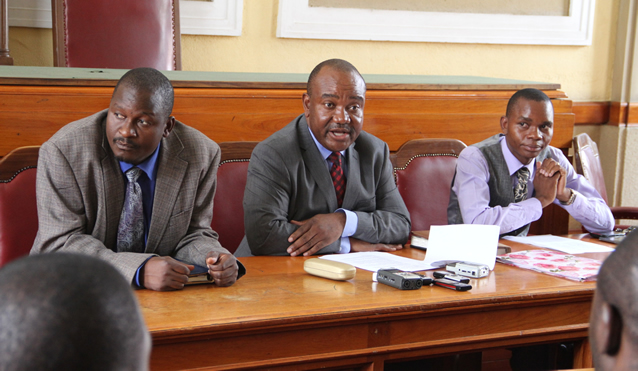
Fortious Nhambura The Interview
Poor service delivery, a crumbling road network and raging pay disputes have characterised the city of Harare over the years. People often wonder whether the good old Sunshine City will ever come back. On Thursday, Harare mayor suspended town clerk Dr Tendai Mahachi on allegations of failure to execute his duties. Our Senior Reporter Fortious Nhambura (FN) spoke with Harare Mayor Councillor Bernard Manyenyeni (BM) on the city’s woes and other issues.
FN: Mayor Manyenyeni, can you briefly tell our readers your experiences as the new mayor of the city of Harare?
BM: It has been a mixed bag. No two days are identical in terms of what you get. So far so good, but a lot needs to be done for the city. I don’t work directly with the directors but with the town clerk. I respect his territory. If there is no performance he has to account. I respect the line of command. Yes, the pace has not been fast enough for my liking but we are managing. Coming from business I want things done and on time. I tell you if you ask me the executive salary of company A, I will ask you if you want it printed or on email and it doesn’t take two minutes. That is not the case with council.
FN: What are your plans for Harare? What is being done to ensure that the city improves service delivery?
BM: My plan is to continue where the previous council left off in stopping further decline in key service areas and identify space to improve the city. The city is currently working on improved financial performance which is where our salvation lies. We are going to do what we possibly can given the current financial constraints. The council does not have enough money to attend to the pressing issues like water, sewer and refuse collection but we are trying our best. In the absence of long-term money, we need to perfect our financial performance.
FN: And how are you going to do that?
BM: The city needs to stop leakages, identify non-performing assets such as housing properties, people are simply not paying, they are paying well below markets. Council assets generally are not at market rates. The difference is where they are and where they should be. We need to close that gap.
FN: You have just suspended town clerk Dr Tendai Mahachi for failing to provide the salary schedule as per council resolution. What do you intend to achieve by this move?
BM: The suspension will provide us with an opportunity to look at the management of the city. It will give us an opportunity get information on the manner the city is being run. Dr Mahachi failed to properly discharge his duties in terms of Section 136(1)(a) and (b) as read with section 136(2)(d) and (e) of the Urban Councils Act. He refused, failed or neglected to provide despite request, the salary and benefits schedule of all Harare City Council senior employees including his own schedule.
FN: Some people are saying you have jumped the gun and rushed to suspend the town clerk which is outside your jurisdiction. To whom does the town clerk report? Who employs the town clerk?
BM: I refer you to section 139 of the Urban Councils Act 29:15. Paragraph 3 says “If it appears to the mayor or chairman, as the case may be, that the town clerk of the council has been guilty of such conduct that it is desirable that the town clerk should not be permitted to carry on his work, he — a) may suspend the town clerk from office and require him forthwith to leave his place of work; and (b) shall forthwith notify the council or, in the case of a municipality, executive committee, in writing, of such suspension and cause the suspension to be reported to the council at the first opportunity. I am acting within my jurisdiction. Mind you this is a suspension and investigations will be done.
FN: Are you not being driven by politics? Was the minister of Local Government aware of your decision before its implementation?
BM: Yes, I am talking to the Minister of Local Government. He was notified of the decision. This has nothing to do with the political party I belong to. It is a purely professional decision. There is nothing personal or political. Actually, the person I report to at the party only got to know of the news of the suspension of the town clerk at 3 O’clock when the announcement was done in the morning. Dr Mahachi must be treated with respect and all fairness. He is innocent until proven guilty. Let’s not politicise his suspension.
FN: Clr Manyenyeni, you are on record complaining about the calibre of management at the city council. What in your opinion should be done to improve management at Town House?
BM: I am for improved quality all round. People (including residents, managers, employees, elected officials, residents associations, the ministry and other stakeholders), our system, the pace and the laws need to have a changed mindset. We need a fresh look at issues. These are not ordinary times and the mode of doing things must change if we are to see an improvement in service delivery at Town House.
FN: Your managers are getting huge salaries and perks and the parent ministry has ordered that they be reduced. What is being done about the bloated management structure at the city?
BM: We are working flat out on the cost of leadership at the city and hope to present a new picture much sooner than you expect. We are even finalising the rationalisation of the management structure, but we believe we cannot just reduce the number of directors and remain with seven or more managers under the few directors. Still more money will be lost in the process of trimming the bloated structure. We also don’t want to compromise operations. It is not about the directors alone but it’s a fuller picture that we are looking at. The whole system requires rationalisation. We have not targeted anyone but the recommendations will give us the direction to take.
FN: There are allegations from some quarters that you could be enjoying the chaos at Town House because your party (MDC-T) has predicted that in a few months Zimbabwe will be ungovernable. What is your comment?
BM: I don’t want to be a mayor of an ungovernable city. We are not politicking about a city in a crisis. None of my political leaders have given me directions around making the city fail. They want a city which meets residents’ needs. Even our political opponents accept that there is no benefit in destroying the city in order to control it. I see more cooperation across the board than confrontation if the first few months are anything to go by.
FN: Promises have been made that the city will soon embark on road reclamation and pothole filling but no significant progress has been made so far. Is the council lying to residents, what is delaying you?
BM: We are serious with the project. The pothole patching programme has commenced and the main roads are being attended to as we speak. I know this is still short of expectations. I am very close to the situation and have been to a number of badly affected areas like Glen Norah, Tafara, Dzivarasekwa and Mbare, it is not good. All our roads are in dire need of refurbishment. We have a big deficit to catch up on. We need to start afresh. The only advantage is that we are not constructing new roads. These roads need a fresh overlay of tar. We are only doing the hubs, the main roads where you can do the 60 kilometres an hour. We are not going into your Muriranyenze and Mutswi Street in the locations yet. That will be our next stage. You have heard about the US$400 million project and if it is perfected it will give a more complete solution to the road network. If it fails we will go back to the drawing board to look at ways of raising capital for the project.
FN: Another thorny issue is that of refuse collection. Why is it difficult for council to frequently collect garbage? What is council doing to ensure that the service normalises in the city?
BM: We now have the vehicles to provide weekly collections and they are ward-based which is great in terms of local actions and focus. The vehicles are numbered by the ward. This allows us to localize operations. But when there is a crisis we then we marshal the resources to one area. We however run out of fuel very often. In fact we are struggling between paying the worker, servicing other debts and getting fuel for refuse collection. There are plans to increase the number of refuse vehicles per ward but if you ask me I would rather have money for fuel and not increase the number of trucks. We need 20 000 litres of diesel per week and sometimes our cash flows do not support full supply. It is all about cash. Increasing the number of trucks per ward yes but I would rather prefer a situation where we increase the amount of fuel we allocate to the trucks.
FN: Harare is collecting lots of money from rates but still it cannot pay its workers, leading to periodic strikes that are affecting service delivery. Your Worship, when are we going to see a stabilisation of salaries at Town house?
BM: To use the words “lots of money” is subjective. It depends on the context. Yes, we do collect a significant amount of revenue; about US$12 million per month but we have huge expenses. We also have a huge wage bill that is eating so much into the inflows. We are currently working on the human resources salary review and we expect a more affordable solution in the next five weeks. The relevant committee is empowered to make proposals to full council on that matter.
FN: I understand you have been using the car left by ex-Mayor Masunda. Will you accept a new official car if you are offered one by council?
BM: Yes, I am using my predecessors’ vehicle. The car was actually left by Mayor Makwavarara and later used by Mayor Masunda and I have no problem with that. A new vehicle is in the budget of course but I have had issues about the cost, particularly now with serious shortfalls in service areas. The Minister of Local Government, Public Works and National Housing has accepted my view and offered a compromise which won’t haunt my conscience. The mayoral car is not a priority for this city or for the mayor.
FN: But Mayor, is this not one of the perks of being the Mayor of Harare, why are you refusing it? Are you not playing to the gallery here?
BM: I am comfortable with any car. If they want it to be a Mercedes Benz let it be second-hand for US$20 000 for an E Class. We can import such a car from Singapore. If it has to be a brand new car, why not get a Jaguar for $60 000 and people won’t be affected much by this.
FN: There are allegations that when you came into power you promised tenders to your friends and that is affecting progress in the city. What is your comment?
BM: Not a single individual or company can claim to have been offered any contract of any sort by this mayor. If you have any names I will be happy to hear them. The mayor does not give contracts and jobs. Even before elections at ward level my supporters will tell you that I repeated enough times that I was not going into town council to give them jobs.



 Online Reporter