Theseus Mauruki Shambare, Features Writer
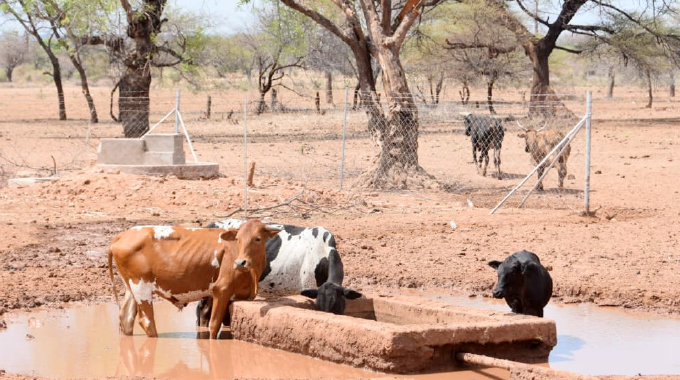
A SEVEN-CATTLE loss is a painful lesson for any livestock farmer, but for 56-year-old Albert Chidyambwizhu of Chidodo Village in Mbire, it has become a reason to prepare differently for the next drought.
The 2023/2024 El Niño-induced drought wiped out seven of his cattle, leaving him with 10 animals and a determination to avoid a repeat of the experience as Zimbabwe braces for another potentially difficult agricultural season.
As rainfall declined and grazing land deteriorated, his animals struggled to find sufficient food.
The pastures that had sustained his herd could no longer provide the nourishment they needed, and seven eventually succumbed to starvation.
His experience unfolded against a growing national livestock crisis.
On December 11, 2023, the Directorate of Veterinary Services reported that 4 744 cattle had died due to drought-induced poverty across Zimbabwe, as deteriorating grazing conditions and dwindling water sources threatened livestock-dependent livelihoods..
Estimates during the 2023/2024 drought indicated that up to 2,8 million cattle across the country were at risk of starvation and dehydration.
For Chidyambwizhu, these were not simply national statistics. They represented the same hardship unfolding in his own kraal.
Seven is often associated with completeness — there are seven days in a week and seven colours traditionally identified in a rainbow.
But for the Mbire farmer, the number represents the cattle he could not save during a season when the land failed to sustain his herd.
Today, with 10 cattle remaining, he is determined to approach the anticipated 2026/2027 El Niño-influenced agricultural season differently.
“I lost seven cattle to hunger; this time, I want to be prepared,” he said.
The loss went beyond the animals themselves. In rural communities, cattle are among the most valuable assets a household can own.
They provide draught power for cultivation, manure for fields and, in some households, milk and other products.
They can also be sold to meet pressing family needs, making them a form of savings accumulated over several years. When drought kills cattle, it takes away more than livestock.
It strips families of productive assets, weakens their capacity to cultivate land and undermines their ability to recover when the rains return.
During the previous drought, Chidyambwizhu also witnessed farmers being pushed into distress sales as their animals weakened.
Some cattle were reportedly sold for as little as US$80, with owners accepting whatever they could get rather than risk losing the animals to starvation.
“I do not want to find myself in that position again,” he said.
His preparations are now focused on securing supplementary feed while crop residues are still available, instead of waiting until natural grazing has been exhausted.
It is a significant shift in how he views the post-harvest period. Materials left in fields after grain collection, which may previously have been regarded as waste, can become an important resource for sustaining livestock through the dry months.
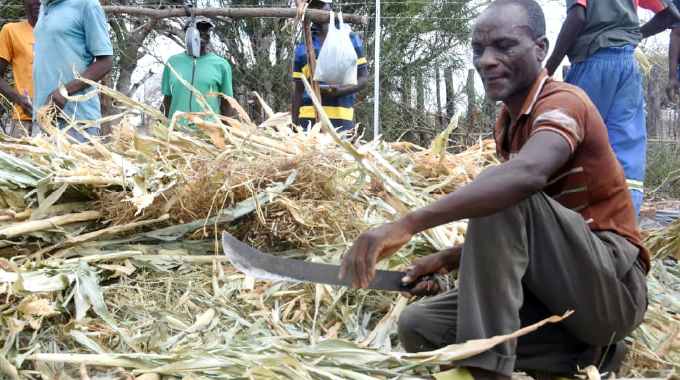
In Mbire, farmers are being trained to preserve crop residues through urea treatment, improving their usefulness as supplementary feed when natural pasture becomes scarce.
Agricultural business advisory officer for Mbire District Edith Dutiro is helping farmers learn the process, which uses residues from maize, sorghum, pearl millet and groundnuts.
The preparation involves approximately 1 000 kilogrammes of crop stover, 50 kilogrammes of urea and 12,5 kilogrammes of molasses, together with water and EM4 as prescribed in the training formulation.
The residues are chopped and weighed in batches before being arranged in a pit lined with black polythene.
“The mixture is applied as the material is layered and compacted to remove air. The pit is then sealed and left to cure for approximately 28 to 30 days,” she said.
Dutiro said the process requires accurate measurements, adequate compaction and airtight storage to ensure effective treatment.
Farmers must also observe the recommended curing period and follow prescribed feeding instructions. Improperly prepared or incorrectly fed urea-treated material can be dangerous to livestock.
The training is being extended through lead farmers, who are expected to share the knowledge with other households.
Training sessions bring together approximately 20 to 25 participants, while farmers can pool crop residues and labour to make preparation easier and reduce the burden on individual households.
The approach is particularly relevant to smallholder farmers who may not have sufficient resources to prepare large quantities independently.
For Chidyambwizhu, the practical value lies in having feed ready before grazing conditions deteriorate.
Rather than relying entirely on what the land can provide during a drought, he is learning to make provisions while crop residues are still accessible.
The intervention is part of a broader Drought Anticipatory Action Plan being implemented under the Welthungerhilfe Anticipatory Humanitarian Action Facility (WAHAFA), in partnership with
Mvuramanzi Trust and the Farm Community Trust of Zimbabwe.
WHH Project field officer for Anticipatory Action, John Tapedza, said the programme was designed to help vulnerable communities prepare for drought before its effects became severe.
“In Mbire, we have set a target of preparing approximately 90 tonnes of urea-treated stover to support livestock farmers facing the threat of depleted grazing,” he said.
The wider programme runs from August to November 2026 and covers selected wards in Mbire, Mt Darwin and Rushinga.
It targets approximately 15 000 households, representing about 70 500 people, with a budget of 500 000 euro.
Beyond livestock feeding, activities include agricultural inputs, Village Business Unit irrigation, safe water provision, poultry hatchery support and measures to strengthen community preparedness.
The livestock component includes supplementary feeding and other interventions intended to protect household productive assets.
The programme also seeks to strengthen local capacity so that communities can respond to drought risks before they translate into major livelihood losses.
Its approach draws on the World Food Programme and Meteorological Services Department’s
“Ready, Set, Go” drought model, which uses the Standardised Precipitation Index and seasonal climate outlooks to help identify and communicate drought risks.
Indigenous knowledge and community-level assessments also inform the identification of vulnerable households and the interventions required.
The initiative complements Government’s Cabinet-approved Six-Pillar Drought Mitigation Strategy for the 2026/2027 season, particularly its focus on climate-smart agricultural production, livestock drought mitigation, financing, early warning and coordination.
The national strategy recognises that drought preparedness must begin before farmers lose their crops, livestock and sources of income.
For livestock owners, this means treating feed security as an essential part of farming rather than an emergency measure introduced after animals have already started dying.
The scale of the previous drought demonstrates why this shift matters.
Matabeleland South was among the hardest-hit provinces, alongside Midlands, Masvingo and Matabeleland North.
Zimbabwe’s smallholder farmers, who own approximately 90 percent of the country’s estimated 5,7 million cattle, are particularly exposed to such shocks.
Many depend on natural grazing and have limited capacity to purchase commercial feed when drought drives up demand and reduces household income.
Government and development partners, including the Food and Agriculture Organisation of the United Nations (FAO), have supported measures such as supplementary stock feed, borehole drilling and communal feeding facilities.
However, the scale of the challenge underlines the need for farmers to build their own preparedness capacity before emergency interventions become necessary.
Agriculture, Mechanisation and Water Resources Development Permanent Secretary Professor Obert Jiri said agricultural production was increasingly being supported by measures that reduced dependence on natural rainfall.
“Climatic vagaries happen, but we have tools that can assist us to anticipate the disaster before it strikes.
“That is what informs our ‘food security everyday, everywhere’ mantra. We have delinked our production away from rains,” he said.
His remarks reflect the broader policy direction of strengthening farmers’ ability to anticipate climatic shocks, preserve available resources and maintain production even when rainfall conditions are unfavourable.
For Chidyambwizhu, that national shift has a very personal meaning. The seven cattle he lost during the previous El Niño drought cannot be recovered. But the experience has changed how he approaches the coming season.
He is now learning to preserve crop residues, prepare supplementary feed and make plans before the grazing runs out.
His immediate concern is the 10 cattle still in his kraal. He wants to protect them from the same fate that claimed the previous seven, avoiding the distress sales and irreversible losses that drought can impose on farming households.
The success of preparedness will ultimately be measured not only by the tonnes of feed produced or the number of farmers trained, but by the livestock that survive when pasture becomes scarce.
For Chidyambwizhu, seven cattle are a reminder of what happens when drought preparedness comes too late. The 10 still standing are his reason to prepare early.