Online Reporter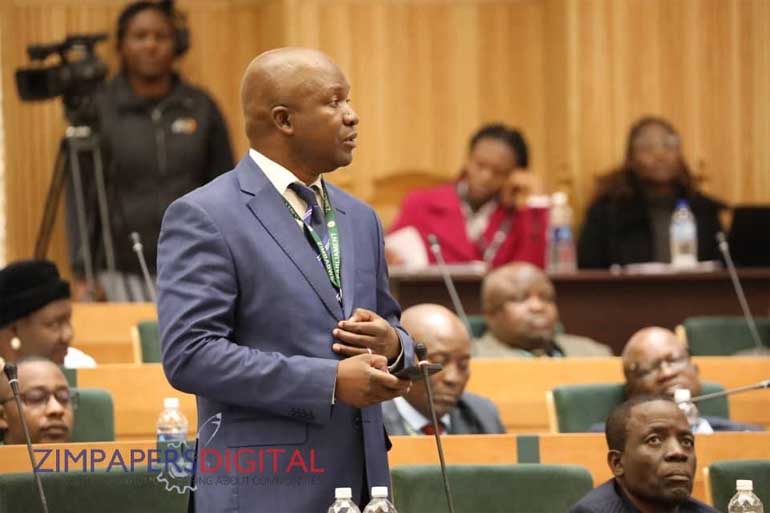
Post Reporter
THE Constitutional Amendment Bill No.3 was introduced in Parliament this week for its first and second readings, with a parliamentary committee revealing overwhelming public support for electing the President through Parliament and extending the electoral cycle to seven years.
Parliamentary Portfolio Committee on Justice, Legal and Parliamentary Affairs chairperson, Cde Eddison Zvobgo (Jr) tabled the report in the National Assembly, revealing that 530 000 written submissions supported the proposed changes, while 2 935 opposed them.
Justice, Legal and Parliamentary Affairs Minister, Honourable Ziyambi Ziyambi presented the Bill for the second time before the Clerk of Parliament, Mr Kennedy Chokuda, made its Second Reading.
Legislators then began debating the Bill.
The majority of submissions backed electing the President by Parliament rather than by direct public vote, with citizens arguing that the model would foster greater collaboration and confidence between the executive and Parliament, enhancing governance and policy alignment.
The committee said submissions emphasised that electing the President through Parliament would substantially reduce the financial costs of nationwide presidential elections.
Past polls had been marred by political tension, violence and contestation over results, the report noted.
The report also showed support for extending the electoral cycle of the President, Members of Parliament and councillors, from five to seven years, further backing applying the change to the incumbents.
Constitutional Amendment Bill No.3 proposes key changes to the electoral framework, and if passed, the country would shift from a direct presidential election to a parliamentary vote.
The Bill must pass through several parliamentary stages before it can be enacted into law.
Under current law, the President is elected directly by voters for a five-year term.
“The majority of public submissions favoured the adoption of longer electoral cycles, primarily because reducing the frequency of elections mitigates both the immense fiscal burden on the state and the disruptive ‘perpetual campaign mode’ that frequently derails governance and development,” the report said, adding that the majority argued that extended electoral cycles defuse the political toxicity inherent in election seasons, providing Government with the necessary time horizon to fully implement long-term projects while ensuring policy stability and continuity.
“They noted that developmental activities routinely slow down or halt during election periods as national focus shifts entirely toward political processes. Furthermore, submissions pointed out that extended mandates are not unprecedented globally, citing Egypt’s six-year presidential cycle and Azerbaijan’s seven-year electoral cycle as successful examples,” said the report.
The committee also reported strong support for transferring voter registration and management of the voters’ roll from the Zimbabwe Electoral Commission to the Registrar-General.
However, it noted that the minority view opposed transferring the voters’ roll to the Registrar-General, arguing that management of the roll had previously been removed from that office because of concerns over credibility and manipulation.
Presenting the Bill for the second time in the House, Minister Ziyambi described the process as a defining moment in the country’s constitutional evolution. He said it was a journey rooted in the liberation struggle, shaped by the aspirations of citizens and formally expressed through the 2013 Constitution.
“Constitutions, by their very nature, are not monuments cast permanently in stone. They are living instruments of good governance, designed to respond to changing realities, to emerging challenges, and to the ever-evolving needs and aspirations of society. The true strength of a constitutional democracy lies not in rigid permanence, but in its capacity for lawful, reasoned and progressive adaptation,” said Minister Ziyambi, adding that the proposed Bill was not an abandonment of the country’s constitutional order but a continuation of it.
He said the Bill was a product of practical experience, institutional reflection and recognition that after more than a decade of implementation, certain provisions of the 2013 Constitution required refinement to enhance their functionality, coherence and service to national progress.