

 admin
admin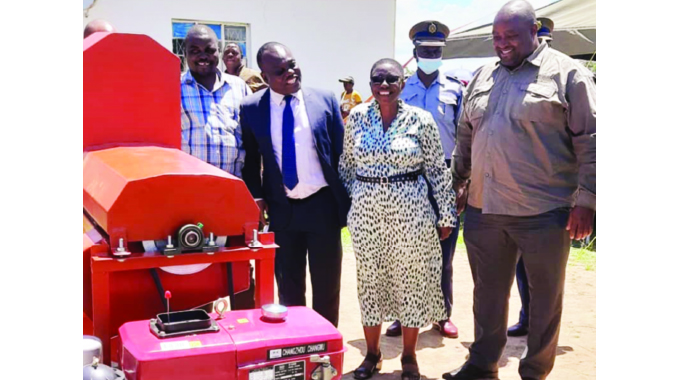
Fungai Lupande Mashonaland Central Bureau
Mechanical shellers have provided a boost to a community of small-scale farmers in Shamva district, reducing the drudgery associated with manual shelling and creating a business opportunity for the community.
A Shamva-based non-governmental organisation, SOS Children’s Village, has donated 17 multi-purpose shellers to small-scale farmers in the area, and they are expected to improve living standards.
The shellers can shell maize, sorghum and soya beans.
Shelling is big business during harvest time and the 17 shellers create a job opportunity for the community as they will provide services to other farmers.
Traditional methods of shelling include use of hands, rubbing cobs on rough stones or beating maize cobs with sticks.
Mr Smibio Jemwa from Mhembere Village in Ward 9 said they used to hire shellers during harvesting time and it was expensive for him.
“I have two hectares of maize and I am expecting nine tonnes. Apart from using the sheller for our harvest, we will get an income by hiring it out to other farmers,” he said.
Mr Sencia Mhembere from Chipole J Village in Ward 17 said she used to gather her children to hit maize cobs with sticks during the night, taking advantage of moonlight as a way of shelling.
She said children usually have the task of beating the maize cobs while elders finished off the process by separating the cob from the grains.
“The process can take three or more days depending on the size of the harvest. Using shellers will shorten the time,” she said.
“We are working in groups and we will also provide services for other farmers for a fee. Our plans are to pool resources, which we can use to send underprivileged children to school.”
Mrs Hilda Bvochora of Kushinga Village in Ward 14 said life was difficult because of the work associated with post-harvest activities.
“Our hands would develop blisters from shelling using our hands. The process was tedious and time-consuming. With these machines, we can complete a huge amount of work in no time,” she said.
Mrs Farisai Kadembe of Kushinga Village in Ward 14, said she used a rough stone to shell her maize.
“This community is into serious farming. We produce maize, sorghum and ground nuts. The pain of shelling would restrict the production rate for some small-scale farmers because of post-harvest losses,” she said.
“Manual shelling resulted in losses and damages to the grains. With these machines, we will venture into serious farming without worrying about post-harvest expenses or losses.”
Minister of Provincial Affairs and Devolution for Mashonaland Central, Monica Mavhunga, commended SOS for the gesture.
She said they had set a precedent on how non-governmental organisations ought to work with communities.
“This initiative lessens the burden of women and girls in processing grains. SOS started operating in Shamva long back and from 2020 to 2022 they spearheaded the family strengthening programme,” she said.
“In this programme they collaborated with several Ministries including the Ministry of Lands, Agriculture, Fisheries Water and Rural Development. Their programming is responding to the recognition that children are better placed to develop within their communities of origin.”
Minister Mavhunga said small-scale farmers in Shamva have fully embraced Government programmes such as the Pfumvudza/Intwasa, Presidential Wheat Scheme, Horticulture Recovery Plan, Presidential Poultry Scheme, Presidential Goat Scheme, and the fisheries programme, among others.
Shamva lies in region 2B that receives at least 800mm of rainfall annually.
“Physical maize shelling is a mammoth task for most smallholder farmers. Traditional shelling and threshing of grains is labour intensive and takes a long time. It involves beating of maize cobs and winnowing,” said Minister Mavhunga.
“Some of the grain is lost in the process and most farmers lose interest in gathering thrown away grain and with time, scattered grain is ignored hence a reasonable amount of grain is lost.
“To ease labour demand, time and minimise grain loss, shellers and threshers are necessary in agriculture grain processing.”
SOS Children’s Village location manager Mrs Nyarai Majoni said they were working with the Government and the Agricultural and Rural Development Advisory Services (Aards) in Shamva and discovered that maize shelling was a challenge for small-scale farmers.
“Farmers in Shamva were getting shelling services from as far as Mazowe. We saw a business opportunity for this community at the same time improving household food security,” she said.
“They are working in groups and 51 farmers will benefit. We saw that people work better when they are in a group and they collaborate in maintaining and protecting the equipment.”



 Online Reporter