

 admin
admin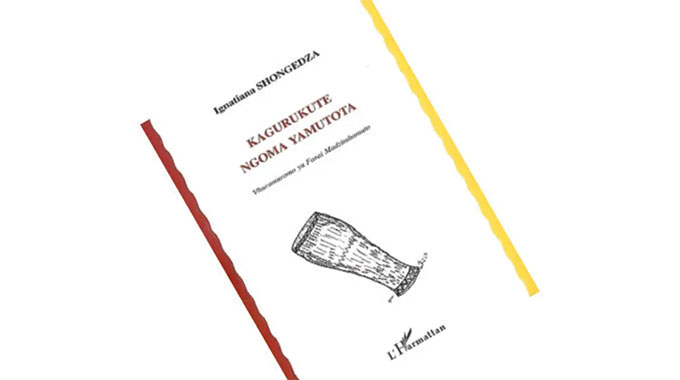
Elliot Ziwira At the Bookstore
Ignatiana Shongedza’s “Kagurukute Ngoma YaMutota” highlights the crucial role women play in African societies, seeing that they are culturally ensconced.
She explores the themes of death, friendship and marriage through powerful use of language, metaphors and symbolism.
An academic of note, Shongedza plies her trade in France at the Universities of Paris 1 Sorbonne and Paris 10 Nanterre. She has written extensively on the emancipation of women in Africa, and earned two doctorate degrees.
Although she has spent three decades in the Diaspora, Shongedza remains linked to her Zimbabwean roots. Indeed, she is a true cultural ambassador, as her depth of language and thorough understanding of the Shona culture is astoundingly original.
“Kagurukute Ngoma YaMutota” was also published in French and English.
Told in the third person collective voice, the historical book is a spring of knowledge to those in pursuit of a true African sensibility expressed in the African way.
Among other thematic concerns, Shongedza explores the central role that women play in fostering social cohesion and harmony, death, friendship, humility, religion and marriage.
Although royalty is used as a barometer and focal point through characterisation, the classless nature of the Shona society is given prominence. It is this that makes it resilient in the face of colonial encroachment.
The pre-colonialism setting capitalises on symbolic and metaphorical elements devoid of alien influence, which authenticates the fictional experience.
The reader is hoisted on a whirlwind voyage of suspense and intrigue into the world of yore through the use of both prose and dramatic conventions, as the writer taps into folkloric allusions.
This, in a way, makes the story captivatingly realistic and ennobling.
Shongedza examines the privileged role that women play in the integration of the family, through VaMakwiradombo, Paramount Chief Nyangu’s senior wife (vaHosi),
As VaHosi, VaMakwiradombo is the one responsible for the day to day running of the household; choosing women for the chief’s harem of wives; and making sure that all the other women in the palace, including the royal sisters, are toed into line.
The Chief reminds her that although he is responsible for the running of the state, when it comes to his own household, she is in control. Whatever she says goes without question, which makes her respected and revered even more than the Chief himself.
Through inter-marriages, women are also responsible for fostering lasting social and political alliances. Princesses, with their debonair, etiquette, deportment and humility, are expected to be exemplary, since they are responsible for keeping the royal name in repute. Aunts and grandmothers are also accountable for their nieces’ behaviour—good or wayward.
However, the writer does not cushion royalty from human follies like deceit and lust, as Katoya, who is newly married, and her sister Mwiti; two of the princesses, are sweet-talked into sex by the deceitful Mutambatuvisi.
He lies to Katoya that her husband has died. Mutambatuvisi impregnates both of them, and later marries Mwiti to raise his social and political bar, as he is also distantly related to VaMakwiradombo.
To the Shona people there is no such thing as a distant relationship, though.
Through their aunt, VaNdege’s scheming, Katoya’s pregnancy is forced on her unsuspecting husband Masango, who surprisingly resurfaces. The Chief’s Sahwira and traditional healer, VaMuparadzi sees through their folly, and jokingly admonishes it. Social cohesion is, however, maintained as both marriages amicably subsist.
This nature of deceit is common in African societies, as the need to protect the family name takes precedence over virtue. Women are expected to remain chaste until they marry at around 20-years, and if they are found to be wanting, the aunts bear the shame.
The issue of controversy on succession in African societies is also debunked. Chief Nyangu, the father, feels that due to illness and old age he is incapacitated, so he is succeeded by his son Toshefa while he is still living.
In a society where one’s wealth is determined by the number of wives and cattle one has, the Chief has many wives befitting his status. As per custom, he offers his younger wives for inheritance to his son, instead of holding on to them.
Death is revered in Shona societies, and the dead are respected as they are believed to join the ancestors and look after their families in the spiritual realm.
Because of the fear of avenging spirits, murder is frowned at. Religious and cultural rites performed after the death of loved ones are testimony to the communion that exists between the living and the dead.
The Chief’s death and his burial are shrouded in mystery, since he is regarded closest to the ancestors and God. The use of the drum in communicating messages of death, war, celebration and exuberance is also explored.
As a custodian of African values, Shongedza takes a swipe at the Eurocentric notion that Africans knew of God for the first time from foreigners through colonisation.
She highlights that colonisation only brought Christianity and Jesus Christ and not God; the omniscient, omnipresent and omnipotent force they had always worshipped through their ancestors.
Though she is aware of the moulding potency of culture at the personal, familial, communal and national levels, Shongedza is conscious of the bane of cultural stasis and paralysis. She advocates the creation of cultural interfaces for societal regeneration and progress, since not all alien cultural norms are destructive; and the reverse also stands true.



 leeroy
 Online Reporter