

 admin
admin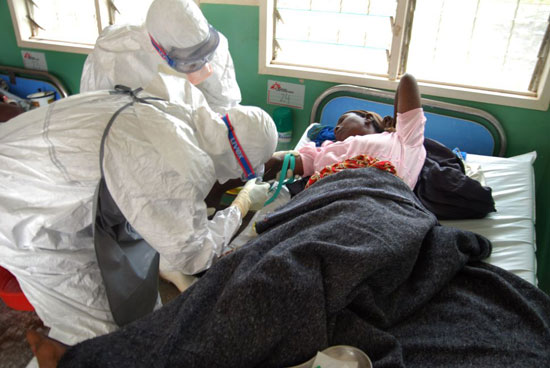
FREETOWN/MONROVIA. — The army blockaded rural areas hit by the deadly Ebola virus in Sierra Leone yesterday, a senior officer said, after neighbouring Liberia declared a state of emergency to tackle the worst outbreak of the disease, which has killed 932 people.
Worried Liberians queued at banks and stocked up on food in markets in the ramshackle capital Monrovia while others took buses to unaffected parts of the West African country after President Ellen Johnson Sirleaf announced the powers lasting for 90 days late on Wednesday.
The state of emergency allows Liberia’s government to curtail civil rights and to deploy troops and police to impose quarantines on badly affected communities to try to contain an epidemic that has struck four west African nations. “Everyone is afraid this morning,” civil servant Cephus Togba told Reuters by telephone. “Big and small they are all panicking. Everyone is stocking up the little they have.”
With troops setting up checkpoints outside Monrovia on the way to some of the worst-hit towns, Johnson Sirleaf justified the measures by saying the state of emergency was necessary for “the very survival of our state and for the protection of the lives of our people”.
In Geneva, World Health Organisation (WHO) experts were due to hold a second day of meetings to agree on emergency measures to tackle the highly contagious virus and whether to declare an international public health emergency. After a trial drug based on the tobacco plant was administered to two US charity workers infected in Liberia, Ebola specialists have urged the WHO to offer Africans the chance to take such experimental drugs. The UN agency has asked medical ethics experts to explore this option next week.
Many in Liberia – a nation founded by descendants of freed American slaves, whose capital is named after former US president James Monroe – look to the United States in time of crisis, as the country did during a brutal 1989-2003 civil war that killed nearly a quarter of a million people.
“We need help from America. We need help,” said Nancy Poure, a small trader in the suburb of Johnsonville. “This is the beginning of hardship. Ninety days of fear and suffering.”
Among the most deadly diseases, Ebola kills up to 90 percent of those infected, causing internal and external bleeding, diarrhoea and vomiting in its final stages.
Discovered in the DRC in 1976, near the Ebola river, it is believed to have been carried to the west of the continent by fruit bats, which are eaten as a delicacy in the region.
Though most cases are in the remote border area of Guinea, Sierra Leone and Liberia, alarm over Ebola’s spread grew last month when a US citizen died in Nigeria of the virus after arriving from the region.
A nurse who treated Patrick Sawyer has now also died in Lagos and at least five other people have been isolated with symptoms, raising fears of an outbreak in the city of 21 million people, Africa’s largest metropolis.
In Saudi Arabia, a man suspected of contracting Ebola during a recent business trip to Sierra Leone also died on Wednesday in Jeddah. Major airlines, such as British Airways and Emirates (EMIRA.UL), have halted flights to affected countries, while many expatriates are leaving.
In eastern Sierra Leone — the worst-hit area of the country — the police chief said security forces deployed last night “to establish a complete blockade” of Kenema and Kailahun districts, setting up 16 checkpoints on major roads.
“No vehicles or persons are allowed into or out of the districts,” Alfred Karrow-Kamara told Reuters, saying the measures would last for an initial 50-day period.
Traders who had registered with security agencies would be able to bring in food and medicines. Security forces would mount foot patrols to ensure civilians did not slip past their road-blocks through the bush.
In Liberia, where the death toll is rising fastest, authorities on Wednesday shut a Monrovia hospital after its Cameroonian director died of Ebola and six other staff tested positive, including two nuns and a 75-year-old Spanish priest.
Miguel Pajares, the first European infected, was in a stable condition in a Madrid hospital after being repatriated with his co-worker, nun Juliana Bohi, yesterday.
The two were escorted by police out-riders on their arrival in Madrid to the Carlos III hospital, which cleared its entire sixth floor for their treatment.
The Liberian military deployment – Operation White Shield – is expected to be fully in place by Friday, officials said.
In the chaotic, ocean-front capital, residents greeted the announcement with fear and concern, though the precise details of the emergency powers have not yet been made public. Liberian authorities have said they are willing to authorise in-country clinical trials of experimental drugs. — Reuters.



 Online Reporter