Chronicle Editor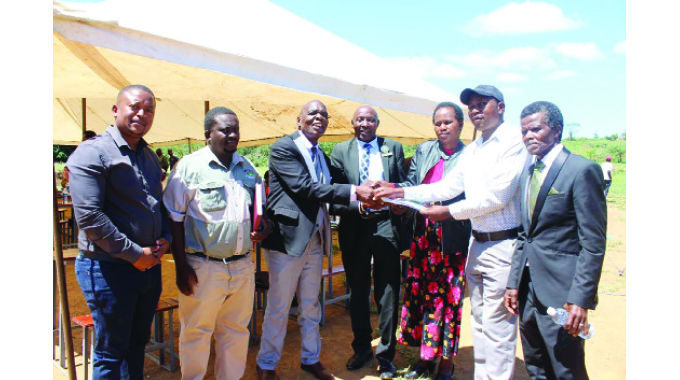
Patrick Chitumba, Midlands Bureau Chief
Residents of Vanguard, a small disused asbestos mine in Mberengwa District, Midlands Province, have been living in fear of being evicted from the mine compound after Government declared it dysfunctional in 2020.
Over 3 000 families who had made the former asbestos mining company compound their home, some for over 40 years, faced eviction.
The asbestos mine was operational from the 1940s up to 1982 when the owners of the company relocated to Germany, leaving workers stranded.
The Vanguard Mine compound falls under Mberengwa Rural District Council.
After the closure of the mine, power was disconnected while the company clinic and other amenities were closed off.
The compound was now notorious for housing illegal gold miners who occupied some of the houses that had been vacated by the mine employees. Lawlessness was the order of the day.
In 2020, the Government announced that Vanguard, among other settlements, was a dysfunctional community – a development that was to see the families relocating.
A dysfunctional settlement is a community that does not have the necessary basic services or is located in a place that does not support proper human settlement by the Government.
In the case of the Vanguard community, there are no health facilities or other amenities except a small primary school that was constructed before independence, when operations at the mine were ongoing.
At one point, illegal miners invaded Vanguard Primary School where they were digging pits in search of gold, putting the classroom blocks at risk of collapsing.
Located near Mount Belingwe, the compound has structures such as tuck shops and houses that have been constructed without approval from Government inspectors.
The structures were constructed haphazardly.
The Vanguard community, however, recently heaved a sigh of relief following the signing of a memorandum of understanding (MoU) with the Mberengwa Rural District Council (MRDC) that legalises the compound.
The development comes after a local non-governmental organisation, Centre for Conflict Management and Transformation (CCMT), which works to promote the management and transformation of conflicts into opportunities for positive change, brought the community together in order to agree on a path to legalise the settlement so that no one is evicted.
Prior to the intervention by CCMT, the relationship between the MRDC and the community was characterised by mistrust as community members believed the local authority was adamant on evicting them.
The local authority was denied access to the settlement by the community leaders, preventing proper engagement over the issue.
CCMT established a platform for dialogue for all parties involved directly and indirectly.
The process, which took about a year, led to the improved relationship between the two parties and in the development of a MoU that the parties signed.
The MoU outlines a clear roadmap to regularising and upgrading the settlement.
The MoU signing ceremony was attended by the Vanguard community which was represented by leaders such as Mr Owen Tonga, MRDC represented by council chairperson Councillor Nyembesi Shumba, Mberengwa District Development Coordinator, Mr Vafias Hlabati, Chief Bvute and Mr Xavier Mudangwe, the director of CCMT.
Mr Robson Shumba, housing superintendent for MRDC said:
“A dysfunctional settlement is a community that does not have necessary basic services or is located in a place that does not support proper human settlement.
Vanguard is one of such settlements that was lagging behind in terms of development.”
Mr Shumba said there were no social amenities in the area save for a small primary school that has stood its time.
“There are no proper roads or structures, no clinics and the buildings, mainly tuck shops, are constructed haphazardly since no planning has been done or was done. Vanguard, as a dysfunctional settlement, was supposed to be destroyed as it was a hazard to the people,” he said.
Mr Shumba said with the intervention of CCMT, council officials sat down with the traditional leaders and community leaders to agree on a way to legalise the community.
“We came here and saw that some people were born here and had nowhere to go.
As a council, we saw it fit to engage in a dialogue with the people and the Government – a development that has culminated in this MoU signing ceremony. We realised that all that was needed was order and for that to be achieved, the people or the community had to be involved,” he said.
Mr Tonga said a plan was in place to provide the community with water and sanitation services as well as proper roads. “We had the department of planning among other departments present here contributing to the plan and we now have a legal document to regularise your stay.
Over 3 000 people were to be moved and the place destroyed,” he said.
Mr Hlabati commended CCMT, the council, and the local leadership for working together towards legalising the mining compound.
“This is a welcome development that will see the people settling well and in a proper and planned manner. The Government could not just look and fold its hands because the community was dysfunctional.
It was a hazard to the people and that process of legalising this place was and is important,” he said.
Mr Hlabati said the Government is there to support its people and develop their areas, adding that no one and no place will be left undeveloped.
Chief Bvute said since the compound had been regularised, no one will be removed.
“Today is a good day for you. We’re signing the MoU to regularise Vanguard mine compound and we expect development here with projects approved by the MRDC.
Let’s try to find each other for the development of this area,” he said.
Chief Bvute said residents were in need of a clinic, a police post and provision of water services as a matter of urgency.
“Thank you CCMT and MRDC because the people of Vanguard would’ve been displaced but now they have been given the greenlight to stay. This is their home that has been regularised and therefore the need for you to follow the laws of the country,” he said.
Mr Mudangwe said CCMT had been facilitating dialogue over a conflict between the MRDC and the Vanguard community on the regularisation of the settlement since 2021.
He said the Vanguard settlement was identified by the Government as a dysfunctional settlement not suitable for habitation and the options were to either evict the residents or regularise the settlement to standards acceptable to Government.
“The dialogue process has culminated in a mutually agreed MoU between the MRDC and the Vanguard community to regularise the settlement. Having worked with CCMT in addressing conflict issues in the district, the local authority sought our support in facilitating a process of building relationships with the community and finding a solution to the regularisation conflict,” said Mr Mudangwe.
He said they were excited about this development which is in line with the National Development Strategy 1 (NDS 1) wherein the Government has committed to regularising informal/dysfunctional settlements that have sprawled in and around urban areas and to upgrade them with the necessary basic and social services infrastructure.
“It is our belief that this agreement can become a model for regularising other informal settlements in mining areas,” said Mr Mudangwe.


 Online Reporter