Chronicle Editor
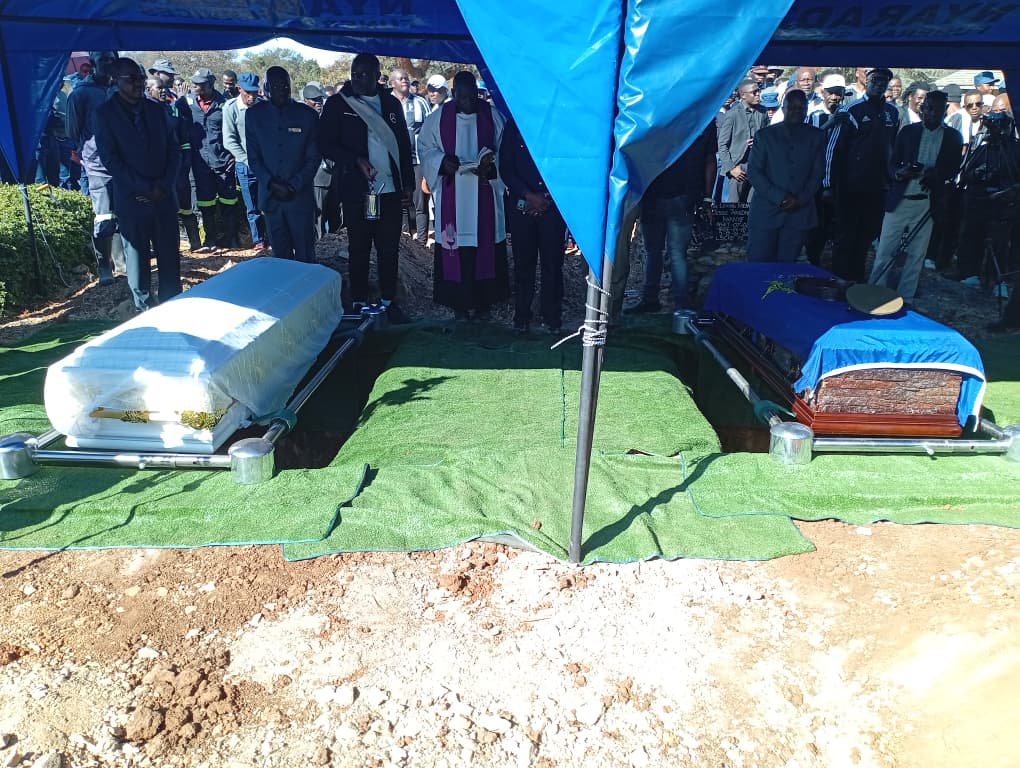
UNITED Congregational Church of Southern Africa (UCCSA) hymns came in quick succession. I could, in their songs and dancing repertoire, detect influences from Lekganyana’s Zion Christian Church (ZCC).
Padding in their palms were used to accentuate thudding and throbbing sounds that went together with their stomping feet. Hands alone would not produce such deep and high-volume sounds. The khaki attire has also found its way into the UCCSA singers’ attire. This is not surprising as both churches have a strong following in Botswana. Besides, the ZCC is more charismatic and closer to African charismatic performances.
Sound as a form of energy has the power to knock on Heaven’s door and make appeals on behalf of supplicants. While all this was going on, I began wandering around looking for possible themes that I could write about. I remembered that the last time I visited this particular cemetery I had observed some crops growing on grave mounds. This time around there were more crops. I do remember back then writing about the crop phenomenon and its possible significance.
I often argue that knowledge accumulates in a spiral fashion. Back then, I had not commenced the “Journey to the Stars series.” Inevitably, my understanding of cosmology, African worldview and thought were at the doddering and wobbling formative stage. The said journey that I embarked upon was more advanced. I engaged my mind into first gear to unpack the meaning behind the planted crops.
Interestingly, all the crops grown on grave mounds comprised the very old indigenous African crops that have been grown on the African continent for longer than 5 000 years. The crops were small grain that are drought resistant. Quite many graves had these crops growing on them. The crops were indigenous to Africa and had adapted to the African climatic and environmental conditions. The crops were sorghum, mapfunde and pearl millet, zembgwe. In addition to these two African crop species, there were creepers, amakhomane that were also indigenous to Africa. That in itself was an indicator that the practice was ancient.
I stood close to my nephew, Walter Bhikijana Nyathi who has naturalised in Botswana and married a woman from the Kalanga community close to the Ramokgwebana Border Post. He trained as a schoolteacher in Zimbabwe. Also standing near to us was Dr Tshuma, who was known to Walter. Walter, equally intrigued by known crops that were growing on several graves enquired about the significance of planting crops on graves. “It’s Kalanga cultural practice,” responded the doctor. I was not surprised at all with his response.
I have experienced this before in relation to numerous cultural practices. Those who make baskets have no clue as to why a circular design is used. They will embellish the baskets with enchanting and charming designs. They will not interpret the designs.
The crafters have no clue with regard to the designs of their embellishments. All that the crafters know is the skill of executing what their elder sisters, mothers and grandmothers taught them. Dr Tshuma is no different from them.
Those who paint their faces will execute stunning designs with absolutely no meaning behind what they draw. The situation here too is the same. The painters knew how to execute designs. As to the meanings behind the designs, they are in total darkness. This is the case in several situations including the practice of medicine. Where symbolic manipulation is applied, the traditional healers, like their counterparts the witches and wizards will not explain their craft, let alone underpinning interpretations. All they know is that it works. The how and why of it is not important. The end justifies the means.
Explanations and interpretations require engagement of perceptive minds of some individuals. These individuals possess strong grounding beyond cultural practices. They are well-versed with African Thought to figure out what the explanations and interpretations are. Such individuals need not be grounded in any particular community’s culture. When sufficiently equipped with broader African cultural essence, they will find themselves at home regarding interpretation beyond merely saying it is a cultural practice of the BaKalanga, for example.
It was at that juncture that I offered my own interpretation of the phenomenon. The crops, I argued, were planted for a reason. That reason may have been lost in the thick sands of antiquity. Beyond the applicable thought, worldview and cosmology what remained were hollow and sometimes irrelevant cultural practices without accompanying purposes. What
I was saying was that cultural practices outlived their bases or motivations.
The same happens when a design or pattern was created with two or more aspects to it. The first was utility and that demanded less by way of finesse. Later, aesthetic considerations came on board. In aesthetics there came buoyed various utilities that explained and interpreted art. It was these utilities whose knowledge was lost. Beauty survive, albeit without its accompaniments in terms of layers of utilities, sometimes of a spiritual dimension, sometimes the lost utilities were of a spiritual nature.
What survived in the thick mists of antiquity were the aesthetic dimensions that continued to live without their accompanying utility aspects. Crafters will know how to produce beautiful designs without even unpacking that which makes them beautiful.
I found myself having to proffer the idea of Duality of Being. A human being has material and spiritual components. What is material and physical is ephemeral and transient. It belongs to the material realm. The clergy refer to this component when they commit “dust unto dust” and “ash unto ash.” Beyond this, there is the second component that is eternal and characterised by continuity, perpetuity, eternity and endlessness.
The second set of characteristics posit the existence of a non-material realm. Actually, it is a spiritual realm. The spirit in man is the real and essential man that continues to live through incarnation, the repeated process that renders it eternal. A grave is identifiable through a mound of earth that is concave/convex depending on the side from which it is viewed. Of necessity, a grave has to represent the two realms of ephemerality/transience and continuity/eternity. A grave of the BaKalanga does exactly that.
Perhaps let us now identify the various aspects in their graves. I will argue that a long time ago their graves were circular in design. Such graves are found in Africa from South Africa to Sudan. As explained in some earlier instalment in this column, human beings enter the world as zygotes that grow into foetuses and embryos. They live, grow and develop in their mothers’ circular wombs. A baby is born after a gestation period of nine months.
Unionised life on earth ends. The material component faces inhumation and cremation in some instances. After several years where there was union of body and soul/spirit, the latter proceeds to a spiritual realm, leaving behind the remains (corpse) in Mother Earth’s womb. The womb-grave is a cultural creation and innovations. At exiting, a cultural womb resembles the natural womb of a biological mother. The designs of the two are the same. A circular body rests in a circular space — a womb and a grave.
Circularity has been explained as referring to and expressive of eternity. The design of a grave in Africa was meant to capture that essence. A circle has no beginning and no end. This is a way of accommodating one of the two aspects being referred to above. Clearly, eternity is associated with spirit. This far the circular grave design and the erect stones represent and express eternity, not of the corpse but that of the invisible spirit that has exited the body to enter the realm of eternal life. This idea was dealt with in my book, Journey to Stonehenge.
Next there are stones placed on the grave with the headstone upright/erect and the footstone also erect but shorter than the headstone. A head is superior to a tail. Rock is sometimes described as the rock of ages. Rock is eternal and when erect, it expresses sexuality and thus eternity and that explains and justifies them as of continuity of an individual and that of the community and humanity.
Now we may make mention of the shade as part of an architecture. This was explained and interpreted in an earlier article. We need not belabour the point. It is time to get to the planted indigenous African crops.
In their case, we seek to unravel and explain why they were consciously planted in the first place. What are they expressing and symbolising?
At the first level, let us acknowledge the link between plants and the cosmos. This has been indicated before. Food on earth comes from the sun that provides the requisite energy in the form of light.
The energy is one of the necessary ingredients in the process of manufacture of food needed by both flora and fauna. It is pertinent to observe that the process has both tangible and intangible aspects. Energy from the sun belongs in the latter.
We thus see the link between the heavens and the earth. This may not however, bring out that which explains the planting of food crops.
We need to search deeper and wider. Planted crops bear seeds and here lies the importance and meaning for the food crops. How are we to perceive seed?
Seed is the hub and source of eternity in a plant. The cycle of spirit and spirit-in-flesh is unending and compares with that of plant and seed. Certainly, the BaKalanga, like other Africans on the continent, needed spiritual support in various forms ranging from food provision to warding off evil spirits.



 Online Reporter