daniel chigunwe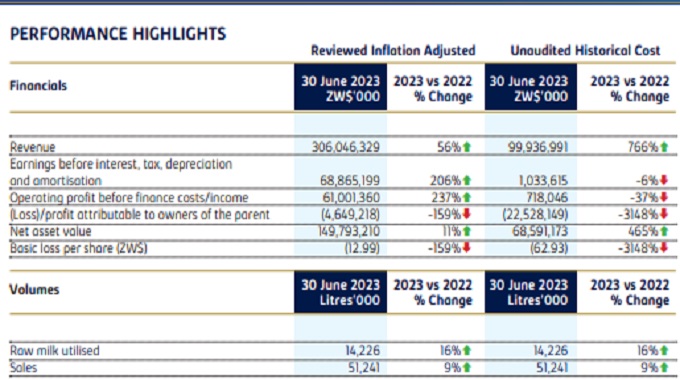
Business Writer
Despite recording growth in volumes and revenue, significant cost increases saw Dairibord Holdings Limited report losses for the half year to June 30, 2023.
In its financials released this week, the Group recorded volume growth across board with the exception of the foods business.
The Group’s cumulative sales volume performance was ahead of the comparative period last year as total sales volumes for the period grew by 9 percent.
Much of the volume growth was for the Chimombe product, up 32 percent, though overall liquid milk sales volumes were up by just 6 percent.
Beverages, which has their Maheu and tea leaves products recorded a notable 16 percent uptick in sales volumes, “fuelled by capital investments made in this revenue segment which improved production throughput and sales”.
It was, however, not all rosy, as foods had volumes declining by 23 percent when compared to the prior year, due to inconsistent supply of quality inputs affecting peanut butter and salad cream, and depressed demand for ice creams.
“The quality issues have since been resolved and the revenue segment is poised for a significant rebound in the second half of the year,” reads part of the company’s statement accompanying financials.
At a time the economy is largely trading in US dollars, Dairibord said 64 percent of the volumes sold during the period were in foreign currency, which was a significant improvement from the 39 percent recorded in the comparative period.
However, by July 2023, volumes sold in foreign currency by the Group peaked at 92 percent a trend which is expected to persist into the future as local currency liquidity in the market remain constrained.
This, according to the firm, is “an attestation of the improving foreign currency generation ability of the business”.
“Business performance in United States dollar terms is satisfactory”.
The notable volume growth on the back of the Group’s strong brand equity, and moderate price adjustments, accounted for a 56 percent rise in inflation-adjusted revenue to $306,05 billion compared to the same period last year.’
The revenue growth was, however, below the increase in costs, threatening the profitability of the group.
The company experienced significant cost increases on account of imported inflation and price distortions arising from exchange rate movements.
“There were sharp increases in material costs and utilities. As a result, cost of sales grew by 68 percent in inflation-adjusted terms.”
In addition, performance during the period under review “was heavily weighed down by significant exchange losses on foreign currency denominated liabilities which significantly increased in Zimbabwe dollar terms between May and June 2023 when the local currency ran into a freefall”, according to management.
But after accounting for monetary gain of $93 367 733 and other income of $12 853 199, Dairibord reported positive operating income.
The Group’s operating profit grew 237 percent to $61 billion compared to $18,08 billion in the prior year.
The operating profit margin for the period was 20 percent up from 9 percent in the prior period.
The bottom line was, however, still hit by significant foreign exchange losses arising from foreign currency-denominated obligations.
According to chairman, Josh Sachikonye, the group recorded high foreign exchange losses of $27,49 billion, which impacted the operating performance and $42,55 billion which increased the total finance costs to $72 billion more than the company’s gross profit of $58 billion.
The Group also had to fund shortfalls in working capital from short-term borrowings.
“Significant expenditure in inventories, prepayments to suppliers and customer settlement delays stifled cash flows from operations,” reads part of the financial statement.
As a result of the high costs and foreign exchange losses weighed down the performance of the business to churn out a loss for the year of $4,65 billion.
Going forward, in the second half of the year, the Group plans to focus on balance sheet restructuring for value preservation and reduction of foreign currency exposure, cash flow management and sales volume growth.
“The Group is seized with efforts to restructure the balance sheet in an effort to fund operations using more affordable forms of financing.”
According to Sachikonye, the penetration into regional markets is gaining momentum with pilot projects in selected markets already underway.
“This is expected to improve the foreign currency earnings of the Group and diversify some of the risk affecting the Group’s current operations.”
The Group is also committed to sustained growth, underpinned by continuous raw milk growth, increased capacity and optimised production capabilities from additional expansion investments.
“Volume growth will also be supported by expansion of the product portfolio through new products and line extensions and regional market opportunity discovery.”



 Online Reporter