daniel chigunwe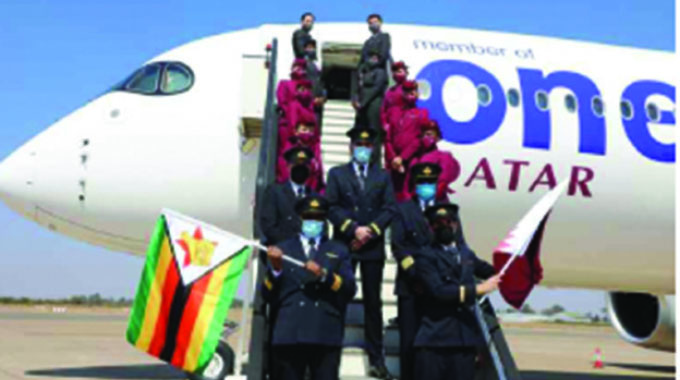
Lovemore Chikova
Development Dialogue
A lot of ground has been covered in upgrading major airports in Zimbabwe, with works on Robert Gabriel Mugabe International Airport in Harare set to be completed soon.
Victoria Falls International Airport and Joshua Mqabuko Nkomo International Airport in Bulawayo have already been upgraded to international standards.
This is all well and fine, very commendable, as airports with international standards can attract more tourists and business people, contributing to the attainment of Vision 2030.
In fact, the landing of Qatar Airways inaugural flight at Robert Gabriel Mugabe International Airport on Friday last week could not have been achieved if the airport was not up to international standards.
But there is a gap that exists, which needs the newly formed Airports Company of Zimbabwe’s urgent attention.
It appears the upgrading has so far been mainly directed at major airports, at the expense of small airports that are scattered in different parts of the country.
These small airports include Buffalo Range Airport near the Great Limpopo Trans Frontier Park and Kariba Airport which offers a transport link to the Kariba Dam, one of the largest man-made dams in the world.
Some of the airports are Hwange Airport located near the Hwange National Park, Masvingo Airport which offers access to the renowned Great Zimbabwe Monuments, Charles Price Airport in Harare and Grand Reef Aerodrome in Mutare.
Bumi Hills Airport, Chipinge Airport and Gweru Airport are also on the list of airports in Zimbabwe.
Well, these airports may appear small or located in little towns or remote areas, but their potential to contribute to the attainment of Vision 2030 is massive.
With government implementing the devolution and decentralisation policy, it is important that each region has its own modern airport ready.
Devolution entails provinces attracting more local economic activity in different sectors, a development that will open them up to the world, increasing the need to carry both people and goods to the areas.
Each province should have an upgraded, functional airport in preparation for the eventual interest that will be brought by devolution.
An airport has the potential to change the entire economic structure of a province by opening it up to outsiders, and a province that is not easily accessible by air is likely to lag in terms of development when it comes to the attraction of both foreign and local investors.
This is where the small airports in various provinces come into the picture. They have potential to link provinces with both the local and international economies.
In fact, the importance of regional airports in facilitating economic growth within the regions needs to be explored further to ensure that more attention is focused on upgrading them.
It is important to be just ready for the take-off — each province with its own upgraded airport.
Airports are catalysts for travelling with ease, yet in Zimbabwe they are often seen as reserved for those who can afford to fly, that is those with some money to spare.
But the small airports are likely to attract low cost airlines, making it affordable for more people to use air transport.
It is important that most of the small airports in Zimbabwe are located in areas with tourist attractions.
This makes them strategic to the development of tourism — one of the pillars for attaining Vision 2030 of achieving an upper middle income economy and the achievement of goals under the National Development Strategy 1 economic blueprint.
Tourism is heavily depended on air transportation, which in turn relies on well-built airports.
The United Nations World Tourism Organisation notes that international tourism has more than doubled in the last 25 years, and continues to increase.
In a developed source market like China, nearly 200 million people travel outside the country for tourism purposes each year, all relying on air transport.
Zimbabwe should be getting its fair share of these tourists, but those who choose to visit the country mostly go to Victoria Falls.
This is because the Victoria Falls International Airport was upgraded recently, with some airlines now flying directly to the tourist resort. Plus, the premier tourist destination is well marketed when compared to others.
It is taxing to expect a tourist to arrive at Robert Gabriel Mugabe International Airport and then take a bus or hire a car to travel to Masvingo to visit the Great Zimbabwe Monuments.
The ideal situation would be for the tourist to find a plane leaving for Masvingo from Robert Gabriel Mugabe International Airport.
An upgraded Masvingo Airport will aid such transfer of tourists from Harare, reducing the time of travel to just minutes.
Improved facilities at small airports can undoubtedly stimulate more human traffic to areas of interest in Zimbabwe because access plays a major role in arousing interest when it comes to travelling.
In fact, the upgraded small airports can be easily linked to other airports in Southern Africa, thereby attracting more attention to the tourist resorts.
Regional flights at the moment are focusing on flying to Victoria Falls for tourism purposes, but with better facilities they can add other local destinations.
It will be beautiful to have an airline flying from South Africa to Victoria Falls, then Grand Reef in Mutare and Masvingo Airport before it embarks on its return journey.
But this needs an efficient infrastructure at the small airports so that they can be able to handle the planes and the travellers.
Apart from upgrading these small airports, it is important that they are marketed vigorously to ensure they become popular with visitors.
Some of them can actually handle bigger aircraft in their state before upgrade, but they are not being advertised enough to attract interest of airlines.
When those in the tourism industry talk about destinations and resorts, they should be able to proudly announce the existence of such airports to solicit more attention on them.
Let it be a full package when it comes to marketing tourism and the airports.
Countries like China that have well-developed air transport systems, including modern airports, actually rely on local travel for most of their tourism receipts.
I have had an opportunity to travel to different destinations within China from the capital Beijing, and it is the domestic sections of the country’s airports that are always teeming with travellers.
The modern airports have managed to attract low cost airlines that many Chinese can afford, thus promoting domestic tourism.
The Airports Company of Zimbabwe, through the Ministry of Transport and Infrastructure Development, should press on with the upgrading of the facilities, in the process extending the works to smaller airports.
Beyond the Covid-19 era, the upgraded small airports can play a crucial role in the tourism matrix by boosting arrivals in the provinces.
It was announced in 2018 that Buffalo Range and Masvingo airports were set to be upgraded to international standards, with Chinese investors having shown interest to partner Government in the two projects.
Buffalo Range Airport’s upgrade had stalled before 2018 owing to funding constraints, while the Government had also indicated readiness to expand Masvingo Airport subject to availability of funding.
Upgrading of the two airports will, among other things, entail expansion of the runway to accommodate bigger aircraft.
This should be revisited to ensure the two airports can play their role to full potential.
It was also announced in 2018 that a number of local and foreign investors had lined up to work on the upgrading of Grand Reef Aerodrome in Mutare, with the Government having already authorised the rehabilitation and expansion of the airport.
Government also announced last year that it was considering upgrading Charles Prince Airport in Harare under the Airport Development Master Plan.
All these efforts show that the ground has already been laid to upgrade the small airports, which come in small size, but can be dynamites that can ignite interest in tourist attractions scattered across the country.
Feedback: [email protected]



 Online Reporter