

 admin
admin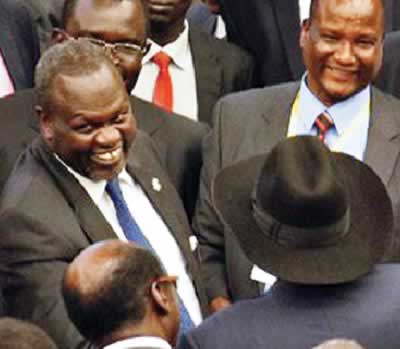

Juba — South Sudan’s government yesterday slammed a peace proposal they are now under intense diplomatic pressure to sign, after rebels agreed to the deal to end the country’s brutal civil war.
“We strongly believe that this document can’t save the people of South Sudan,” Information Minister Michael Makuei told reporters, as President Salva Kiir returned home from peace talks in Ethiopia.
“It’s a sellout, and we’ll not accept it,” the minister said, adding the government would now discuss the deal with the people for 15 days.
With diplomatic frustrations at breaking point over a conflict that has cost tens of thousands of lives, the international community had threatened possible sanctions if a deal was not reached by the end of Monday, urging the government to sign it.
“Failing to comply would entail consequences,” the European Union said yesterday, while the United States said Washington “would consider ways to raise the cost for intransigence”.
Rebel chief Riek Machar signed the deal late on Monday, calling on Kiir to join.
But Kiir — who watched the signing and briefly shook hands with Machar — had warned from the start of talks it would not be possible to sign a credible peace deal because rebel forces have split.
“We objected to it. There are disputed provisions and there are outstanding issues that need to be negotiated and agreed upon,” said Makuei, the government delegation chief to the negotiations.
“If you — people of South Sudan — say that [we should] go and sign it, we’ll do so — but I doubt if people will say so,” Makuei added.
Key issues of disagreement are understood to include details of a power-sharing proposal between the government and rebels, which could see Machar return as vice-president.
But powerful rebel general Peter Gadet and other key commanders last week accused Machar of seeking power for himself, and said they would not recognise any deal agreed.
The peace proposal has been put forward by the regional eight-nation bloc IGAD, the Intergovernmental Authority on Development, as well as the United Nations, African Union, China and the “troika” of Britain, Norway and the United States.
South Sudan’s civil war erupted in December 2013 when Kiir accused his former deputy Machar of planning a coup, setting off a cycle of retaliatory killings that has split the poverty-stricken, landlocked country along ethnic lines.
Meanwhile, the United States urged South Sudan’s president Monday to sign a peace deal with rebels within two weeks to end 20 months of brutal civil war.
“The United States deeply regrets that the government of South Sudan chose not to sign an agreement that was supported by all of the states in the IGAD plus the troika – the United States, United Kingdom and Norway, China, the African Union and the United Nations today,” said US State Department spokesperson John Kirby.
“We call on the government to sign the agreement within the 15-day period it requested for consultations.”
Kiir had warned from the start of talks that it would be impossible to sign a credible peace deal because rebel forces have split.
The regional eight-nation bloc IGAD, the Intergovernmental Authority on Development, as well as the United Nations, AU, China and the “troika” of Britain, Norway and the United States mediated the talks for 10 days.
“As the president has stated, if there was no agreement signed today, we consider – we would consider ways to raise the cost for intransigence,” Kirby said.
He added that Washington would “work with our regional and international partners on next steps and on ways to increase pressure, especially against those that are undermining the peace process or opposing this agreement”.



 Bongani Ndlovu
 Online Reporter