Online Reporter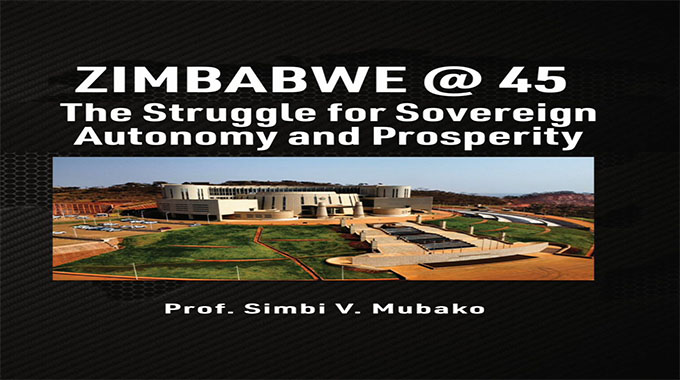
Pofela Ndzozi, Correspondent
IN Zimbabwe @ 45: Struggle for Sovereign Autonomy and Prosperity, Professor Simbi V Mubako does more than narrate history. He calls us to reflect on the very philosophy that has animated Zimbabwe’s existence since 1980; sovereignty.
In other words, and for clarity, if independence was the birth, then sovereignty is the continuous discipline of living as a free nation. As such, Prof Mubako reminds us that independence did not complete the liberation struggle.
It transformed it.
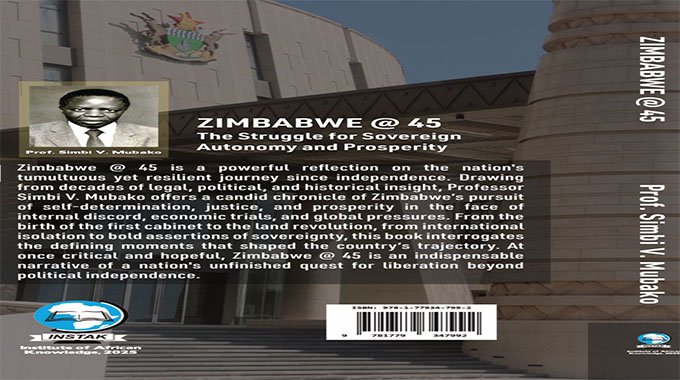
Zimbabwe @ 45: Struggle for Sovereign Autonomy and Prosperity is Prof Mubako’s insider chronicle of Zimbabwe’s four-and-a-half-decade journey after independence.
He aptly blends history with reflection. Prof Mubako revisits Zimbabwe’s defining moments; the integration of warring armies, the land revolution, the sanctions era, and the peaceful transfer of power in 2017 to argue that sovereignty is not a one-time achievement but an ongoing struggle.
The book frames Zimbabwe’s trials and triumphs as part of a larger philosophical project: the pursuit of dignity, prosperity, and self-reliance in a world that has often resisted African autonomy.
Anecdotes from the submission show us that sovereignty is an ethical possession, a lived reality constantly under siege from both external powers and internal contradictions. Zimbabwe’s story, therefore, is not just about survival against “the odds” but about the ongoing assertion of its right to remain the author of its own destiny.
This philosophy is much clearer in the land question. Prof Mubako reframes land reform not just as a policy, but a moral completion of the liberation struggle.
In reclaiming land, Zimbabwe reclaimed dignity, affirming that sovereignty must be materially grounded. Today, as the nation pursues value-addition, industrialisation, and Vision 2030, the land revolution remains the philosophical anchor. True independence means economic control by and for Zimbabweans.
The book is sharp in its indictment of sanctions as instruments of imperial discipline. Sanctions were not imposed to promote democracy but to punish sovereign people who dared to act outside the script of global capital.
Zimbabwe’s endurance under sanctions is presented as resilience, and as proof of the will to sovereignty. Yet, here lies a subtle lesson: sovereignty must also be nurtured internally, through accountable governance and equitable development, if it is to withstand external pressure.
Prof Mubako also reflects on democracy as an African experiment, not a Western import. Zimbabwe’s peaceful transfer of power in 2017, however contested in interpretation, stands as evidence that sovereignty can reconcile authority and renewal without chaos.
Still, the book leaves us with a philosophical challenge; sovereignty demands both protection from external interference and constant self-interrogation. How do we guard against corruption, factionalism, and inequality without compromising unity?
In the contemporary moment, Vision 2030 emerges as a technocratic plan, and as the philosophical continuation of the sovereignty project.
Political independence reclaimed the state; land reform reclaimed the economy; Vision 2030 seeks to reclaim dignity by eradicating poverty and affirming prosperity on Zimbabwe’s own terms.
The unfinished struggle of sovereignty, then, is not about returning to the past, but about extending the ethic of autonomy into development.
Zimbabwe @ 45 is, ultimately, a philosophical meditation disguised as history.
It challenges us to see sovereignty as a continuous responsibility.
The book acknowledges mistakes, excesses, and missteps, but frames them as part of the painful, necessary process of learning what it means to be free. As such, Prof Mubako’s work is a reminder that sovereignty is fragile if left unattended.
The work is also an invitation to reflect: our nation’s future will not be gifted from outside; it will be forged through the courage to live the philosophy of sovereignty daily.