

 admin
admin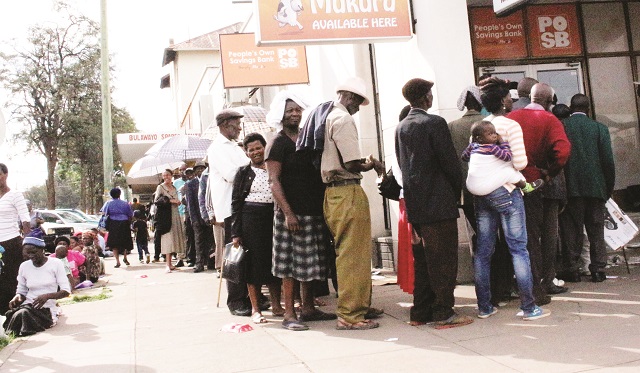
Kudzai Chikiwa
A SLEEPY Shadrach Ngomalala squeezes into a queue after spending the night outside a bank in Bulawayo’s city centre. The 65-year old pensioner is waiting to collect part of a monthly $200 pay-out from the National Social Security Authority (NSSA), which recently increased pensioners’ stipends by 65 percent across the board.
Due to the country’s swingeing cash shortages, Ngomalala has no idea whether he will even be able to withdraw money to pay for the essentials on his $800 grocery list. The former sales manager told Business Chronicle: “This month they added $120 on top of our payouts, but frankly speaking, it makes no difference. Considering today’s parallel market rate, this pay-out is equivalent to US$10 only, unlike before inflation escalated, when the local currency was at par with the American dollar, and could meet many needs.”
Before Government suspended publication of annual inflation figures, yearly price increase had surged to 175.7 percent in the twelve months to June 2019, up from 4.3 percent in the year to July 2018.
The cost of basic commodities has climbed beyond the reach of many Zimbabweans following the shift to local currency, after close to 10 years of using the US-dollar dominated multiple-currency system. Since the multiple currency regime was abolished in June 2019, the market value of the local currency against the greenback has tumbled from $2.5 early this year, to $9 mid-year and to around $16 in November.
Analysts say because retailers’ have pegged their prices on the US dollar, the cost of basic commodities is ratcheting up each time the local currency loses value. In October, the average electricity tariff was increased by 320 percent, from 38c per kilowatt hour to 162c. The cost of fuel, on the other hand, has shot up to an average of $17.45 for petrol and $17.95 for diesel, compared to prices that were below $2 per litre last year.
A snap survey by Chronicle revealed that prices of basic goods have shot up by over 300 per cent with that of bread having increased to around $15 per loaf from $8.40 in August. A 10 kg bag of roller meal is now pegged at average $90, while 2 litres of cooking oil now costs $65, with 2kgs of sugar pegged at $30 and 2kgs of rice at an average of $50. The situation has hit hard on ordinary Zimbabweans and pensioners, whose salaries and pension stipends are unable to keep pace with rising prices.
“I cannot afford to buy groceries for my family, let alone travel to and from my rural home in Plumtree,” said Ngomalala. His situation mirrors the struggles of many pensioners, who are failing to make ends meet.
He said pensioners wanted to form an association to represent their interests. They said the association could approach Government to negotiate for “decent” earnings for pensions, most of who depend on NSSA payouts for a living.
“We need to form a pensioner’s association that can approach Government and negotiate for reasonable earnings that can afford us a decent life,” said Mr Ngomalala.
“There is no increment to celebrate about because this $200 is a bank transfer and we need to buy cash from Ecocash agents who are selling it at 50 per cent, meaning this payment is equivalent to just $100 in cash.”
The practice of ‘selling’ cash has become rife in Zimbabwe due to shortages of notes and coins. Banks have introduced daily withdrawal limits to ration cash, forcing desperate Zimbabweans to pay a premium for notes and coins.
“If you want the $200 in cash, you need to come to the bank four times since one can only get a maximum of $50 per day,” said Mr Ngomalala. “That’s why we slept outside the bank for the past few days.”
Considering the rate of inflation compared to the US-dollar value, he said Government’s recent cushion would not improve pensioners’ situation, hence the need for negotiations for another increment.
“There is no hope that this price madness will end any time soon, and this $200 will not capacitate us,” he said. “As we speak, this money can only afford me a 10kg sack of mealie meal, 2 litres cooking oil and a 2kg rice. We need a strong board of radical pensioners who can go to NSSA headquarters and protest against this mistreatment. The local currency has lost value so whatever they give us should afford us buying a reasonable amount of US dollars.”
In July this year, civil servants’ representatives petitioned Government for a salary increment of at least US$475, or its equivalence of $7 267 at the prevailing interbank rate for the least paid worker. In response, Government reviewed their salaries by 76 percent, which saw the least paid worker now earning $1 023, up from $582.
Announcing the recent cushioning of pensioners, NSSA board chairman Mr Cuthbert Chidoori said the move was necessitated by prevailing economic challenges that had seen pensioners becoming incapacitated. He said NSSA would continue monitoring the situation to ensure that pensioners earned a better living. Pensioners’ welfare has become a matter of concern, with Members of Parliament also challenging Government to cushion retired Zimbabweans and give them their pay-outs in time.
A 70-year-old retired teacher, Mrs Nomsa Ngwenya, also said a pensioners’ association should be established at national level to represent retirees from all provinces.
“This is not a Bulawayo issue alone, but it affects the whole nation both in urban and rural areas,” she said. “Besides giving us ‘peanuts’, sometimes we are told at the bank door that there is no money, even after spending the whole day waiting. Those from outside of towns and cities are forced to sleep outside the banks. Such issues are pertinent and need to be discussed at a national level.”
Mr Aiden Tichareva, a pensioner from Harrisvale suburb in Bulawayo, suggested that once a national association was formed, it should be registered and hold a meeting with Government to deliberate on the challenges faced by pensioners.
“A round table meeting is crucial because we have a lot of issues that need attention,” he said. “We can no longer afford accessing health services. This is very unfortunate because with old age comes a lot of health complications like blood pressure and sight problems that need constant checkups. My medical aid card was nullified upon retirement in 2008, and right now just to consult a private doctor l need at least US$20, which is equivalent to what government pays me in two months.”
A disgruntled Mr Tichareva said if inflation continued to escalate without Government cushioning them, pensioners feared that their payouts would further lose value.
“We have been disproportionately affected by the latest burst of inflation because we spend a higher proportion of our already low income on essential items like food and energy, whose prices are massively going up almost on a weekly basis,” said Mr Tichareva.
The writer is a fourth-year journalism and media studies student at the National University of Science and Technology.


 Online Reporter
 Bongani Ndlovu