Online Reporter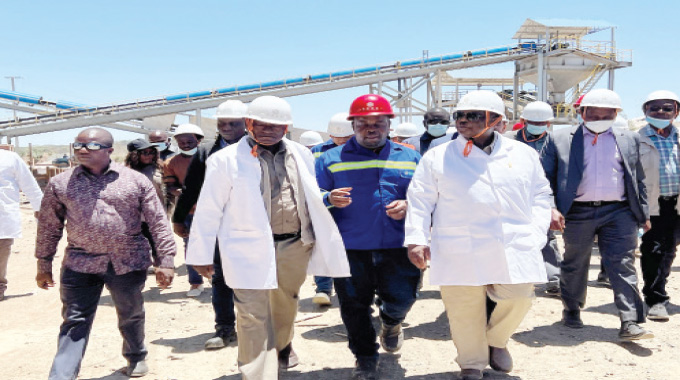
Sukulwenkosi Dube-Matutu, [email protected]
VICE PRESIDENT Constantino Chiwenga has reiterated the urgent need for Zimbabwe to accelerate domestic mineral value addition and beneficiation, in order to curb the export of cheap raw materials that are vulnerable to global market fluctuations.
Speaking during a tour of the new lithium plant in the Mandihongola area of Gwanda on Friday, VP Chiwenga emphasised that increasing value addition would significantly enhance the country’s economic returns.
He stated that resource extraction in Zimbabwe must translate into improved livelihoods for local communities through job creation and urged the mine to go beyond lithium exports by manufacturing various products locally for export.
He noted that under the Second Republic, led by President Mnangagwa, the Government is committed to shifting from the traditional “extract and export” model to a more progressive “extract-process-beneficiate-manufacture”approach.
The US$54 million mining venture is a subsidiary of Chinese global investor Tsingshan Holdings Limited Group.
“Government has already issued a policy position and come January 2026, we expect all minerals being produced — including lithium — to be processed locally. We want to realise Zimbabwe’s vision of economic development through the utilisation of our own resources. We must see various products being manufactured locally using our minerals.
“We need to beneficiate these minerals within Zimbabwe. The market for these products exists across our continent. We will export only after beneficiation. Our goal is to extract, process, beneficiate and manufacture, rather than exporting raw materials. This will bring life and employment to our people and uplift livelihoods,” said VP Chiwenga.
VP Chiwenga stressed that investment in the mining sector must deliver mutual benefits to the community, the investor and the Government. He encouraged mining companies to engage in corporate social responsibility initiatives, including infrastructure development, skills training and community empowerment. He also called on mining companies to address grievances raised by local stakeholders.
“This relationship, which benefits both countries and their people, must be sustained for generations. It is our responsibility to build and strengthen it today. The resource is here, and it must be utilised on a win-win basis. The company is providing equipment, while the community offers the resource — this partnership must benefit all parties.
“We encourage corporate social responsibility initiatives such as the construction of clinics, schools and roads, especially as the current roads were not designed for the heavy trucks now passing through the area. For development to be realised, stakeholders must collaborate. Where disagreements arise, dialogue is essential to find a way forward,” he said.
VP Chiwenga highlighted the longstanding relationship between Zimbabwe and China, dating back to the liberation struggle. He noted that the two nations traded before the colonial era and that China played a pivotal role in training Zimbabwean troops during the fight for independence.
He said these historical ties are now being strengthened through economic development and trade.
“The establishment of Gwanda Lithium is no coincidence — it is another milestone in the development partnership between friends. We want to see this mine thrive for the benefit of both nations.
“The Government commends the comprehensive strategic partnership with the Republic of China. This relationship must be preserved and passed on to future generations. It is up to us to nurture this strategic alliance,” said VP Chiwenga.
Gwanda Lithium Mine project director, Mr Wilfred Motsi, said the mine employs around 450 workers, with approximately 400 being locals.
He stated that the mine has the potential to produce over 20 000 metric tonnes per month, but is not operating at full capacity due to water supply challenges.
“We receive lithium ore and process it through various stages, including primary and secondary crushing, flotation and finally producing powdered lithium concentrate, which we export. In future, we aim to add value to the concentrate by converting it into carbonate or sulphur carbonate,” he said.—@DubeMatutu