


 malvernmugadzikwa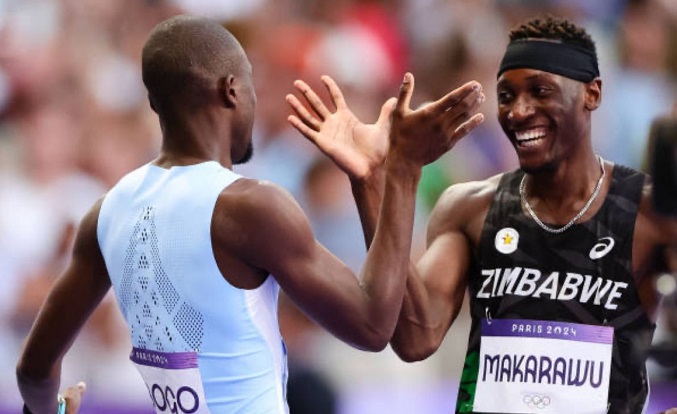
Tinashe Kusema
Zimpapers Sports Hub
UNLIKE most of his contemporaries in the United States, both past and present, Tapiwanashe Makarawu is a rather laid-back fellow.
In fact, nonchalant would accurately describe the 24-year-old Zimbabwean sprinter.
It is against this background that the attention that has come from his memorable debut at the Paris Olympics last month has been so overwhelming that Makarawu has taken a short sabbatical from social media.
“The dust has now started to settle and it is becoming better and better every day,” said Makarawu of the attention.
“I think it’s mainly due to staying off social media that really helped and now everything is starting to get back to normal.”
For an illustration of the frenzy surrounding Makarawu and his compatriot Makanakaishe Charamba’s exploits at the Paris Games, each of them received a hero’s welcome upon their return to their bases in the US.
Makarawu recently finalised his move from New Mexico Junior College to Kentucky State, and has instantly shot to celebrity status at the new school.
“Upon arriving at the airport, my coach came to pick me up and give me a ride to school. He didn’t tell me anything about what was ahead.
“It was only when we arrived at the school gates that I saw people gathered, holding signs and screaming my name. It is kind of a celebrity status as I now get special treatment, my pictures and videos are around the school and I have signed many posters,” he said.
Makarawu is probably having one of the best seasons of his young career.
By April, the 24-year-old was one of four sprinters to break the 20-second barrier, alongside American Courtney Lindsey (19.71s), Olympic champion Letsile Tebogo (19.71s) of Botswana and Tarsis Orogot (19.90s) of Uganda.
He then went on to book his ticket to Paris with an impressive performance at the Corky Crofoot Meet in Texas, the US, also in April, crossing the line with a time of 19.93 seconds. Unfortunately, he could not replicate that run in Paris as his time of 20.10 seconds could only give him a sixth-place finish. Still, Makarawu views his debut as a success.
Firstly, because of his performance that saw him make the final, together with compatriot Charamba, and also due to the many lessons that came out of the experience.
“If I am to judge my performance, the word I would use is great,” he said. “Making that Olympic final is not easy and many great names failed to make that starting list.
“They (big names) did not qualify and I beat guys like Andre De Grasse and other guys I thought were faster than me going into the meet.
“I just want to thank God that he gave me the strength and endurance to run the good race and make it as far as I did.”
As it pertains to lessons from the Games, Makarawu said: “I learnt a lot of things as this meet afforded me the opportunity to see how other guys (professionals) go about their business.
“I picked up a couple of stuff from Noah Lyles, who everyone was talking about, and it is now up to me and my coaching staff to choose what works for me and what can improve me.”
And for the cherry on top, the Zimbabwean sprinter managed to catch up with old friends and make new ones.
“I did get the opportunity to mix and mingle with the other athletes, and they are like my brothers now,” he said.
“Fred Kerley, for example, is someone I knew before the Games as we follow each on Instagram. Vernon Norwood, the 400m American runner, is another example of someone I talk to.
“There was also Alexis Holmes (US 400m female), who was at Kentucky, and we managed to share some stories about the institution and life. The list goes on.”
With the Olympics now in the rearview mirror, Makarawu plans to spend the next couple of weeks acclimatising to his new environment at Kentucky State. After that, he plans to start preparing for the new Indoor and Outdoor NCAA season, after which his next big mission will be next year’s World Athletics Championships.
Makarawu has already qualified for the meet, which will be held in Tokyo, Japan.


 Bongani Ndlovu
 Online Reporter