Online Reporter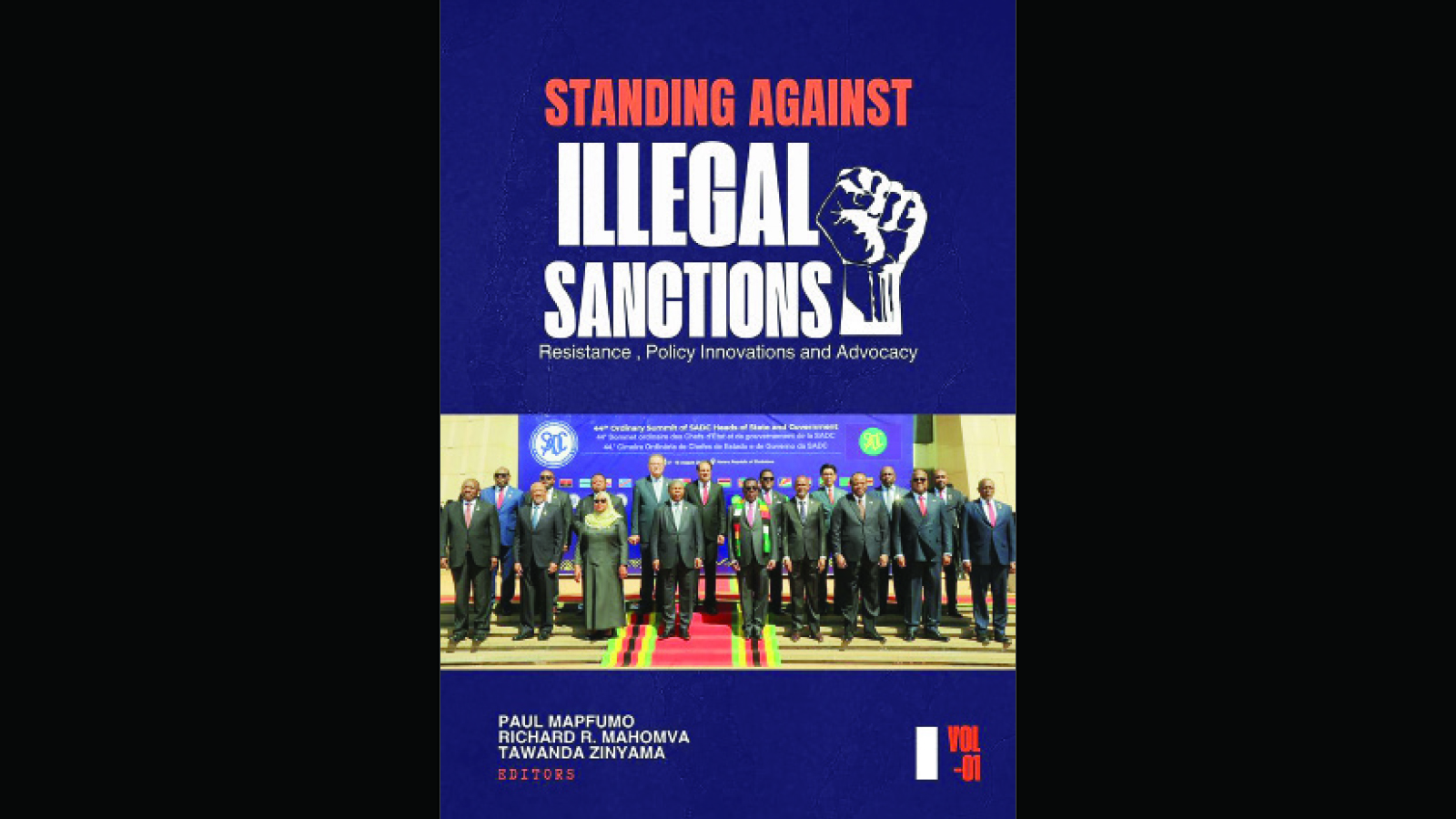
Prof Paul Mapfumo
The launch of our new book, “Standing Against Illegal Sanctions: Resistance, Policy Innovations and Advocacy”, signals an unapologetic and recharged commitment to decolonising the archive by Zimbabwean intellectuals in defence of national interest.
It will be recalled that with the illegal sanctions came the consorted anti-land reform polarising narratives.
Therefore, having a book that presents an anti-Western perspective on the illegal sanctions imposed on Zimbabwe marks an important truth reclamation in telling the Zimbabwean story.
While we commend other fragmented anti-sanctions contributions to the body of knowledge, our book is the world’s first-ever one-stop academic compendium locating the dehumanising causes and effects of the illegal sanctions that Zimbabwe has experienced since 2001.
This publication is an outgrowth of the flourishing academic freedom under the leadership of His Excellency and Chancellor of all State universities, President Dr Emmerson Dambudzo Mnangagwa.
Beyond making Zimbabwe open for business, the President also made Zimbabwe open for ideas.
Not only has he created a free-market economy, but under his astute leadership, we are experiencing a free market of ideas.
The continued germination of ideas proliferates industrial growth; in the process, social cohesion becomes fertilised and unity of purpose becomes nourished.
Innovation hubs expressly depict the importance of ideation in cultivating industrious interventions, which serve as a panacea to Zimbabwe’s erstwhile development stagnation due to illegal sanctions.
The academia owes this to the President’s passion for knowledge production and ardent respect for freedom of expression, as well as his respect for the liberty of reason.
This book could not have been conceived if the Second Republic was censoring academic freedom.
Under President Mnangagwa’s academic freedom-driven leadership, intellectuals are able to do what they are supposed to do; that is, to think and express their thoughts.
“Standing Against Illegal Sanctions: Resistance, Policy Innovations and Advocacy” is an outgrowth of a series of anti-sanctions fora, including symposia, organised by the Chitepo School of Ideology since 2021, as well as some papers presented in the past editions of the SADC Anti-Sanctions Solidarity Summits that have been annually convened by the Ministry of Information, Publicity and Broadcasting Services since 2022.
The institutional interconnectedness of the Chitepo School of Ideology; the Ministry of Information, Publicity and Broadcasting Services; and the University of Zimbabwe proves the extent to which the country’s premier State university has its epistemological grounding and collaboration thrust anchored in nurturing an enduring national consciousness among our people.
The Institute of African Knowledge, as the publisher, ensured that the book has a strong Afrocentric editorial worldview, undergirded by assertive and principled viewpoints detailing the illegality of sanctions imposed on Zimbabwe.
The book features multi-disciplinary social science research submissions which endorse the Second Republic’s foreign policy transformation.
Each chapter in the book gives factual detail on the illegality of sanctions and why they must be immediately and unconditionally removed.
The book also mirrors the admiration which the academia has in President Mnangagwa’s diplomatic genius, which continues to positively change the character and complexion of our statecraft.
There is consensus among progressive intellectuals that his distinct leadership has ushered in a unique culture of governance excellence.
The book commends the extent to which the President has stood with the people of Zimbabwe to create anti-sanctions resistance policy interventions and smart advocacy strategies which have mobilised progressive sections of the world to demand the sanctions to fall.
The first chapter gives a historical and conceptual context of what sanctions are and how they have affected the lives of ordinary Zimbabweans.
Chapters 2 and 3 situate the crisis of sanctions in the reality of neo-colonialism, particularly how issues of decoys of human rights are used to justify why African governments must not reclaim their land.
Both chapters explain how wealth decolonisation is demonised through pseudo–Anglo-Saxon human rights and democracy civil society organisations and Western-assisted opposition political parties.
Chapters 3 and 4 exhaustively expose the illegality of the sanctions imposed on Zimbabwe using scholarly evidence from case law.
The report of the Special Rapporteur on the Negative Impact of Unilateral Coercive Measures on the Enjoyment of Human Rights by Professor Alena Douhan is also critically examined to show the legal shortcomings of the illegal sanctions corroding Zimbabwe’s political economy.
The fifth chapter discusses the merits of the engagement and re-engagement policy, and outlines the unrepentant character of the sanctioning countries for failing to reciprocate Zimbabwe’s benevolence and friendly nature.
Chapters 6 and 7 highlight how certain sections of the media have abdicated their role to inform and are now using their platforms to misinform the citizenry on the root causes of the sanctions and their effects on the nation’s economic infrastructure.
Chapters 8 and 9 articulate various advocacy initiatives spearheaded by the Government to promote public awareness on the causes and real impacts of the economic sanctions.
Chapter 10 underscores the peace and nation-building strategies implemented by the Second Republic, which nullify the very basis of the justification of illegal sanctions.
Chapter 11 discusses how Pan-Africanism has been operationalised to inform Zimbabwe’s anti-sanctions resistance.
The book then discusses the ideological foundations of the Second Republic and how they are driving the country to prosperity against all the odds.
The closing chapters share perspectives on how tertiary institutions are developing learning systems which support a type of pedagogy that deliberately promotes production of goods and services that benefit our people.
“Standing Against Illegal Sanctions: Resistance, Policy Innovations and Advocacy” is a bold demonstration of the University of Zimbabwe’s role as an engine of research-based policy innovation, advocacy and social transformation in Zimbabwe and across the African continent.
Through such endeavours, the University of Zimbabwe continues to set the pace for higher education, turning the new philosophy of Heritage-Based Education 5.0 into a lived reality that shapes the destiny of Africa’s socio-economic development aspirations through science, technology and innovation.
This timely publication must nudge all of us to maintain the anti-sanctions momentum generated by this event to continue mobilising support that can make the total lifting of the illegal sanctions imposed on Zimbabwe inevitable.
For any one of us to stand aside passively, or to act in complicity with those imposing sanctions on our country, is not only unholy, unjust and unethical, but it is also treasonous.
Prof Paul Mapfumo is the Vice Chancellor of the University of Zimbabwe and co-editor of the book “Standing Against Illegal Sanctions: Resistance, Policy Innovations and Advocacy”, which was launched by President Mnangagwa on October 25.