

 admin
admin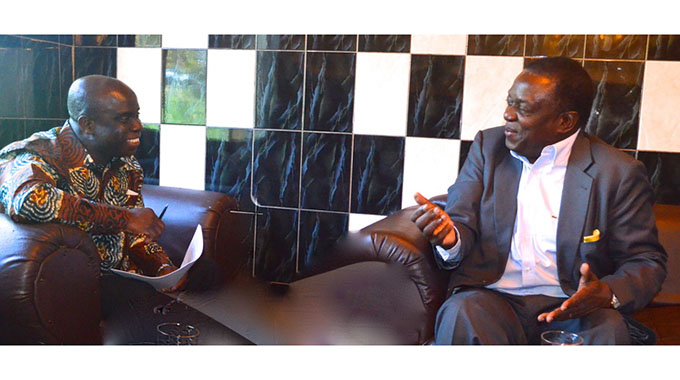
THE INTERVIEW Baffour Ankomah
Q: You were born on 15 September 1946…
A: Incorrect. I was born on 15 September 1942. The Press has been saying 1946, but it is incorrect.
Q: I saw a TV clip the other day of the famous pre-independence rally at the Zimbabwe Grounds where President Mugabe spoke to a million or so people after returning from exile in Mozambique. I saw you and someone I thought was General Mujuru leading the President to the podium. You have been with him for a long time. What have you learned from your long journey with him?
A: You can do the arithmetic. I have been with the president since 1963. We have been working together since then, first in Tanganyika and thereafter we were in prison together; he did 11 years and I did 10 years. The difference was that he was detained and I was in prison, so we couldn’t communicate under the circumstances. After that we were together in Mozambique for the entire period of the armed struggle, and at the Lancaster House Conference in London in 1979, and through 35 years of independence. So all together, we have been together for 52 years
Q: That is a really long time. But you were quite young in 1963; what were you doing at that age?
A: Well, I was expelled from the Hodgson Technical College in Lusaka, Zambia, in 1960 when I was a youth leader and activist. UNIP [President Kenneth Kaunda’s United National Independence Party] had been formed in 1959 and one of their officials, Nalumini Mundia, recruited us at the college into the UNIP Youth League which was then under Dingisiwayo Banda. And we burnt down Mr Smith’s house. He was one of the instructors at the college. So we were expelled from school.
Q: Why did you burn down the house?
A: It was during the period of nationalism in 1960. We were very radical young students at the college, so we agreed to burn down Mr Smith’s house because he was a racist white lecturer. He had gone on holiday in England, so we agreed to burn his house while he was away.
But we were found out and expelled because the authorities tricked us. At the hostel, I was staying in Maybin House Wing C. We didn’t know that the authorities had brought young people from the Police Special Branch to live on campus to investigate the burning of the house. They put one in each room where we were sleeping. We thought they were young people from other trade schools and technical colleges from across Northern Rhodesia who had come on a visit. So our committee agreed that we would influence these young people to go and burn down their schools. We didn’t know they were CIDs.
So we agreed that after lights out at 10pm, members of our committee would go and speak to these newcomers. I was responsible for Wing C in Maybin House. So during the night the guy came to me trying to be friendly, and I told him: “This is what we do here. We burn things”. In every other wing of the hostel, somebody from our committee was speaking to these guys. So we were all trapped.
One morning when we went for breakfast, we were inside the dining hall when suddenly we were surrounded by the police from the CID whose commanders were whites. Inside the hall, we prayed silently: “Oh God, bless our food and chase away the policemen who are outside.” Of course, God did not do it.
Then the whistle was blown and we assembled at the parade grounds. Our names were read out. To the man, the correct committee was read out. We thought we were speaking to students, but they were now standing with the police. We were then about 17 or 18-years-old. So we were expelled. That was when I fully joined UNIP in Lusaka and became its youth secretary.
Q: And from there?
A: From there, despite the fact that I had done much of my primary education in Northern Rhodesia, I was still a Zimbabwean. But my father had been forced by the Southern Rhodesian authorities to move to Northern Rhodesia in 1954. And this is what happened: In our home village at Shabanie, the whites were de-stocking cattle. They did that from time to time. Normally there would be a dip tank in the village where the villagers would bring their cattle to be de-stocked. They would be given a card on which the number of their cattle would be written.
In our village my grandfather was the chief and my father was in the chief’s council. It happened that when the de-stocking exercise was going on, a woman who had five cattle written on her card was told by the young white land development officer, we called them LDOs, to sell two of her five cattle and be left with three. My father opposed it, saying: “How can she survive on three cattle. It is better she has five so that she can milk some and use some for ploughing.” But the young LDO arrogantly told my father: “No, no, I am the boss, this old woman will remain with three cattle.”
My father allowed the LDO to have his way, but he and his brothers — he was the eldest — went and removed one wheel from the LDO’s Land-rover, put the car on stones, and took the wheel up the hill. At 4 pm when the LDO finished the de-stocking, he found his Land-rover now had only three wheels. He asked what had happened. My father told him: “You said the old woman could live on three cattle. Now you go back to town on three wheels.” The LDO was not amused, but as he could not go back on three wheels, he slept at the village.
Q: Sure, they did not give him back the wheel?
A: No, he slept at the dip tank. At the time, my grandfather, the chief, was old and wizened by age. So he called his sons and said: “You don’t fight the white people in this way. You can’t fight them alone. If you want to fight the white people, you must come together and do it collectively, not individually. So you must return the wheel.” The next morning, my father and his brothers told the women in the village to go and sell eggs to the white man so he could have some breakfast. “But don’t give the eggs for free, he must pay for them,” my father told the women. Later my father returned the wheel to him.
Two days later, the police came and beat up my father for what he had done. They took him away to Shabanie town and locked him up. The following day, my father’s brothers took many people with them — because we were a big clan — and went to Shabanie to confront the police. I was a little 12-year-old boy at the time but they took me along. They put me on a bike and tied my legs to the bike so I wouldn’t fall.
When we arrived at Shabanie town, we saw many people with axes, spears and so forth. The district commissioner, seeing the foul mood of the people, addressed them saying: “No, we are releasing your brother but he mustn’t do it again.” So we went back home with my father. But two weeks later, the police asked my father to come to Shabanie. So he went with the chief’s council and other villagers, and was promptly arrested.
Now, here was the district commissioner again, standing proudly there in front of a parade of soldiers from the Rhodesian African Rifles whose commander was a white man. The commissioner said to my father: “Mnangagwa, the last time you came here, you had your people armed with axes and spears. Now I am here with my African Rifles, we shall see who is who.”
Now, with the troops behind him, the commissioner was in his element, but my father and his brothers didn’t talk. After some time and much display of power, the commissioner then said my father would not be put behind bars but he would have to leave the country with his family. He must go to Northern Rhodesia because the authorities in Southern Rhodesia did not want people to disobey public officials or public orders. This is how my father was kicked out of his own country in 1954. He went alone at first, but in 1955 my mother and the rest of the family followed him. We only came back to live in Zimbabwe in 1981 or 82, after independence.
Q: I will take you back to Zambia later, but for now I want you to talk about your time with President Mugabe. What do you think has made him to withstand the assault on him by the combined might of the Western world? He is, by far, the only leader in pre- and post African independence history standing after being assailed by the West. What is the secret?
A: I will tell you a little story. In 1980, just after the elections in Zimbabwe but before Mugabe who was the Prime Minister-Elect was inaugurated, we were at a place in Mount Pleasant in Harare when Mugabe said he wanted to talk to Ian Smith, the outgoing prime minister, and the generals. I was then Mugabe’s personal assistant and head of security.
So I used an intermediary who happened to be Ian Smith’s stepson to ask him and his deputy to come to Mount Pleasant at about 7 pm. I told the intermediary: “We want to be on our own. We would be only two on our side, Mugabe and myself; and Mr Smith and his deputy would be two on their side.” Our security people did not think Ian Smith would come. But I said “no, I don’t think Ian Smith would be afraid to come”. So they came.
Once inside the room, Ian Smith said: “Mr Mugabe, before you speak, I want to say something.” Mugabe said “OK, go on”. Then Ian Smith said: “Mr Mugabe, do you know why you won this election?” Mugabe said why? Smith said: “Me as Ian Smith, I represent white interests and I have been championing white interests. But I have been able to call other African leaders to discuss issues with them. People like Chikerema, Joshua Nkomo, Ndabaningi Sithole, Chief Chirau of Zvimba and others. All these have lost the election because the African people of this country have realised that these leaders do not only stand for the interests of the black people, they can also be swayed by me to represent white interests. But you have not met me. You have refused to meet me. So the people know that you are the only one who represents their interests. So Mr Mugabe you should be grateful to me for not having met me.”
We laughed. And Mugabe said, “Ah, Mr Smith, I have called you here for serious business and you are telling me jokes”. You see, I am telling you this story to say that President Mugabe has survived because he is a principled leader. He makes sure he champions the interests of his people. So his people, the majority in this country, stand with him in good or bad times, and he does not desert his people. This is why he has survived. That is the secret.
Q: Is it correct also to say that Mugabe’s strength is partly due to the calibre of the colleagues, like you and others, that he has worked with?
A: I wouldn’t say so. I think the reverse is true. We have survived because we have had a leader of his calibre, not the other way round. We have benefited from his clarity of vision. He has been very clear and very principled. We have benefited from the way he deals with issues, how he interrogates issues, and how he fights for the best interests of our people. He is a lawyer, so he has an interrogative mind. So I think I will be safe to say that most of us, and I in particular, have benefited from his interrogative mind on national issues.
Q: Having fought a good fight, President Mugabe himself now talks about the twilight years. He is in the evening of his rule and life. His shoes will be difficult to fill, isn’t it?
A: No doubt about that. I don’t think the next generation will be able to produce a person like him. I don’t think we can get a person even in our generation who can fill his shoes to the extent that he has been able to remain an intellectual giant in leading our people and charting a course for the African people of this region, perhaps even continentally.
The other leaders of the same calibre I can think of are Kwame Nkrumah, Sekou Toure, and Modibo Keita who in the 1950s and 60s spoke about a vision for African unity. Now those leaders are gone. Within the current African leadership, I don’t see many who fit the shoes of the founding fathers. The only one I know, without thinking much, is President Mugabe.
It will take a long time for this country to produce a man of his calibre, if at all we can. A man who would stand whatever pressure, who would stand the pressures of the West and not sacrifice what is correct for expediency, just to say for now I will forgo what is right for my people in order to be comfortable. No, Mugabe doesn’t do that. And I don’t see anybody in our region of that calibre, let alone among ourselves as Zimbabweans. We don’t have that calibre yet.
But, having worked with him for all this time, there are so many cadres who are now solid. But they are not of the same vision, character, and intellectual mettle of Mugabe. We shall miss him dearly. He is an outstanding leader and human being.
Q: Why can’t the many “solid” cadres you talk about be like Mugabe? Iron sharpens iron, isn’t it?
A: I don’t know what that means, iron sharpens iron. That is English language. But I can say that most of us who have worked together in the last 40 years – in government I can count them on my fingers – the majority were in the army. The current army commanders were very young at the time, and I can guarantee you that there is nobody in the army who is of our generation. Those who are heading the military now were junior officers during the struggle because all their commanders have either died or retired.
But the young people who are now in the leadership follow the footsteps of the president. They admire him and are committed to him both in terms of loyalty and perseverance, and they will uphold what we call “the revolutionary correct line”.
There are also colleagues in the leadership that I am hundred per cent sure will continue to identify the correct line of the revolution and follow it. And the correct line is “where we ought to go”, because there is a difference between “where we want to go” as a nation and “where we ought to go”. A leader must not take the people where they want to go, but where they ought to go, whether the people or the leader want it or not, or whether it is hard or not.
Q: The Zanu-PF government has been in power for 35 years. Would you say it has put systems in place that can be carried forward by the next generation, when the current leaders retire?
A: To instil a culture of commitment and the upholding of the values of our revolution into the people, we had initially introduced a Youth Service to preach and teach patriotism to our youth. But down the line, we did not have the resources to sustain the programmes at the Youth Service centres. We felt that every child, as they grew up in this country, should put the country first and their personal interests second.
We felt that the best method was to introduce the Youth Service where when our children had reached secondary-level education, they would go and be taught the elements of patriotism. That as a nation we are where we are today because we have stood up and are ready to shed our blood for what we believe is ours. And that we must, day and night, remain masters of our destiny and masters of our resources. And we must preserve our God-given resources for ourselves and generations to come, and that anybody who wants to participate in our resources must come on our terms. That is the culture we are preaching.
But you are asking: Are we satisfied that the future generations will be able to carry on with the spirit of the revolution? We believe that they will, that for the foreseeable future we shall lie quietly in our graves. Else we may wake up from our graves if they fail to teach or continue with the resolute spirit we are imparting to them
At the moment, we are pursuing a two-pronged approach: one, to bring back our Youth Service programmes, and two, to change the curriculum in our schools so that the history of the revolution is taught and taught well. I went to school in China in 1963-64 and we were taught about the Chinese Revolution, and up to this day Chinese schools still teach the Chinese Revolution. As a result, the majority of the Chinese people today are very loyal to their country. This is because they begin at an early age to inculcate patriotism into them.
We also believe that if we introduce our revolutionary history into schools, it will help the nation to appreciate where we have come from, who we are, where we are going, and why we should continue to be who we are. It will help them to know that other nations are proud of themselves and there is no time when a British or American child ever aspires to be a Zimbabwean. In the same vein, we should also not have our children aspiring to be Americans, Indians, Chinese, and so on. They should aspire to be themselves. If we have that gravitas, then we, the current generation in the leadership, can rest well in our graves.
Q: But the commitment of the youth of today is not the same as the commitment of the youth of the 1960s. You have talked about catching them young, but what about those who are already out of school and working. How can you whip up their fervour to become committed citizens?
A: Well, the generation out of school is in-between the generation in school and our generation that was directly involved in the liberation struggle. In the 1960s, our leaders decided that we must take up arms, and the youth were very enthusiastic to go to war. We had nothing to lose at the time. We had no wives and no property. The only property we had was the clothes we wore.
Now the generation out of school, they have wives and children, they have homes and mortgages, so to tell them to sacrifice and die for the nation [laughs], they think twice. In fact, resources are our constraint, but our goal is really to catch them young.
Q: I promised earlier to take you back to Zambia, but let’s start with your personal life. Your totem is Shumba, which means a lion, yet your nickname is Ngwena, meaning crocodile, given to you when you were a youthful activist. How did it come about?
A: During the revolution, we did not ask ourselves about our totems because we didn’t want people to say So-and-So is my uncle, So-and-So is my auntie, and so on. So there were no totems during the revolution. That is number one.
Number two: We did not want comrades to be called by their proper names. When you arrived at the training camps, we had what we called “three check-ups”. I was the head of the security department and, through the “three check-ups”, we recorded the proper names of new comrades in our books, but we also gave them revolutionary names. And that were the names they were called throughout the struggle.
Now these revolutionary names were neutral as to one’s totem and one’s area of origin. So during the war, nobody knew that I was a Shumba. But because of the things we were doing, I was given the name Ngwena.
Of course we had what we called the Crocodile Group in 1964. The group came about when 11 youthful comrades assembled in the house of Rev Ndabaningi Sithole in Old Highfield in Harare. We had come back from China, and on reflection now, I find that Rev Sithole liked people from his home area. He wanted the 11 comrades to engage in some “action”, at that stage it was more sabotage than armed struggle. Out of the 11, some of us had had military training, others were not.
So we were split into two groups to cause sabotage, to set up roadblocks, to kill whites, destroy property, and so on. So we called our group the Crocodile Group. We were six in our group, but we split four to two. And it was at Chikuku, a place after Bikita but before Birchenough Bridge in Manicaland, where the first white man was killed at Nyanyadzi. I was the commander of the other group while Comrade Ndangana commanded the group of four. This group was called the Crocodile Group. This is how my nickname Ngwena came about.
Q: But at last the Rhodesians got you and your group?
A: Finally we were captured. At the time all my colleagues were above 21 years old. I was below 21. The age of majority then was 21, not 18 as it is today. That is how I escaped the death penalty. They charged us with undergoing foreign military training. I had done my first military training in Egypt then under President Abdel Gamal Nasser at the Heliopolis Military Academy.
But in 1963, there was a split back home in Zimbabwe in the ranks of the revolutionary party, ZAPU. We had been sent to Egypt for military training by ZAPU, but just when we were beginning the training, differences within ZAPU led to a split and the formation of ZANU.
We were 13 students in Egypt, and when the split occurred, I wrote a letter home, as the head of the students in Egypt, saying we support “the rebels”. Mugabe and his colleagues who had formed ZANU were called “rebels” at the time. So Joshua Nkomo who was the president of ZAPU sent the late James Chikerema, the late Vice President Musika, Arnold Sibanda and David Mpongo to come to Cairo to discipline us for what I had done.
When they came, they said, “who is Emmerson?” So I stood up. Msika was the one interrogating. When I stood up, he said in Shona: “And he is so tiny!” Interestingly, out of the 13 students in Egypt, 11 including myself supported ZANU, the new group formed by Mugabe, Leopold Takawira and Enos Nkala. The two students who supported Nkomo and ZAPU were from Bulawayo, Nkomo’s home area. So training could not continue. The two students were then sent to America for studies.
But the 11 of us were sent back to Tanganyika on Mugabe’s instructions. When we arrived in Tanganyika, out of the 11 students, 6 refused to go for further training, so they came back to Rhodesia. Five of us were then sent to China for military training. We were the first people to go to China in 1963 from the new ZANU party.
Q: Does your nickname Ngwena, Crocodile, have any bearing on your closeness to the other Crocodile, Gushungo?
A: No, no. We didn’t even know that Mugabe’s totem was Gushungo. He was just our boss, our commander. We didn’t ask him about his totem. We only discovered much later that he too was a crocodile. Gushungo means crocodile.
After independence, I once joked with President Mugabe. He came to Gweru, capital of my home area. So I said to him, “Mr President, you know I am a Shumba, a lion, and there is a lions’ park in Gweru where you can walk with the lions in the morning until 11 am when it becomes unsafe because the lions become a bit hungry.” In the history of the park, there has been only one incident when a lion ate the arm of a man. So I told the President: “It is now 9 am, I want us to go and walk with the lions, but don’t be afraid because I am a Shumba, a lion.”
Was the President amused? He waited till he came to the podium to give his speech and then told the people: “Mr Mnangagwa has asked me, because he is a lion himself, to go with him and walk with the lions here. Since I am the president, I am inviting him to come and swim with my crocodiles at Kutama. If he comes out alive, then I will walk with his lions.” You can see that he did not take up my offer [laughs heartily].
Q: The two of you are called crocodiles, and we know the strength of the crocodile as an animal. Do your nicknames have a bearing on the strength of your personalities?
A: Honestly, I cannot interrogate the nickname given to me. Those who gave it thought it was important. But for President Mugabe, it is his totem. He is a Gushungo which means crocodile. For me it is a nickname arising from the Crocodile Group. We blew up bridges and at one time a locomotive train. And I was the ringleader.
But you know the trait of a crocodile, don’t you? It never hunts outside water. It always goes into the water to catch its prey. It never goes in the villages or in the bush looking for food. It strikes at the appropriate time. So a good guerrilla leader strikes at the appropriate time. That’s the import of the nicknames we gave each other.
Q: You spent 10 years at the Harare Central and Khami Prison …
A: … And in other prisons too. I was in Salisbury Prison (now Harare Central), then at Fort Victoria, and Gray Prison in Bulawayo, and finally at Khami Maximum Prison.
Q: And when you were released, you were deported to Zambia, even though you were a Zimbabwean. How was that possible?
A: I was a Zimbabwean but they had to release me into the hands of my parents who were in Zambia.
Q: Now let’s talk about the economy. Things are not going well despite the country’s huge stock of natural resources. Why?
A: If you look at the history of our economy, you will see that from the time we became independent we had economy growth up to the time we decided to take back our land from the white farmers. We were registering growth on a yearly basis, because we were abiding by the agreement we reached at Lancaster House in 1979, where we said for 10 years we shall not legislate for land acquisition. So from 1980 to 1990, we did totally nothing on the land.
However, in 1988 I was transferred from the Department of National Security to the Ministry of Justice, and my brief from the president was that I should begin drafting legislation to take land after the expiration of the 10-year moratorium. So in 1992, we passed the first piece of legislation, the Land Acquisition Act, but it was a weak one because we only attempted to remove the Lancaster House provision of “willing seller, willing buyer”. It was a bad provision as the “willing seller” was selling land at a price of his choice and in a currency of his choice.
So during that time it was very difficult to acquire land from the whites for redistribution. We therefore reached a stage where we said the government should acquire land by paying only for the development on the land, but not for the land itself. The land issue was the major grievance of the liberation war. But as we were getting nowhere with the policy of gradualism, we decided to ditch the Lancaster House provision.
We then discovered that there was no formula in history for getting back our land; other nations just grabbed it and then wrote about it after the event. So we decided to take back our land in 2000. People may think that the people of Svosve who started it, did it on their own. No, it was the party, ZANU PF, which decided that the time had come to take back the land.
Q: So you created what is called a “bogey” in this country?
A: What is a bogey?
Q: A kind of a false flag, where people might think it was the villagers of Svosve who started it on their own, but in reality it was the party that set them up as a front or catalyst?
A: Exactly! It was a party decision. So our comrades understood the message when the people of Svosve started the action. Remember our motto during the war was, “politics leads the gun”. The gun never leads our politics. The gun must receive instructions from politics, not the other way round. So when the action started at Svosve, our people throughout the country began to take land from the white farmers.
Then the British were angry, and said “this is chaotic, you must stop it”. They had forgotten that in 1989 when they sold us 500 Landrovers to be used by the police, they inserted a clause in the protocol which said we couldn’t use the Landrovers in riotous situations.
At the time, we were having trouble with a rowdy group of students at the University of Zimbabwe led by Arthur Mutambara who became the deputy prime minister in the Inclusive Government in 2009. The students were making a lot of noise and throwing stones at government officials. But the British did not want our police to use the Landrovers to quell student riots, so they put that clause in the protocol.
But now, all of a sudden, when the farm invasions started in 2000, the British started asking us to quell the situation. We said “no, the Landrovers you sold us cannot be used by the police in riotous situations”. So we allowed the farm invasions to continue.
Q: But now that you have the land back, why is the economy still struggling?
A: I am coming to that. So we got back our land, but the British and their friends in America, Europe, Canada, Australia, and New Zealand slammed economic and other sanctions on us! Before the land reform began, we had almost 40% to 45% of our national budget supported by programmes by the IMF, World Bank, bilateral donors, multilateral donors, lines of credit, and so on. But all this stopped overnight! This 40 to 45% support was cut. So many projects were stopped.
After imposing the sanctions on us, Britain and its allies prohibited their financial and other companies from dealing with us. So all of a sudden, all lines of credit and foreign funding dried up totally. We were now on our own. But look at what is happening in Greece currently, no country, not even the USA or Britain can survive without the government being able to borrow money either from domestic sources or externally. But we were prevented from borrowing from international sources even though our domestic sources had dried up. Our local banks were suffering from the sanctions themselves.
Q: Was it why the economy imploded?
A: Yes, but we survived! The most important thing is that our people have now developed the culture of believing in themselves. Come winter, come summer, come storm, they will remain Zimbabweans! They will remain solid. So Britain and its friends have failed. It doesn’t matter what happens, the biggest pride a people can have is to be independent. After all, God has given us everything, we have sunshine, we have rains, we have minerals, and we now have the land. We shall work the land and survive on our own.
You asked about the economy imploding. It did. In a massive way! It fell to the ground. If it was on the 20th floor, it hit the ground floor. And then they attacked our currency, which became almost totally useless. It went to 12 digits. They totally destroyed our currency and we could not finance ourselves. It was difficult because we could not earn enough foreign currency.
Q: And in the end, you decided to introduce “enemy currency” as legal tender in Zimbabwe?
A: [Laughs]. This is what happened. In December 2008, the President formed a committee of which I was one of the five members. That committee decided that we should introduce a foreign currency or currencies as legal tender in Zimbabwe as a fightback against the attempts to destroy our currency.
At first we thought we could use the South African rand. So we sent our central bank governor at the time, Gideon Gono, to go and see his counterpart in South Africa, Tito Mboweni who was the governor of the South African Reserve Bank and the first black to hold the post. But Mboweni gave us several conditions, which, when we looked at them, we said no we cannot accept.
So we looked at the regulations of both the Bank of England and the American Federal Reserve. We studied them both and discovered that we could introduce their currencies as legal tender here without consulting them. Interestingly, these were the very countries at the forefront of the attack on our currency. So in February 2009 we crafted a statement which Patrick Chinamasa, the then acting finance minister, read to the nation, introducing the US dollar and a basket of other currencies as legal tender in Zimbabwe. Since then, I don’t think the enemy has found a formula to fight their currency here.
Q: The most interesting part is that after introducing the “enemy currency”, the flying inflation here, not galloping inflation, disappeared overnight?
A: Isn’t that amazing? That is why I say they have not found a formula yet to fight their own currency here. This is why in the last three years or so, our economy began to recover because there is no way that they can fight their own currency. But because our economy had gone down to ground zero, some of our factories went down to 10% or 20% capacity utilisation as a result of the failure to access hard currency.
And over the last 10 or 14 years, they were not retooling or introducing new machinery to keep pace with new technology. So our industries are many years behind, some are one-and-a-half decades behind, and now we have to leapflog to catch up with the current technology. We cannot move in the same way as other countries have moved. We have to leapfrog to the latest technologies available. And it is not going to be easy.
Q: The Western nations that imposed sanctions on you deny that they imposed economic sanctions. But you are saying your economy really suffered as a result of the sanctions imposed by the West?
A: Of course! Our economy suffered as a result of those sanctions, and I think we are the only country in the world, or in the history of the world, that has suffered from such harsh sanctions and has survived. And we are likely to grow without external backing or intervention. Already our agriculture is showing signs of growth. But for the vagaries of the weather, especially the droughts that hit us in the last decade, we would have done even better, far better. Our tobacco sector is growing in terms of output, and other crops are doing the same.
The mining sector is also beginning to pick up. The tourism sector is doing the same. The area that is lagging behind is manufacturing because we need money to introduce new machinery to catch up with the current technology. This is why, for instance, we are not very hard in dealing with foreign cheap goods coming into the country because we have to focus on introducing the latest methods of production, then we can be competitive.
For example, for us to be competitive in the SADC region, we have to study what our neighbours are doing which we are not doing. We must find a way of creating an environment that attracts the investor more to Zimbabwe than other areas. But we have to balance that attraction with remaining ourselves. There is a danger of losing ourselves if we become too liberal, and as vice president I have been given the task to lead economic reconstruction in the country.
Q: So I am talking to the right man. Interestingly, one thing that could have created a very bright economic future for Zimbabwe is the indigenisation policy. But these days we hardly hear anything about it. Is it dead?
A: I don’t know where you want to hear about it from. In the first place when we were introducing the policy, we wanted people to know about it. Now that people know about it, why should we continue talking about it?
Q: Maybe I should put it this way: we don’t see any more of the near militant advocacy it had just two years ago?
A: No, when we introduced it, it met serious opposition but we stood our ground. We said the fact must sink in, for good or for worse, that we were masters of our resources and anybody who wanted to exploit our resources would do so on our terms.
And what are our terms? In relation to the extracting industry, that is the mining sector, the ownership structure is 51% Zimbabwean and 49% foreign, because these are depletable resources. Once depleted, they will never come back. So with regard to the resources sector, the benchmark is 51-49.
In the other areas, initially we put the same 51-49 benchmark across the board, but when we examined it we found that if an investor comes to Zimbabwe wanting to mine, say, platinum, he would take four years on the average to do a feasibility study, sink shafts, and determine the reserves that are there. He would be putting in money, perhaps $500m or more, during that period. After discovering the type of reserves and their quantity, he would now determine the type of equipment necessary to do the job.
It is different from somebody who wants to come in and put up a furniture factory. He won’t do feasibility studies. He would go into a building which is already there, he would then ship in machinery, and in six months he would be in production. And the capital outlay is not as much as the one who wants to mine platinum. So you cannot give them the same treatment.
So we are now looking at each subsector of the economy and determining different benchmarks. Therefore the ownership structure is no longer an issue. When any investor comes in, depending on the sector he is coming into, he will negotiate. But at the end of the day, it doesn’t matter which subsector, the Zimbabwean component must be the majority.
So indigenisation was popular at the time, it was loud because we were introducing it. We said that before you got into a plane in Jamaica or Ottawa, Melbourne or Frankfurt to come to Zimbabwe, you needed to know that where you were going the people were not asleep.
Q: But there are still some investors who say the indigenisation policy is not clear…
A: It is themselves who are not clear. For those who have money, the policy is clear. It is the ones with briefcases who say it is not clear. Don’t listen to them.
Q: ZimAsset is the in-thing, but how feasible are the ZimAsset targets on enhanced capacity utilisation in agriculture and mining, as the fortunes of these two sectors impact hugely on the manufacturing sector and its recovery?
A: First is the concept. You look at the concept, you interrogate it and you establish a framework of how you want to reach your goals. But the media has a problem. For instance, a journey from here to China begins with the first step. But if I say to a journalist like you, “I want to go to China”, the next day he calls me back and asks, “have you arrived?” He doesn’t take into account that I have to walk or drive to the airport, board a plane or bus which is now on the way to China. Already he is asking: “What have you fulfilled with regards to your ZimAsset policy?” As if it can be fulfilled overnight. No. We have put a framework in place.
You are asking about agriculture. We have acquired the land, our people are already on the land, but left on their own, it will take them years to achieve the goals we want. And we don’t want our people to take the same system to develop slowly as the Europeans did during their history. We must therefore assist them as a government; we must empower our farmers to catch up with modern production techniques.
This is why we now have a $98m Brazilian project in which we are getting tractors, irrigation equipment, planters, harrows, and so on from Brazil to distribute to our smallholder farmers in their groups, not individuals. We want to empower them as groups.
Q: I hear also of a Belarus project?
A: Yes. We are also at an advanced stage of discussions with Belarus, again, to support our agriculture as well as road and dam construction. We cannot continue as a country to rely on the rain pattern. We need to have numerous water bodies in this country. Of course, currently Zimbabwe has the largest number of water bodies in Southern Africa but we need to get more water bodies so that whether the rains come or not, we can still sustain our agriculture. Therefore, whenever it rains, we must do maximum capture of the rainwater, and we are getting equipment from Belarus to do that.
Secondly, in infrastructure development, especially road construction, we have two possibilities. We can allow investors to come in and get loans from whatever sources and build the roads, but these loans will be on our balance sheet.
The second option is to get the road construction equipment from Belarus at a cost of say $100m or $200m and use the equipment to construct the roads ourselves. Fortunately we have highly educated people in this country in most disciplines – civil engineering, mechanical engineering, electrical engineering and so forth – so we can actually do the infrastructure development ourselves with that equipment. We may need 10-15% foreign skills but we will do it ourselves. That will cost us less.
Some of the roads may normally cost $1.5 billion to build. Others may cost $700m or whatever, but with an expenditure outlay of $100m or $200m, we can have enough equipment to build all the roads ourselves. So that is what we are doing.
But the media is not patient. “Oh ZimAsset, where have you reached?”, they are asking. But what can we do? They are in business to put bread on the table, so they make noise. But we in government are structured. This is how we move and we will reach our goals that way.
Q: Going forward, how can Zimbabwe liberate itself from the trap of a resource-rich but cash-poor country?
A: There are two possibilities. We can go the way many African countries have gone, where they say, “oh, we have no money”, then they bury themselves deeper and deeper into debt by getting more and more loans in order to boost their own funds.
But we have now experienced 15 years of sanctions and this has taught us that we can actually grow our economy depending on ourselves. It is at a slow pace but it is solid. We will hand over to our children in 10 or 15 years to come a solid economy. I have no doubt about it, in fact I am being conservative when I say in 10 or 15 years time, but I believe that in 5 years to come we may have to find ways of restricting people from coming here. All our people in the diaspora will come back and this country will be booming, because everything that we need to grow our economy is here.
What we don’t have at the moment is enough cash resources to do what we want to do. But we are not going to be reckless to go out and borrow money left right and centre, and burden the nation and our future generations with the repayment of such loans. Where we cannot avoid it, we will borrow. But we want to grow the economy in a sensible way. We have the mining sector which can grow, and we would want to beneficiate and add value to our minerals before export. This is an important component under ZimAsset. It is the same in agriculture, we want to beneficiate our crops and add value. Also in industry we want to do the same.
But although we want to do all these things, we are not an island. We must also know what is happening elsewhere. Why should an investor want to put his money in Zambia and not in Zimbabwe? So these things are necessary. The environment must be such that it is attractive to capital, and capital is only attracted to where it has returns, and where it can fly in and fly out. So we must create those conditions.
Secondly there must be political stability in the country, which we guarantee that there is. Third, the labour laws in the country should be competitive with other countries because it has a return on capital. Now we have a problem in that area but fortunately I am also the minister of justice and I am chairing a committee which is looking into the labour laws of the country in order to improve them.
When we came to power in 1980, we were hard socialists and we wanted the worker to be more important than the owner of capital. But this has not been very successful. So we are looking at our labour laws, because now it is very difficult to fire a worker. We want to harmonise the laws so that workers can be protected but not to the extent of abusing the protection. We must find a balance so that our labour regime becomes competitive regionally and internationally.
Q: You participated in the Lancaster House Conference, a conference blamed for the standoff on the land issue. Did anything strike you as odd while you were at the conference?
A: Let me tell you what happened. I was involved because I was the special assistant to the President, so I attended most of the conferences called by the Frontline States. I accompanied the President throughout. Then we reached a stage where Presidents Kenneth Kaunda [of Zambia], Julius Nyerere [of Tanzania], and Samora Machel [of Mozambique] succeeded in persuading Margaret Thatcher to hold a conference on Rhodesia because they felt that the war had become very bitter and also Ian Smith wanted to talk than continue fighting.
So we went to Lancaster House in London where all we wanted was for Ian Smith to surrender, but the British did not want that, they wanted to find a middle course, so it was imperative to have peace. They wanted to operate a tutelage regime for us through which independence will come. But our leaders were resolute and said, “no, we are about to win the war so we can’t be taken back to a tutelage status”. We wanted our land back, there were no two ways about it. But in the end, we agreed on the Lancaster constitution, which was a compromise. We agreed because we had pressure coming from our neighbours, from Presidents Machel, Nyerere, and Kaunda.
In the end, the British accepted that we would have independence, but it would come through an election. So we agreed. But on the land issue, they said because 70% of the land was in white hands and 30% in black hands, we could not dislodge the whites immediately, it must be a process.
Then the Americans, I think it was President Carter in office at the time, came in to support the British by promising to put up a fund to support land acquisition on a willing seller willing buyer basis. We didn’t like the willing seller willing buyer idea, but we were also under pressure from Kaunda, Nyerere and Samora, who told us bluntly: “If you don’t reach an agreement, we will not facilitate your fighting from our countries. You must agree, at least to become politically independent, and once you are independent, 10 years is not much time, you can legislate and have your land back after 10 years.”
Q: There were also other sticking points on the agenda, weren’t they?
A: Yes, it took four months debating at Lancaster House. The other discussing points were demobilisation of our fighters and stopping the war. It took a lot of time to agree on the mechanics of doing that.
In the end, we agreed in the early hours of the morning to the proposals on the table. ZANU was more radical than ZAPU, but we decided together to make compromises and get things moving. It was about 3 am or 4 am when we finally decided that we would get our independence on the terms discussed, because we were also confronted by the fact that we couldn’t continue to be adamant and see our comrades dying at the warfront. People were dying on both sides. So we decided that we would stop the war and within a period of 10 years suffer the indignity of not having our land back or doing nothing on the land issue.
Q: Tell us, there are critics who say the government took its eyes off the land issue because you wanted to play the good boy to the white world. There are others who also say the government did not take a radical stance on the land issue in the first 20 years because African leaders, particularly Ben Bella of Algeria, pleaded with Zimbabwe to die a little in order to free South Africa. Which is which?
A: All those factors came into play. At the time the focus was not on South Africa, it was on Zimbabwe. But if we had insisted on not accepting the Lancaster House deal, it meant that South Africa would not become independent for a long time. But if we gained independence in Zimbabwe, Apartheid South Africa would be more exposed because now the ANC would have another operating base in Zimbabwe. South Africa would now have a broader frontline to contend with.
At the time, Mozambique had fallen to FRELIMO. Namibia was still under the control of South Africa, but Angola had fallen to the MPLA. However, Ian Smith was acting as a buffer between Zambia and South Africa. But Botswana was independent, and if Zimbabwe became independent, it meant South Africa was now surrendered by independent states, and together we would be driving the frontiers of freedom closer to strangle South Africa.
That was a factor we considered. And to a country what is 10 years? In the life of a person, 10 years may be important, but to a country it is not. So we accepted the 10 years’ clause on the land issue, and we agreed that we would not focus too much on the land issue because we were anxious that Apartheid South Africa would take a hard position on granting independence to the black people.
However, in 1993-94, when I was minister of justice, we took a decision to put in place legislation for land acquisition. Nelson Mandela had been freed in 1991 and discussions on black independence were going on. As a result, we felt that we had to go slow to allow the process in South Africa to settle. So the situation in South Africa settled, but they are far disadvantaged than us. The compromise in South Africa was real compromise, and it will take them a long time to come out of it.
Q: You are against the death penalty. Why?
A: I will tell you. When I was sentenced to death, in fact if you go to Harare Central Prison, if you enter from the open yard, on your left is the Condemned Section where I stayed in Room 2. Across that room was a door to another room where, if people were hanged, their bodies dropped. So my colleagues and other people were being hanged, and their bodies were dropping into that room, and I was hearing them drop.
Every Sunday, sometimes after two or three weeks, they would open the doors to the cells and call the names of those to be hanged. They would take them upstairs on Sunday evening and keep them there for the whole of Monday, and on Tuesday, a bell would sound continuously for one hour, and when the sound died down, they began hanging. The bodies would then drop into the room across mine. I didn’t like it at all. So I told myself that if I survived the life sentence, I would become a lawyer and oppose the death penalty.
When I survived, in fact I did my education in prison by correspondence. I didn’t have much education at the time, so I did my O and A levels and my law degree in prison and became a lawyer. And I have not changed. I am still opposed to the death penalty.
For the first 12 years after independence when I was minister of justice, no one was hanged in this country. I refused to sign the papers, because those papers have to be signed first by the minister of justice before being passed on to the president for the final signature. And I refused to sign them. Fortunately the president did not fire me.
Now, again, as minister of justice, I find myself in the same situation. Death penalty papers come across my desk, and I am not signing them. In fact, now we have been able to improve the situation because under the new constitution, women and persons under 18 years of age cannot be hanged anymore. And fortunately for me, I was not hanged in the past because I was 18 when the majority age was 21, and now, under the new constitution, anybody above 71 years cannot be hanged. And I am 73.
Q: Zimbabwe is a unitary state, but if you hear the talk coming from Matabeleland, you might think the opposite is true. What’s your view on that?
A: Zimbabwe is a democracy and people are allowed to dream. But the truth is that Zimbabwe is a unitary state. I often talk about it. It is a unitary state and those who dream about secession will not be allowed to break up the country. But we will not imprison a person for advocating for secession. You can continue to dream in a democracy. But we are a unitary state and nobody can change that status.
Q: From the outside, Zimbabwe appears to be tightly united. But from the inside, you begin to hear minorities, even within the dominant Shona group, saying the Zezerus are monopolising power and that the other smaller units are disadvantaged. What is the government doing to appease such murmuring within the union?
A: We have about 16 Shona languages, and if the president of the country comes from one of the 16, the other 15 say we are disadvantaged, and if he shifts to Number 11, the others will say they are disadvantaged. No, the issue is if we have the best person of the day elected as the leader, that should be it, we should forge ahead. We can’t build a wall around ourselves and think about divisions. Where will that lead us?
Q: My last question begins with a long quote from one of your admirers …
A: Who is this?
Q: You will know when I finish the quote. He was reported to have said at your 66th birthday that you are “the only surviving member of ZANU PF’s first politburo meeting because in the first days the president did not attend the politburo. All the others who attended the first meetings are now dead. I’m sure he is alive for a reason which we all know”. The admirer was implying that God has preserved you for the presidency. Interestingly, today, from inside and outside the country many people see you as the leading candidate to succeed President Mugabe. Are they right in their assessments?
A: No, they are totally wrong. Before we called it a politburo, it was the National Executive Committee or NEC. We were only 12 members. And Mugabe was chairing it. I don’t know whether every member of the NEC is dead. At least, Mugabe is there, I am there, Teurai Mujuru is there, she was the only female member of the NEC.
Then we introduced the Politburo when we came into the country from exile. Initially it was only the heads of departments of the party who were members of the Politburo. And Mugabe was chairing it again. There is no time that Mugabe was not chairing. Looking back since 1977, I have been there throughout, first as NEC member, and from 1984 when the Politburo was introduced, as a Politburo member.
Again, looking at the Politburo members from that time who are still alive, there is Mugabe, there is myself, there is Teurai Mujuru. Who else is alive? I will tell you when I remember their names. But later on, the deputy heads of departments of ZANU PF were made Politburo members. And that brings in Sekaramayi and others. But throughout the lifespan of the NEC and Politburo, Mugabe has been chairing.
Q: And the people who see you as the leading candidate to succeed President Mugabe, are they right in their assessments?
A: No, they are not informed. I think they are outside ZANU PF. Those inside ZANU PF know that being vice president or being a member of the Politburo or Central Committee is not a stepping-stone to becoming president. Not at all. A president is elected at the party congress. There are no conditions that you must be at this level or that level to become president. The condition is that you must be a member of ZANU PF, and anybody can become a member of ZANU PF. So you can’t say that because I am vice president or a member of the Politburo or a member of the Central Committee, I am nearer to becoming President.
You see, you can be on the [Borrowdale] road between the State House and Zim House, the President’s official residence across the road. You can throw a stone into the yard of the State House when you are on that road, but someone walking from here to China will arrive first before you arrive in State House if you are on that road. So that is what it is. That is how far it is!
Q: Now this is my very last question I promise: Somebody has said that ZANU PF as a party thrives on having enemies and that if the party has no enemies, it creates one. Is that why there is so much infighting in the party?
A: [Laughs heartily]. No, ZANU is democratic. If you create a democratic situation where people are allowed to think freely, people will not agree on anything, and this is where the healthiness of the party is. This is why the party has survived for 52 years now. It is because we allow internal debate. People debate, they disagree, agree, and agree to disagree. Others get thrown out. This is what it is.
But if you coerce people into one straight line, then it is like the MDC. It breaks! Now there are five MDCs, but there is still only one ZANU PF in 52 years. It is because we exercise democracy where we allow people to disagree, and they can still sit together and have tea. But when it comes to issues, we differ in order to arrive at the best solution for the party, the best way forward, the best way to arrive at the correct line to preserve the party, the best way to lead the people. That is the reason. It is not creating enemies. It is creating the environment where you are allowed to air your foolishness or wisdom.


 Online Reporter