tawandamusarurwa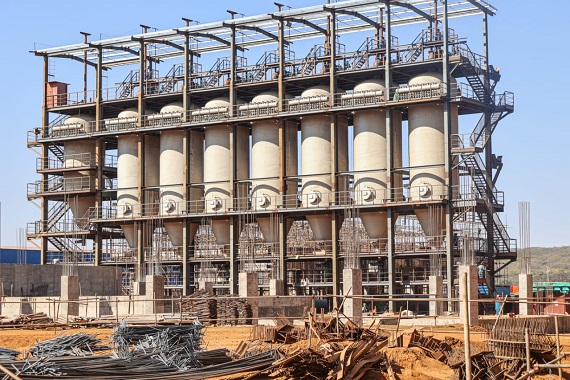
Oliver Kazunga
Senior Business Reporter
ZIMBABWE is set to significantly whittle down its steel import bill following revelations that Dinson Iron and Steel Company (Disco) — a Chinese company building Africa’s largest integrated steel plant in Manhize, near Mvuma — has already secured over 250 000 tonnes of steel orders from the domestic market.
Work on the Disco steel production facility in Manhize is scheduled for completion before the end of this year. Completion of the project will result in a massive cut in Zimbabwe’s steel import bill. The domestic demand for steel stands at 1,5 million tonnes.
Disco, a unit of China’s Tsingshan Holdings Group Limited, is constructing the Manhize plant at a cost of US$1,5 billion.
The plant is now 70 percent complete and is set to go into production in December this year.
The plant is expected to churn out 1,2 million tonnes of steel annually in the first phase, and subsequently raise the capacity to 5 million tonnes when it reaches full throttle.
In an interview last week, Disco project director Wilfred Motsi said: “People (local market) are coming up with different orders and right now, it’s premature to say who these people are, but we have orders already.
“They have also indicated the type of steel they want and cumulatively, the orders we have received so far are over 250 000 tonnes of pig iron and carbon steel, but we know the figure will increase significantly as we move closer to production.”
Disco will spur the growth of Zimbabwe’s iron and steel engineering industry, which took a heavy battering following the collapse of the Zimbabwe Iron and Steel Company (Zisco) in 2008, once the largest steel manufacturing plant north of Limpopo.
Since the closure of Zisco, Zimbabwe has been spending over US$400 million annually in importing steel products from the Southern African Development Community (SADC), mostly South Africa.
“Before we even start talking about exporting, the local market is big and on account of the orders we have received so far, it shows that the domestic market is warming up to do business with us.
“The national requirement for the local market is 1,5 million tonnes of steel per annum and when we commence production, we are targeting 600 000 tonnes of carbon steel, which figure will rise as we ramp up production under the first phase,” said Mr Motsi.
“In terms of supplying the export market, some companies in South Africa have already approached us, indicating that they need our products. There have been business delegations from all over the SADC region visiting our plant. For instance, from Mozambique and Zambia, we have received inquiries about our steel, again an indicator that the market is there for us.”
It is believed local steel manufacturing by the Chinese investors would cut imports by 90 percent.
“Our prices will be very competitive because of our cost of production, which is going to be low as our iron ore is just 7 kilometres from where we are. Furthermore, we are producing our coking coal as a company and I think this is something that is going to reduce the price of our products and because of that, we can penetrate the market very easily within the region, as well as locally,” said Mr Motsi.
In Zimbabwe, Tsingshan Holdings produces coking coal through its other local subsidiary, Dinson Colliery, in Hwange, Matabeleland North province.
In a separate interview, Zimbabwe Institute of Foundries chief operations officer Dosman Mangisi said Disco would be making a positive step towards the growth and development of the iron and steel industry in Zimbabwe.
“This is a very positive move and step towards the iron and steel industry, in terms of growth. It’s also an indicator that there is big business ahead for the industry and the appetite has already been exhibited, taking into account the number of orders that have been placed so far, even before the company starts producing.
“It adds confidence to the company that people have hope and faith in the company that offers competitive products to the market and this will impact the growth considering that from takeoff, Dinson will be producing 600 000 tonnes.
“In a very short space of time, production will jump to 1,2 million tonnes, subsequently 3 million tonnes and 5 million tonnes at full capacity.
“So, that alone gives us a picture that there is a very positive impact, which will see easing of the forex dilemma in the country because there will be import substitution on steel and related products,” he said.
“Currently, Zimbabwe is importing 75 percent of its steel and considering that Dinson is far way bigger than the capacity of Zisco, downstream industries are also going to grow because of the availability of pig iron, as well as the rapid increase in employment.”
According to the Engineering, Iron and Steel Association of Zimbabwe sector strategy, more than 50 000 jobs would be created by 2026 on the back of a robust local steel manufacturing industry.
Disco expects 10 000 jobs to be created directly once the Manhize operations start, while 1 700 jobs have been created from the works currently underway.
At its peak in the 1990s, Zisco produced over one million tonnes of steel and employed over 5 000 people directly, while thousands were employed in downstream industries.
“We look forward to seeing many sectors of the economy improving in terms of foreign direct investment, ease of forex wars and also the growth of a new town in Manhize within a short space of time,” said Mr Mangisi.
The establishment of the steelworks will see the launch of a number of infrastructural projects such as road and rail networks,
and a dam to provide water for domestic use, irrigation and industrial operations at the
plant.



 Online Reporter