Online Reporter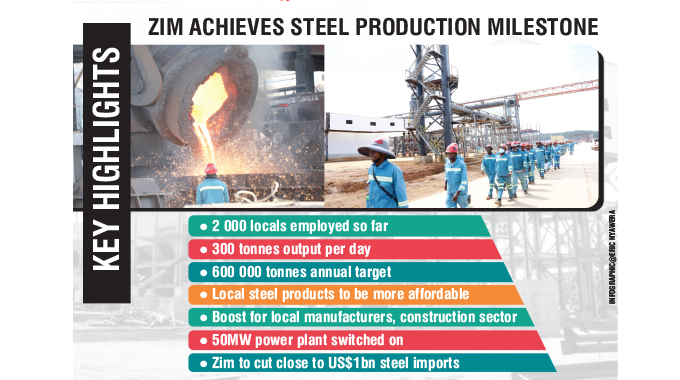
Patrick Chitumba, [email protected]
A major stride in Zimbabwe’s import substitution drive has been realised with the start of extensive finished steel production at the Dinson Iron and Steel Company (Disco) plant in Manhize, Midlands Province; a development that holds the promise of significantly propelling the nation’s industrial transformation agenda forward.
The successful implementation of the multi-million-dollar project reflects the positive impact of the Second Republic’s pro-investment policies and promises far-reaching benefits for the domestic economy and the region at large.
The revival of the iron and steel industry marks a turning point for Zimbabwe, which has been spending an estimated US$1 billion annually on steel imports. With this development, the nation can narrow its trade deficit and enhance export earnings.

Following the completion of preliminary test runs and the production of steel billets, Disco is now manufacturing ready-to-use finished steel products, including deformed bars in various sizes.
The plant has a daily production capacity of approximately 300 tonnes, with an ambitious annual target of 600 000 tonnes.
At this scale, Zimbabwe will not only meet domestic demand but also support infrastructure development, contributing to economic growth and industrialisation.
“We are now producing 16mm, 20mm and 25mm deformed bars, which are final products suitable for construction purposes. Currently, we are producing about 300 tonnes of deformed bars per day, with an annual target of 600 000 tonnes,” said Disco public relations manager, Mr Joseph Shoko.
Mr Shoko expressed confidence that local demand will be adequately met, stressing that their steel products will be more affordable than imports.
“Zimbabwe has been importing nearly all its steel, but soon we will be substituting those imports with our local production. Dinson Steel’s operations will contribute to increased steel production capacity in Zimbabwe, reducing reliance on imports and enhancing self-sufficiency,” he said.
The plant has already created about 2 000 jobs for locals, with additional employment opportunities expected as production ramps up.
“The steel production facility is creating employment opportunities, stimulating economic growth, and contributing to the development of the manufacturing sector. Steel production will also support infrastructure projects, such as construction, transportation, and energy, driving economic progress,” said Mr Shoko.
The Manhize plant is regarded as one of Africa’s largest integrated steelworks. It is owned by Disco, one of the three local subsidiaries of Tsingshan Holdings Group Limited, a leading global stainless steel producer.
Tsingshan also owns Dinson Colliery in Hwange and the Afrochine Smelting ferrochrome plant in Selous.
Mr Shoko described the steel production breakthrough as a game-changer for economic diversification, reducing reliance on traditional sectors like agriculture and mining. He also highlighted the role of domestic steel production in advancing economic development, industrialisation and infrastructure growth.
To support its operations, Disco has established a 50-megawatt power plant, though it is not yet connected to the national grid.
“Steel manufacturing requires substantial power. At the moment, our usage is around 24 megawatts. The surplus could be directed into the national grid once we fulfil the necessary requirements,” said Mr Shoko.
In line with global sustainability efforts, Disco plans to develop a wind power station to complement its operations.
“We have identified a suitable site around the Manhize Range, which has already been surveyed. The next step is securing funding,” he said.
Addressing environmental concerns, Mr Shoko highlighted the company’s commitment to land reclamation and fostering smooth co-existence with local communities.
“We acknowledge the environmental impact of our operations. As part of our reforestation efforts, we planted 5 000 trees last year in collaboration with the Forestry Commission during National Tree Planting Day,” he said.
Disco has also initiated upgrades on the 23km gravel road connecting the plant to the highway, a project expected to be completed in time for the plant’s commissioning in the first or second quarter of the year.
The Manhize steel project positions Zimbabwe as a global steel manufacturing hub, with projections indicating the country’s potential to emerge as a powerhouse in the steel and iron industry. What was once a dense forest has transformed into a thriving industrial zone, with modern buildings emerging from the wilderness.
The mega-investment also includes plans for the creation of a Smart City, named Manhize Town, and a science university, underscoring the transformative impact of the investment.
President Mnangagwa, who toured the factory in March last year, was impressed by the progress. Company officials expressed gratitude to the Government for facilitating smooth investments and committed to creating opportunities for locals.
The plant is expected to generate 3 000 direct jobs in its first phase, with numbers projected to exceed 10 000 in the fourth phase of production.
The steel plant is set to produce 600 000 tonnes of products in the first phase, rising to 1,2 million tonnes in the second phase, 3,2 million tonnes in the third phase, and ultimately five million tonnes per year in the final phase. This output will earn the country substantial foreign currency.
Future products include pipes, bolts, nuts, slag, rolled tubes, fences, shafts, wires and bars, among others.