Online Reporter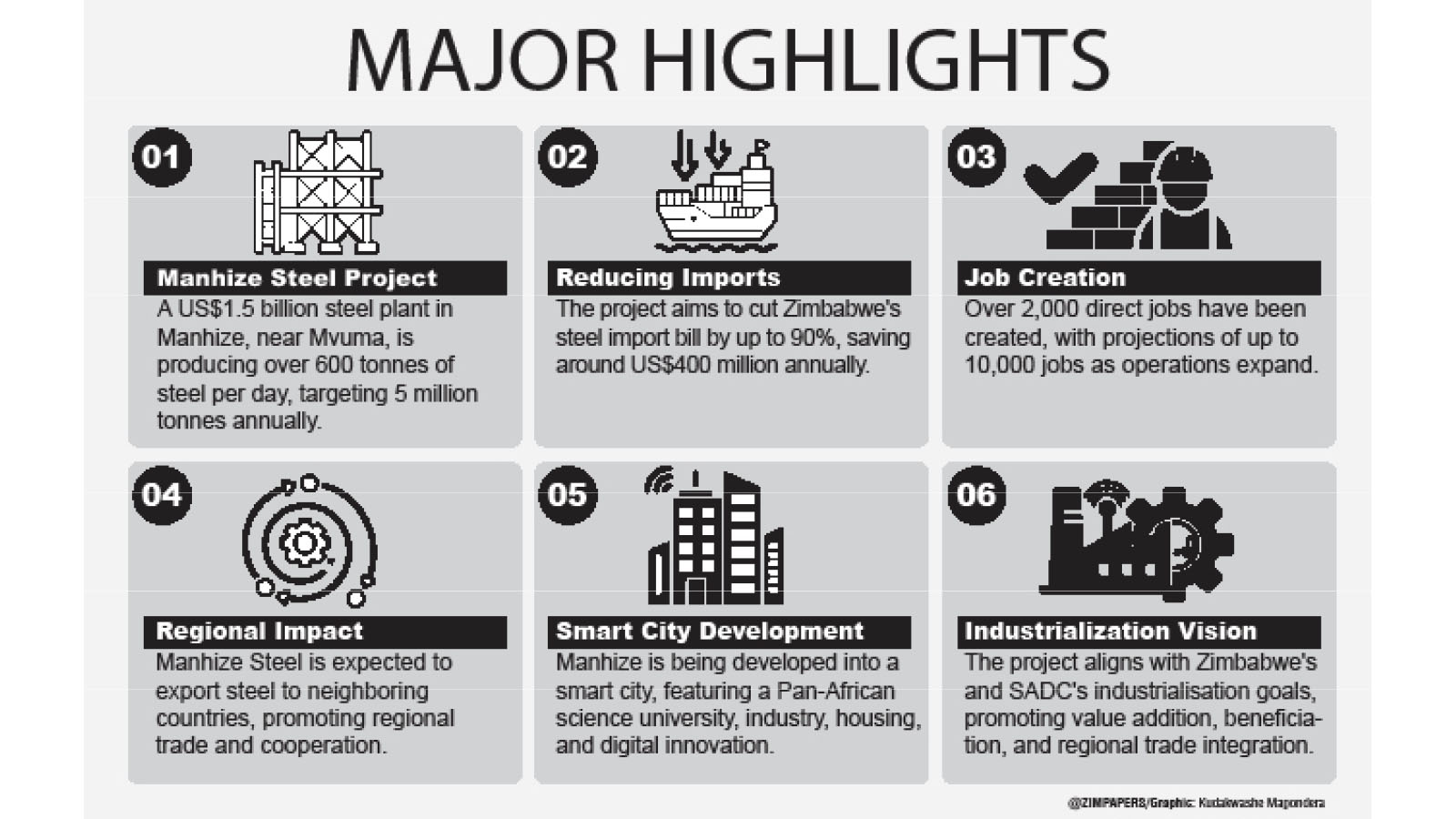
Theseus Shambare
A DRIVE across Harare tells its own story.
The skyline is changing — steel and iron jut from new residential blocks in Highlands and Hatcliffe, beams brace shopping complexes in Highfield and Chitungwiza, while warehouses along Seke Road stand tall in their metal skeletons.
Each new structure mirrors recovery, resilience and ambition.
However, a persistent challenge that has vexed Zimbabwe and the wider Southern African Development Community (SADC) for years has been the availability of cheap steel, as most, if not all of it, had to be imported.
A regional challenge
Since the collapse of the Zimbabwe Iron and Steel Company (Zisco) in the early 2000s, Zimbabwe has been spending roughly US$400 million annually importing steel, mostly from South Africa and China.
Many SADC countries, including Zambia, Malawi, Botswana and Mozambique, face similar challenges.
Imports inflate infrastructure costs and drain foreign currency.
“Every tonne of imported steel is a tonne of opportunity lost for our region. SADC cannot industrialise sustainably if it relies on imports for its most basic building block,” said Harare-based urban planner Engineer Ambrose Matanhire.
The SADC Industrialisation Strategy and Road Map (2015-2063) underlines this reality: the region forfeits billions each year by importing manufactured goods, undermining local industries and jobs.
Lessons from the past
Zimbabwe already knows what steel can build. At its peak in the 1980s and 1990s, Zisco produced close to one million tonnes of steel annually and gave life to entire towns. Redcliff rose around Zisco’s furnaces, while Kwekwe thrived with Lancashire Steel.
These towns were more than industrial hubs.
They were communities, complete with schools, clinics, markets and recreational facilities.
Steel companies went further, investing in football clubs that became national symbols.
Ziscosteel Football Club and Lancashire Steel Football Club played in the Zimbabwe Premier Soccer League, bringing pride and identity to their towns.
Talented players like Paul Gundani, who rose through Ziscosteel and Lancashire Steel before earning national team caps; and Luke Petros Jukulile, a midfielder who transitioned from Lancashire to the international stage, are living proof that these plants were incubators not only for industry, but for culture and human potential.
Manhize now rekindles those memories, but on a much larger and grander scale.
A leadership vision aligned
During his tenure as SADC chairperson, President Mnangagwa placed industrialisation at the heart of regional renewal.
“As the peoples of the SADC region, let us celebrate our shared vision of an integrated, industrialised, prosperous and peaceful region.
“We must scale up our collective efforts to value-add and beneficiate our natural resources,” he said.
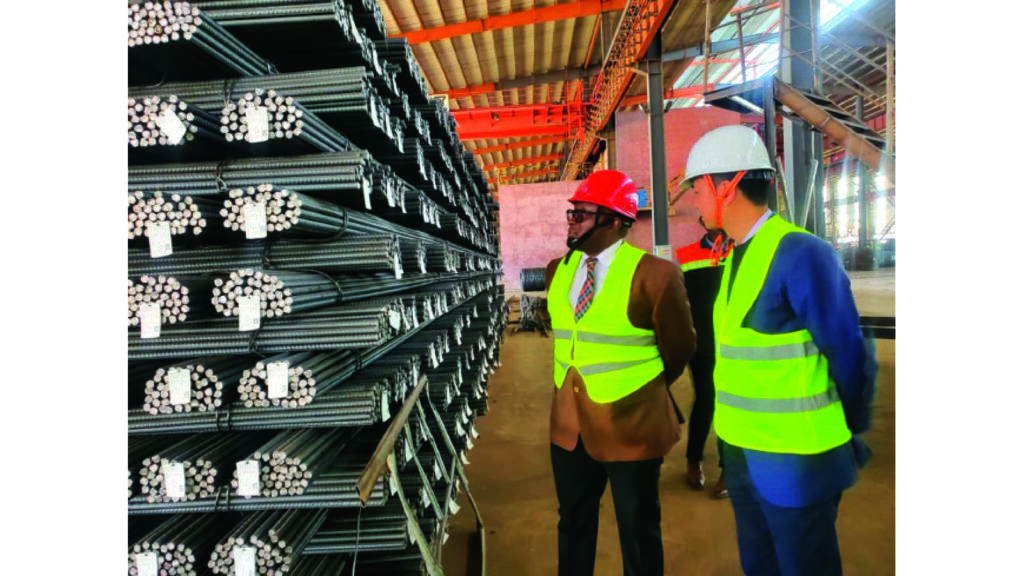
Information, Publicity and Broadcasting Services Minister Dr Jenfan Muswere being shown steel bars by Disco chief executive officer Mr Benson Xu during a recent tour of the plant in Manhize.
He stressed that the youth, women and skilled professionals are the “key catalysts” of this transformation.
The new regional chairperson, Madagascar’s Andry Rajoelina, has since reinforced the vision.
“It is time to industrialise more, to better connect our economies and to strengthen our collective autonomy,” he recently said.
Together, these leaders position Manhize not only as a Zimbabwean project, but as a beacon of industrial resurgence for the entire region.
Reimagining communities
In Manhize, near Mvuma, this vision is being realised.
The US$1,5 billion Dinson Iron and Steel Company (Disco) plant has roared to life; it is an integrated hub combining iron ore mining, carbon steel production and rolling mills.
Currently producing over 600 tonnes per day, the plant is targeting five million tonnes annually — five times Zisco’s historical output.
This will position Zimbabwe as one of Africa’s steel giants.
“Zimbabwe has been importing around 100 000 tonnes of steel reinforcement bars annually at a cost of US$68 million.
“At full throttle, Manhize will cut that bill by up to 90 percent,” said Disco project director Mr Wilfred Motsi.
The vision extends far beyond steel.
Manhize is being reimagined as a smart city anchored by a Pan-African science university, where industry, housing and digital innovation converge to create a futuristic community. As Redcliff and Kwekwe once flourished around Zisco and Lancashire Steel, so, too, can Manhize anchor new opportunities — schools, clinics, shopping centres and homes designed for the future.
Dinson chief executive officer Mr Ben Xu said Manhize’s impact will stretch beyond Zimbabwe.
“Our goal is to make Manhize a benchmark for African steel production that competes globally. Exports will flow to Zambia, Malawi, Mozambique, Botswana and even the Democratic Republic of Congo,” he said.
Regional trade experts argue that this is a breakthrough moment.
“SADC’s intra-manufactured goods trade sits under 20 percent. Locally produced steel can fast-track infrastructure development, strengthen manufacturing and empower participation in the AfCFTA (African Continental Free Trade Area),” said Dr Patience Moyo, a trade analyst based in Gaborone.
The US$400 million Zimbabwe has been spending on steel imports annually could be used for other purposes locally.
“It is not just about steel; it is about freeing resources to improve lives,” said economist Mr Shepherd Dube.
Beyond steel, Manhize is changing lives.
Over 2 000 direct jobs have been created, with projections of up to 10 000 as operations expand. Tens of thousands more will benefit in downstream sectors.
Local markets now bustle with vendors and transport operators. Training programmes are nurturing welders, mechanics and heavy machinery technicians.
“Before, I thought I would never work. Now, I am gaining skills that will support my family and open regional doors,” said 24-year-old trainee technician Tendai Ncube.
Energy needs are being addressed, too.
A thermal power station currently producing 50 megawatts (MW), with expansion to 70MW planned, will serve both the plant and the national grid.
Policy and partnerships
During a site visit recently, Information, Publicity and Broadcasting Services Minister Dr Jenfan Muswere linked Manhize to Zimbabwe’s Vision 2030 and National Development Strategy 1 goals.
“Manhize demonstrates commitment to value addition, beneficiation and industrialisation.
“It positions Zimbabwe and Southern Africa for global trade competitiveness,” he said.
Professor Elias Mwamba, of the University of Zambia, added:
“ “SADC’s industrialisation depends on strong local manufacturing bases.
“Steel is foundational; it underpins energy, housing, transport and agriculture.”
From Harare’s growing skyline to Manhize’s molten furnaces, Southern Africa’s story of industrial emergence is unfolding.
For Zimbabwe, Manhize signals sovereignty and revival.
For SADC, it heralds a new era of manufacturing, trade integration and resilience.
With every beam and rod leaving Manhize, the dream of self-reliance and shared prosperity moves from vision to reality.