Online Reporter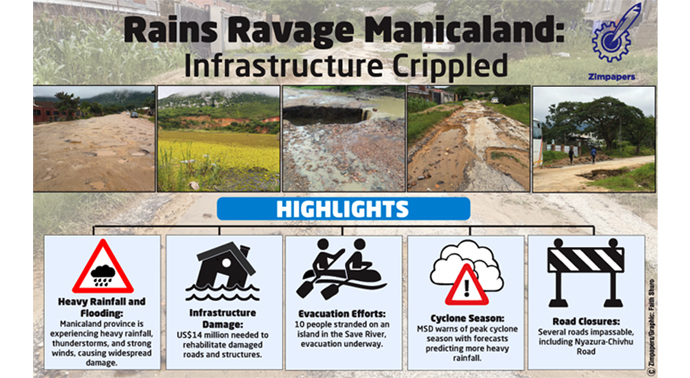
Ray Bande and Lovemore Kadzura
HEAVY rains, violent thunderstorms, and strong winds have battered Manicaland, crippling key public infrastructure and leaving roads impassable, schools and homes damaged, and health facilities in ruins.
With the cyclone season now at its peak, fears of further devastation continue to mount.
The destructive weather has torn roofs off classrooms, clinics, and homesteads, while roads and bridges have suffered extensive damage — rehabilitation costs are expected to run into millions of dollars.
Many rural routes are now inaccessible, raising alarm over the vast resources required to restore the province to normalcy.
The Mutare-Harare Highway remains the only major road still intact.
In contrast, surfaced, gravel, and earth roads across the province have been severely eroded, forcing public transport operators to either abandon rural routes or hike fares to offset mounting vehicle repair costs.
On link and Bhinya roads, unchecked vegetation has further obstructed drivers’ visibility, especially at intersections.
Feeder roads have been washed away, and damaged bridges are forcing motorists onto costly, time-consuming detours.
The Nyazura–Chivhu Road, particularly between Nyazura and Rukweza, is among the worst affected, with deep potholes demanding extreme caution.
As of Wednesday, the Rural Infrastructure Development Agency (RIDA)—which oversees a 3,360-kilometre road network—estimated at least US$14 million would be needed to rehabilitate damaged roads and structures. Additional roads under the Ministry of Transport and Infrastructural Development and rural district councils remain unaccounted for, with repair costs yet to be quantified.
The province’s dire situation was underscored during Wednesday’s Provincial Civil Protection Committee (CPC) virtual meeting.
Reports revealed that nine cattle were killed by lightning in Nyamazira, Makoni District, while 10 people remained stranded on an island in the Save River at Mahenye Village, Ward 23, Chipinge District, with evacuation efforts underway.
In Mutare rural, flooding has placed poorly maintained inland dams at risk of collapse. Chikundu Dam in Village R, Ward Four, Odzi, is particularly vulnerable, with its downstream wall showing signs of failure due to neglect and vehicle traffic on the embankment.
The Meteorological Services Department (MSD) has warned that the cyclone season—typically spanning January to March—poses recurring threats of destruction.
The CPC is struggling to mount an effective response, hampered by shortages of pre-positioned disaster relief supplies such as tents, WASH (Water, Sanitation, and Hygiene) equipment, and other essentials.
Ministry of Transport and Infrastructural Development Manicaland Provincial Road Engineer, Engineer Raphael Sigauke confirmed that roads across Manicaland have been severely battered by the rains and will require extensive resealing, pothole patching, and graveling to restore trafficability.
“Our roads have been significantly affected by the heavy rains pounding the province, especially the ageing ones. The tarred roads are experiencing potholes and excessive vegetation growth, while gravel and earth roads are suffering from corrugation, and are at risk of being cut off. Government has acquired pre-mix for pothole patching, with production ongoing in Harare and Bulawayo. A pothole patching blitz is planned for the next two months. The Nyazura-Chivhu Road is one of the severely affected routes in the province. We plan to work on a 20km stretch. Pothole patching on Nyazura-Chivhu is no longer compatible to the damage. The damage requires an overlay to fix the entire stretch,” said Engineer Sigauke.
Acting provincial director for RIDA, Mr Rudo Nyanguru said the agency’s roads are in poor condition, with some structures destroyed, making areas inaccessible.
“We are collecting information, and have gathered that roads requiring remedial action as we speak, will cost US$14 million. Some roads are cut off, and structures are destroyed, making parts of Buhera, Makoni, and Chipinge inaccessible. Some roads are slippery and require gravelling, but we are currently unable to act due to rain, we are only mobilising resources and equipment in the affected areas,” he said.
Chipinge District Development Coordinator (DDC), Mr William Mashava reported that the district CPC is activated, with 30 evacuation centres, mostly schools.
He said three people, including a three-year-old, have drowned since the start of the rainy season.
Mr Mashava said 10 people marooned in the Save River are evading rescue officers.
“It is unfortunate that the 10 people are running away from officers deployed to rescue them, including the ZRP Sub Aqua Unit. We are unsure if this is resistance, but they should not be there, and we appeal for help to evacuate them,” he said, adding that roads in the district were in a deplorable state.
Chimanimani DDC, Mrs Vivian Mateta said: “We have managed to activate all arms of the CPC although we have not prepositioned resources in the 82 evacuation centres that we have. We have an ECD classroom block, headmaster’s house and a Grade Seven classroom block whose roofs were blown off at Mashonjowa Primary School. A house’s roof at Runyararo was blown off and two footbridges were swept away. We have had three deaths of people who fell into mining shafts, including a minor, who had followed his father to a mining area. Our roads are in a bad shape. The 68km Scenic Road stretch is in bad condition and the same with Rusitu’s Kurwaisimba Road. Along the road to Skyline, we are experiencing some rock falls.”
Mutare DDC, Mr Tendai Kapenzi said: “We had a 53-year-old man who died after drowning in Ward 24. We also have very deep pools in Mountain Rise here in Mutare Urban that are now a hazard to the communities around. They are filled with water and risk overflowing into surrounding communities. Unfortunately, these pools have been a convenient site for people who want to commit suicide. They are a death trap. We do not have prepositioned resources such as tents, even though we are in the process of sourcing. We also have roads that are really in bad shape, especially most roads in Mutare Urban. The same with Riverside, Odzi. The Murahwa Greenmarket bridge continues to be a challenge for motorists.”
Makoni District Development Coordinator, Mr Edwin Mashindi said: “We have received a report that nine cattle were struck by lightning in Nyamazira yesterday (Tuesday). We have not yet received more details about the incident because the report came before we came into this meeting. We have managed to set 32 evacuation centres, 22 schools and 10 council halls. We have a bit of prepositioned resources in the event of a disaster, but that might need additions. We experienced deaths, including a minor who was trying to cross a river while holding on to the tail of a cow.
“In terms of roads, the Headlands-Chiendambuya Road is now untrafficable. Roads in Nyazura Township, Headlands Township and Rukweza Rural Services Centre are in a deplorable state.
“The same situation is prevailing in Rusape, especially in the Magamba Extension area. In terms of infrastructure, we had a roof blown off at Nyamidzi Clinic.”
Buhera DDC, Mr Freeman Maviza said: “The Birchenough Bridge-Murambinda Road is now almost unpassable. The road is now in a very bad state, much worse than before. We also have schools that have been badly affected in Buhera District, the hardest hit being Chabata Primary School, where eight classroom blocks had their roofs blown off.”
Mutare city’s roads are in a poor state, with motorists complaining of difficult navigation due to potholes on both tarred and gravel roads, particularly in residential areas.
Mutare City Council spokesperson, Mr Charles Sadondo said the council is carrying out pothole patching, drain clearing, and desilting programmes to improve the situation, but efforts are sometimes hampered by the rains.
Mr Charles Sadondo said the city has categorised its road network into primary commuter routes and secondary access roads, prioritising the former, including Aerodrome Road, Chikanga Commuter Route, Magamba Drive, and others, to ensure they remain trafficable.
“The incessant rains have had a devastating impact on the city’s roads, causing widespread washaways and potholes across residential areas and tarred roads. To mitigate the situation, we are carrying out pothole patching and continuous drain cleaning and desilting programmes whenever the weather permits. This will prevent further damage to the repaired roads and carriageways. However, funding remains a significant challenge, with serious underfunding affecting our road network. Despite this, we are prioritising primary commuter routes, including Aerodrome Road, Chikanga Commuter Route, Magamba Drive, Jeff Road, Feruka Road, Blessing Makunike Road, Dangamvura Commuter Route, Dangamvura Link Road and Park Road. Park Road is also being maintained as an alternative route in case of challenges along Chimanimani Road,” he said.
He clarified that some residential areas, such as ZIMTA, where earth roads have turned into gullies, are yet to be handed over to the local authority for management, as they were developed by private entities.
“ZIMTA project is one of the projects that are still under the developer and was not handed to council since there are still some outstanding works including the roads. This is the same situation in other projects serviced by private developers and not yet handed over to council,” said Mr Sadondo.
In Chipinge, some teachers missed the opening day of schools as vehicles were stranded on muddy roads.
Chipinge Rural District Council roads engineer, Engineer Henry Dhliwayo said the rains have caused severe damage, making it impossible to carry out assessments as the roads are impassable.
“Our roads were already in a poor state before the rains, and the incessant rains have worsened the situation. We attempted to assess the situation around Checheche on Monday, but were unable to proceed due to the rains. People are abandoning their vehicles on the roads and walking to access their villages.
We will begin rehabilitation work at the end of March 2026, after the rains subside. Grading roads now would exacerbate the situation. We are currently procuring materials and dumping gravel,” he said.
Makoni Rural District Council chief executive officer, Engineer Edmore Chidembo said their roads have developed potholes, experienced waterlogging, and lost the gravel surface.
“The state of our roads is poor, and we are still receiving heavy rains, causing further damage. Major repairs are difficult at present as machinery gets stuck. We are doing manual maintenance to ensure that people can access services,” he said.
Manicaland continues to record a significant amount of rainfall with the report presented by MSD focal person, Mr Tapiwa Maringo indicating that Mutasa and Nyanga districts received the highest amounts of rainfall at 984mm and 942mm, respectively, cumulative from January 1, 2026.
Makoni District received 735,7mm, while upper Chipinge received 691,1mm.
The Lowveld part of Chipinge received 363,8mm of rainfall for the same period, while Buhera received 304,7mm.
Chimanimani District received 856,1mm, while Mutare received 594,8mm.