admin
admin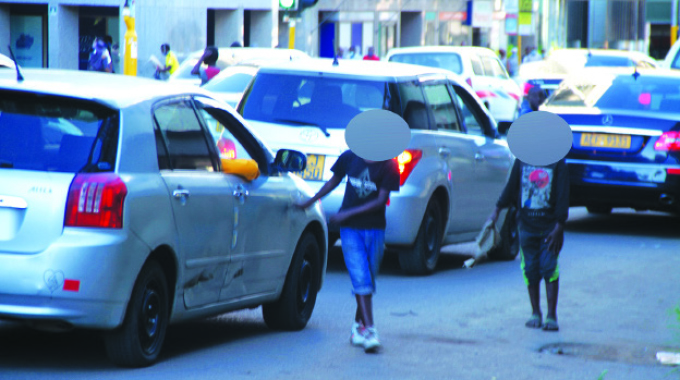
Roselyne Sachiti-Features, Health & Society Editor
Samora Machel Avenue in Harare’s central business district (CBD) is a busy road, especially during the evening peak hour.
It is 5pm on a wintry Tuesday and Zimbabwe Republic Police (ZRP) and Harare municipal police officers help ease the rush hour congestion on the road.
Vendors selling cellphone chargers, USB cables, key holders, dashboard cleaners, dog leashes, biscuits, sweets, among other small items, pace up and down hoping to cash in on the motorists stuck in the congestion.
Standing near traffic lights are four boys aged between five and nine. They are holding pieces of cloth and seem ready to run.
As the police officer stops cars driving out west of Samora Machel Avenue, the smallest of the four, Taku (not real name) swiftly moves towards a car, which has just stopped.
Without saying a word, the five year-old boy starts cleaning the window on the driver’s side and also a section of the windscreen.
As his tiny hands clean the windscreen, his pleading eyes look at the driver, a desperate appeal for acknowledgement of the work he is doing.
In a few seconds, the driver lowers his window and hands over $40 to Taku, who thanks him and dashes down the road.
He looks for more cars, succeeding in collecting money from some drivers, but unlucky with some.
His peers Moses (7), Charles (6) and Tonde (9) (all not real names) also move from one car to the other doing the same routine.
“I am not doing anything bad,” says Taku. “I am helping to clean cars. It is better than snatching food from passersby.”
The boy is cunning, his wit and precision when spotting prospective clients is like that of a hungry predator hunting down its prey.
“I look for cars that are dusty and really need a wash,” says Taku, his attention shifting from the interview to cars. “So, I run to such cars first and wipe the bonnet or part of the windscreen without even asking the driver for permission.”
Living and working on Harare’s streets seems to have snatched his innocence, hardening Taku as he rarely thinks of his family.
He says he has little contact with his family in Epworth, a sprawling settlement a few kilometres east of the city centre, and mainly depends on his peer group.
When his grandmother comes to look for him on the streets, he runs away.
“My grandmother is old,” says Taku. “She cannot work anymore. I do not want to stay in Epworth as she cannot take care of me. My mother died when I was two.”
As the interview progresses, Taku’s friend Moses is visibly not amused.
He rushes towards Taku and yells at him: “Taku, cars are passing while you are busy talking to her. Mari irikubaya wangu, bhoo here (You are missing some money. Is that okay with you?”
Given his age, the sharpness of Moses’ tongue and knowledge of street lingo is unsettling as other kids his age are busy singing nursery rhymes.
Yet to the young man, this is normal, an ordinary day in office and in life.
“I have to hustle,” says Moses, who has taken a short break to count his money. “I clean about 10 cars a day at intersections and traffic jams. That’s how I live. I make US$3 or $300 in local currency per day depending on traffic volumes and kindness of those I would have cleaned cars for.”
Moses says his mother is blind and now begs alongside his little sister aged three.
“My mother would take me to traffic lights to beg for money and food,” he says. “Now, I do it alone and pocket all the money I get. Sometimes I buy her and my little sister food and give them.”
Moses says he has never been to pre-school, does not think he will go to school anytime, and may never do so as this never crosses his mind.
“Which school will accept me when I stay on the streets?” he says. “Plus, why do you think I like school,” he asks as he rushes to another car that has just stopped.
Charles is standing at a corner after a scuffle with a teenager living on the streets, who has just tried to snatch his money.
Having been rescued by a vendor selling bananas, Charles picks the remainder of his money which has fallen to the ground as the teenager flees.
He counts the remaining notes slowly, one by one, over and over again.
At this tender age he knows too well the value of money and does not want to lose any.
“These older boys always steal our money,” says Charles. “They are bullies and sometimes beat us up and throw away the pieces of cloth we use to clean cars. I am scared of them.”
His family is also in Epworth and he rarely goes home, only doing so when he is sick or when his mother has dragged him.
But Charles adds that the moment he gets home, he always comes back to the city centre.
“I am used to working on the streets and cleaning cars,” he says. “I love it when there is congestion and this gives me enough time to clean the cars. Congestion also means more cars for us and more negotiating time.”
Charles says he uses his money to buy food.
In between cleaning cars, the young boys also play on pavements sitting on refuse bins, tossing refuse out and chasing each other.
“No one controls us or the time we go to bed,” says Tonde, the oldest of the four boys. “I do what I want, buy what I want and sleep when I want.”
Tonde says his family is also in Epworth and he has not seen family members in three months.
The children living and working on the streets say they would rather risk life on the streets than go home or taken into care.
This is despite the dangers and risks on the streets.
These include exploitation and violence, where children are constantly exposed to the risks of drugs, sexual abuse and delinquency.
Such children also risk being run over by motorists as they pace up and down the roads. Yet to these four, the streets have become a home and a workplace.
A motorist Mr Brighton Gunda of Warren Park says he fears that some people may take advantage of the young boys.
“They may be exposed to trafficking or sexual abuse by some people,” he says. “It is important to remove them from the streets.”
Mr Gunda says giving the children money will only encourage them to keep returning to the streets.
“If we stop giving them money, the streets will be uncomfortable and those with families will go back home,” he says.
Another motorist Ms Memory Pito said she feels sorry for the kids and regularly gives them some money.
“They are so young and innocent,” he says. “They need love and care from everyone.”
Last year, the Government relocated people living on the streets, including children, but some have since returned. At night, Taku and his friends Moses, Charles and Tonde light up a big fire on an island along Samora Machel Avenue.
Here, they spend the night talking and thinking of the next day, their money stashed somewhere safe….



 Online Reporter