admin
admin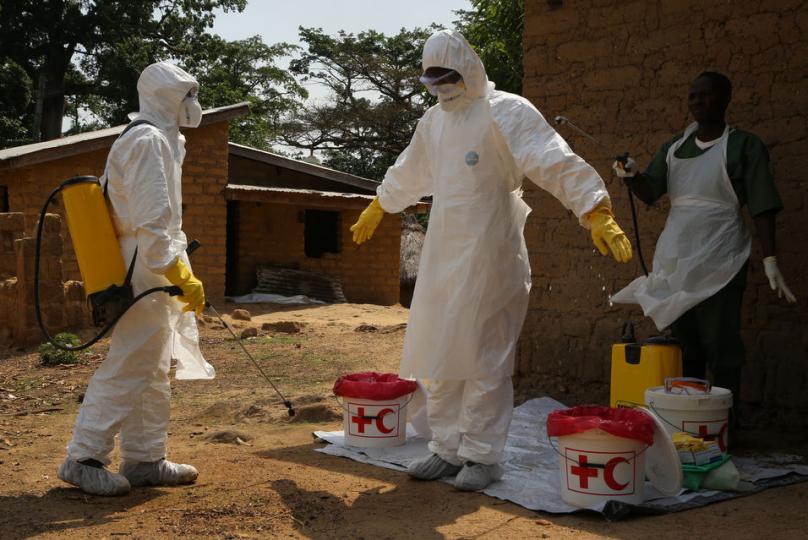
 Freetown – The Sierra Leone Broadcasting Corporation reported yesterday that bodies of Ebola victims have been left in the country’s streets because of a strike by burial teams, who complain they have not been paid. Health ministry spokesperson Sidie Yahya Tunis said the situation is “very embarrassing”, insisting money was available to pay the teams. He promised to provide more information later yesterday.
The World Health Organisation says Ebola is believed to have killed more than 600 people in Sierra Leone, where there have been more than 2,100 confirmed cases.
Meanwhile, Spain has quarantined a total of four people in an attempt to prevent the spread of Ebola after a nurse became the first confirmed case of infection outside West Africa.
The 40-year-old nurse, her husband, another health worker and a Spaniard who travelled to Nigeria are in isolation in hospital, Madrid health officials said on Tuesday.
The husband shows no symptoms, and the health worker has diarrhoea but no fever. There was no information about the condition of the fourth person.
One of the four has tested negative for the disease, Reuters reported on Tuesday, citing a Spanish health official. It was not clear who of the four was tested.
Rafael Perez-Santamaria, the head of the Carlos III Hospital, said a further 22 people who had been in with the nurse contact were being monitored.
The nurse had treated a 75-year-old Spanish missionary who had caught the disease in Liberia, and a 69-year-old priest who caught Ebola in Sierra Leone. Both missionaries died, the first on August 12 and the second on September 25.
The nurse fell ill on September 30, and officials said she entered the room of the second patient twice.
“This has taken us by surprise,” said Perez-Santamaria. “We are revising our protocols, improving them. The priority remains to find out what actually happened.”
The health ministry’s chief coordinator for health alerts and emergencies, Fernando Simon, told local radio that there was a small chance that people who had come into contact with the nurse may have contracted the disease.
A small number of public health workers demonstrated in Madrid over the infection, and the danger faced by hospital staff.
“This is not a game to be played in the way they have done. It is a very worrying matter and they have not handled it correctly,” a nursing assistant at Madrid’s La Paz hospital, which one of the missionaries had visited.
A cardiologist at the hospital added: “We cannot understand how someone who was wearing a double protection suit and two pairs of gloves could have been contaminated.”
The outbreak of Ebola, the worst on record, has infected at least 7,400 people, according to the World Health Organisation. At least 3,400 people have died of the disease in Liberia, Sierra Leone and Guinea, the three countries most affected by the epidemic.
On Tuesday, Unicef delivered 70 metric tonnes of supplies to Guinea to help the country combat Ebola, according to the Manuel Fontaine, the organisation’s regional director for West and Central Africa.
The supplies included protective equipment for health staff, basic drugs, nutrition, water and sanitation supplies, he said. Fontaine added that Unicef had delivered 600 metric tonnes of supplies to Guinea, Liberia and Sierra Leone – the three countries hit-hardest by the Ebola outbreak – over the past two weeks.
In a related incident the United States will announce tightened controls on international travellers in the coming days to prevent Ebola from spreading on US soil, health officials said on Tuesday.
Since the first case of Ebola in the United States was detected a week ago – a Liberian man in Texas who arrived September 20 without showing symptoms – there have been calls in Congress and elsewhere for stricter controls.
“As the president said yesterday we are looking hard at what we can do to further increase the safety of Americans and in the coming days we will announce further measures that will be taken,” said Tom Frieden, head of the Centres for Disease Control and Prevention (CDC).
President Barack Obama said on Monday that new protocols were under study to boost controls on travellers as they left West Africa and upon arrival in the United States.
Obama said the United States could work with Customs officials and Homeland Security to identify people on connecting flights so as to determine their port of entry in the United States.
Charles Schumer, an influential Democratic Senator, said on Tuesday after a conversation with Frieden that Washington would impose measures even tougher than suggested by the president.
Schumer has said passengers arriving from countries where the tropical virus is taking a heavy toll should have their temperature taken upon arriving in American airports.
He pressed Homeland Security to create a database of passengers arriving from West Africa directly or indirectly, to which all American hospitals would have access.
Both Obama and Frieden ruled out a ban on flights to and from affected countries, as called for by some lawmakers.
Frieden said this would worsen the health crisis by reducing the ability to fight the disease, while stressing that half of all airlines had already stopped serving the affected countries.
He also hailed the work of the CDC in Liberia, Sierra Leone and Guinea, the three west African states hardest hit by the worst outbreak of Ebola on record, which has killed more than 3,300 people since the start of the year. – AFP


 Online Reporter