Thabo Ncube and Nicole Madombwe
AFRICA is facing one of its worst humanitarian crises in recent history, and not enough people are paying attention.
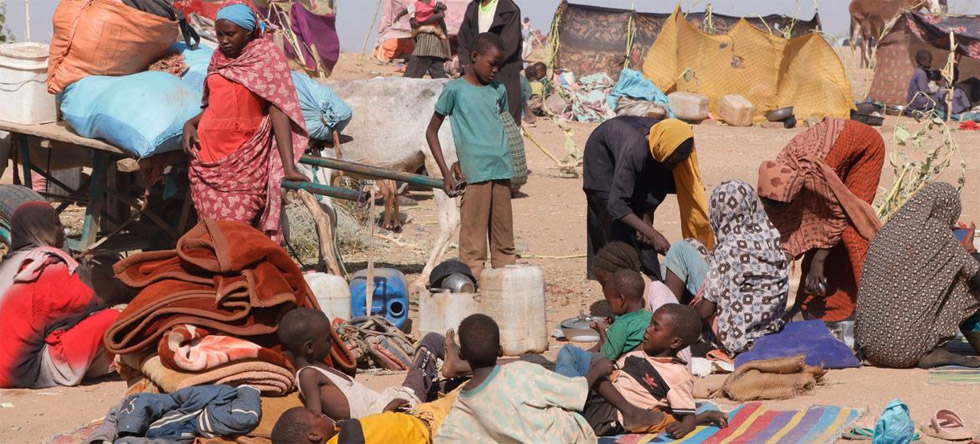
The ongoing conflict in Sudan, which started in April 2023, has already displaced over seven million people.
Families have been forced to flee their homes with nothing, but the clothes on their backs. Thousands have died. This is not just a Sudanese problem. It is a continental crisis that threatens peace, stability, and human dignity across Africa.
Sudan’s conflict began when fighting broke out between the Sudanese Armed Forces (SAF) and the paramilitary Rapid Support Forces (RSF).
Both sides are fighting for control of the country, and civilians are caught in the crossfire.
What started as a power struggle has become a humanitarian disaster. Cities like Khartoum and El Geneina have turned into battlegrounds. There is no safe place left in the country.
The displacement caused by the war has been massive. People have fled to neighbouring countries like Chad, South Sudan, Ethiopia, and Egypt.
These host countries are already struggling with their own economic and political challenges.
Taking in millions of refugees puts extra pressure on already weak systems. Food, water, shelter, and medical care are in short supply. Schools and hospitals are overwhelmed. Borders are overflowing with people who have nowhere else to go.
What makes this crisis even worse is the lack of international attention and support. Compared to crises in Europe or the Middle East, African conflicts often receive less media coverage and fewer donations.
The UN and aid agencies are struggling to raise enough funds for Sudanese refugees. In 2024, the UN appealed for US$2,6 billion to help Sudan, but less than half of that was received.
African lives should not be seen as less valuable than others. We need to change how the world responds to crises on this continent.
It is also important to look at how African governments and regional bodies like the African Union (AU) are handling the situation. Sadly, their response has been too slow and too weak.
While there have been some efforts at peace talks, they have not succeeded. The AU needs to take a stronger leadership role. This means, not just holding meetings, but also applying real pressure on the warring parties to stop the fighting. Africa cannot afford to watch one of its largest countries collapse.
But governments are not the only ones with a role to play. Civil society groups, religious leaders, youths, and the African diaspora must also speak out and take action.
The people of Africa need to show solidarity with Sudan. Displacement is not just a humanitarian issue — it is also a threat to regional security. Refugee camps can become breeding grounds for disease, crime, and even recruitment by extremist groups. The longer the crisis continues, the harder it will be to rebuild Sudan and reintegrate the displaced population.
There is also a long-term lesson here. Africa needs to invest more in peacebuilding and conflict prevention. Many of the continent’s conflicts, including the one in Sudan, are driven by poor governance, ethnic tensions, inequality, and competition for resources. These problems are not new. But until they are addressed, wars will continue to break out, and people will continue to be displaced. Leaders must focus on building strong institutions, ensuring justice, and creating opportunities for all citizens.
Youths of Africa — who make up more than 60 percent of the population — must also be part of the solution. Too often, young people are used as tools of violence. But they can also be powerful agents of peace. With education, skills, and a voice in politics, they can help build a future where conflicts like the one in Sudan become less common.
In conclusion, the war in Sudan is not an isolated event. It is part of a bigger pattern of conflict and displacement that is affecting millions of Africans. The suffering of Sudanese refugees should be a wake-up call. Africa must not only respond to the crisis but also learn from it. Stronger leadership, better planning, and greater solidarity are needed now more than ever. The time to act is not tomorrow — it is today.
The writers are students at Africa University pursuing a Bachelor of Science Degree In International Relations.