Bruce Ndlovu Sunday Life Reporter
IT is early morning in one of Bulawayo’s affluent suburbs.
Outside, birds chirp in earnest, while indoors, the familiar cacophony of children getting ready for school fills the air.
Yet, amid the commotion of family life and birdsong, another, less familiar sound drifts through the property, the
rhythmic clatter of sewing machines emanating from the veranda.
A space usually reserved for quiet family moments has been transformed into a bustling work-shop.
Scraps of fabric, loose threads and cuttings lie scattered across the floor — evidence of hours of painstaking labour.
With every stitch, the three men edge closer to their goal.
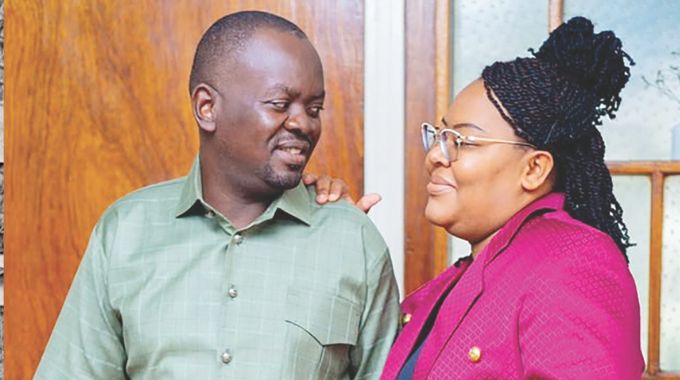
Led by renowned designer Thembani Mubochwa, the team has been working in the house for four days and nights, crafting garments for businessman Decent Sibanda, his wife, Nobuhle Msimanga and Sibanda’s elder brother, Stephen.
After four gruelling days, during which the trio worked up to 22 hours a day, the assignment is complete. Ten garments have emerged from the makeshift studio: four for Sibanda, six for Msimanga and a suit for Stephen.
Surviving on barely two hours of sleep each night might seem punishing, but such is life within Thembani Mubochwa’s Premium Bespoke Service.
It is an unrelenting routine that takes the designer and his team into the homes of some of Zimbabwe and Southern Africa’s wealthiest and most influential figures.
Wherever they are summoned, the crew arrives with sewing machines, equipment and fabrics in tow, establishing a fully functional workshop inside the client’s home.
For days, the house ceases to be merely a residence and becomes a tailoring studio where garments are measured, cut, stitched and refined under the watchful eye of the owner.
Every fitting, adjustment and stitch is completed with the client present, ensuring each piece meets their exact expectations.
Sibanda, a farmer and owner of Dee and Noe Deli and Grill, is the first entrepreneur to bring Mubochwa’s service to Bulawayo.
Previously, the designer has provided this exclusive experience to flamboyant businessman Phillip Chiyangwa, music superstar Jah Prayzah and the late South African gospel star Sifiso Ncwane.
For Mubochwa, the service is about far more than convenience, it is about turning a transactional relationship into a collaborative journey.
“People become part of the creative process,” he told Sunday Life.
“We are not just taking measurements and disappearing until the garments are finished. Every client has their own preferences. Someone might love a particular fabric, another might want their pockets styled in a certain way.
Working from their home allows them to contribute right down to the final stitch.”
In an industry where clients often complain about missed deadlines and designers who disappear after receiving deposits, Mubochwa believes the service restores confidence in bespoke tailoring.
“It raises the standards of professionalism because people can see the work happening. There is transparency throughout the process,” he said.
For the award-winning designer, Bulawayo represents new territory.
While his sewing machines have hummed inside the homes of some of the country’s biggest names, Sibanda’s invitation marked his first assignment for a Bulawayo entrepreneur.
“This feels like a homecoming for me,” he said.
“We have done this for many prominent businesspeople around Zimbabwe, but this is the first time we have been hired by someone from Bulawayo. We hope this is the beginning of something bigger in this part of the country.”
For Sibanda, the relentless schedule came as no surprise.
“I first discovered his work on social media and was impressed. He had worked with celebrities and respected businesspeople, so I wanted to experience it for myself,” he said.
As a businessman accustomed to long hours, Sibanda admired the designer’s work ethic as much as his craftsmanship.
“It was not shocking to see them working almost around the clock, because that is how I also work. We work the ‘Japanese way.’ I believe in hard work and I could see that he believes in it, too.”
The finished garments only strengthened Sibanda’s conviction.
“I do not think this will be the last time we work together. I will definitely be calling him again and I will encourage other businesspeople I know to support what he is doing. It is something exceptional.”
For his wife, Nobuhle Msimanga, the experience was unlike anything she had imagined.
Having a designer move into her home with sewing machines and fabrics seemed like a luxury re-served for the celebrities she had only seen on television.
“Working with the Afrojumbo team has been an experience. It is a lifetime event for me because this is the first time I have had a designer come to my space and craft tailor-made suits in the comfort of my home,” she said.
“It was really exciting; on some days, I would go to them and film my clothes being made.”
The experience fascinated the entire household.
Her children initially struggled to understand why strangers had filled the veranda with sewing ma-chines, wondering what occasion could justify such an unusual sight.
“I never thought it was possible,” Msimanga reflected.
“I did not think it was something that could happen for someone like me — it felt like something done only for celebrities. My kids were confused at first. They asked, ‘Who are these guys? What are they doing with this machinery?’ I had to explain that they were tailoring my clothes. They asked, ‘Why? What’s the occasion?’ I told them, ‘Guys, I just wanted nice, tailor-made things.’”
As the days passed, curiosity gave way to familiarity.
The family grew accustomed to waking in the early hours to the sound of sewing machines accompanied by soft music drifting through the house. Before long, the visitors no longer felt like guests, but members of the household.
“After the first and second day, we were like a family,” Msimanga said.
“We knew that when you woke up at 3am, you would hear music and the hum of the machines. It became something we were used to. I wish they could have extended their stay because we got so used to having them around.”
Among the garments produced during the four-day marathon, one outfit has already claimed a special place in Msimanga’s wardrobe.
“I like things that are different. The fabric, the fit — everything about that outfit speaks to me,” she said.
Suits, stiches. . . and sleepless nights